Using Kirigami Techniques To Make Functional Designs

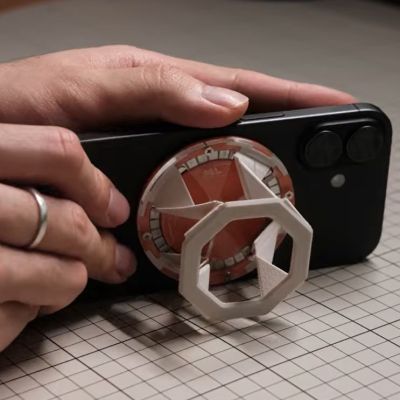
The variant of origami called kirigami (‘cut paper’ in Japanese) also starts off with a sheet of paper, but it allows for cutting the paper to increase the number of shapes that you can create. It is this technique that [Matthew Lim] used to create a number of three-dimensional designs that can convert between a flat configuration and some kind of functional object without any bolts, glue or similar. These include everything from a phone grip to a pretty sizeable side table.
The video starts with an interesting demonstration of how to fold an origami crane that has a smaller crane on its back. This is documented in a 1797 book on the many ways to fold a crane, with one of the first known instances where cuts are made in the single sheet of paper, which becomes the second, much smaller crane.

The same book extends that idea into making an origami grid that can fold into a grid of cranes after making a series of cuts. Later this form of origami got the name ‘kirigami’, with the video demonstrating how a few strategic cuts in an original flat shape can make it much more functional, based on scientific papers like this 2024 one by [Liu] et al. on cylindrical origami with tunable mechanical behavior.

For these functional mechanisms a laser cutter and FDM printer are used to prototype and test increasingly more advanced versions of the pop-up mechanism, before moving on to make full-sized furniture using plywood panels and 3D printed hinges. The coolest part about the resulting table is that it can be changed into different configurations, with the mechanism locking into its new position to make a relatively stable new shape.

Even if not immediately practical, these mechanisms provide interesting options for robotics and flat-pack furniture alike, as well as in applications like space exploration where every gram and cubic millimeter of space counts.

Continue reading “Using Kirigami Techniques To Make Functional Designs” →
Thorium Clocks Start Ticking With Lasers

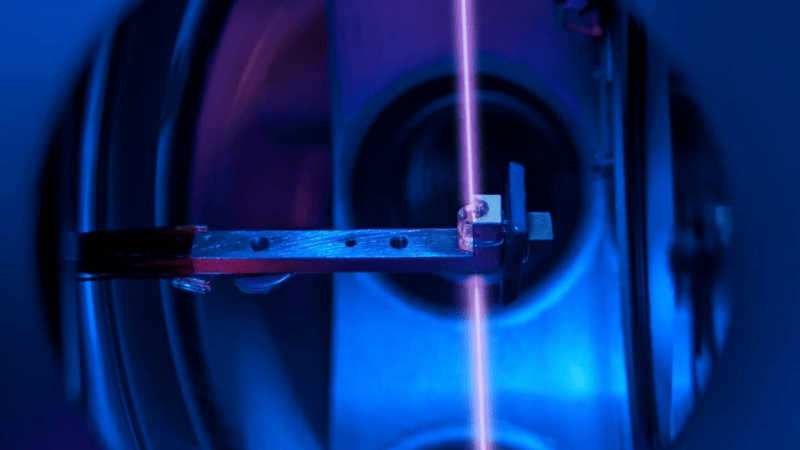
Atomic clocks are super accurate. But, unsurprisingly, some atomic clocks are better than others, depending on your definition of better. Researchers at Vienna University claim to have a superior thorium-based atomic clock. It isn’t necessarily more accurate than other atomic clocks, but it is self-regulating.

Apparently, prior atomic clocks need help to stay stable. But scientists have thought that thorium, with its very narrow gap between two states, would make an excellent clock with the help of a laser. However, the laser has to have precise properties that, at least in early experiments, were provided by another nuclear clock.

Obviously, you’d like to be able to use a laser to excite the source — a thorium crystal in this case — and then use the output of that to adjust the laser. That’s apparently what the team has done. If the laser drifts, the thorium nuclei absorb less light, and that adjusts the output frequency to compensate. If you can follow the physics, you can read the source paper in Nature.

Optical atomic clocks are the way to go for time standards, but this research has promise to provide even more accurate results in the future.

Unique Archeological Discovery Sheds Light On Neanderthal Wooden Tool Usage

The Abric Romaní site in Spain is rather unique in archeology for one simple reason: the caves in its limestone-rich cliff have seen humanoid occupation for thousands of years. A thick layer of calcium carbonate-based travertine deposit has, over time, covered and largely preserved tools and other implements, including those made of wood. Over many decades of archeological exploration, 597 wooden imprints have been uncovered, with a recent research article by [Palmira Saladié] et al. detailing these findings.
Wood is one of those archaeological artefacts that are very elusive due to their fragility, even though we know that wood has been used pretty much everywhere from the first day that a humanoid critter discovered that branches make great clubs and spears, and can also easily be shaped to make them even more useful.

Continue reading “Unique Archeological Discovery Sheds Light On Neanderthal Wooden Tool Usage” →

Introducing The Garlic-Powered Door And Window Sensor

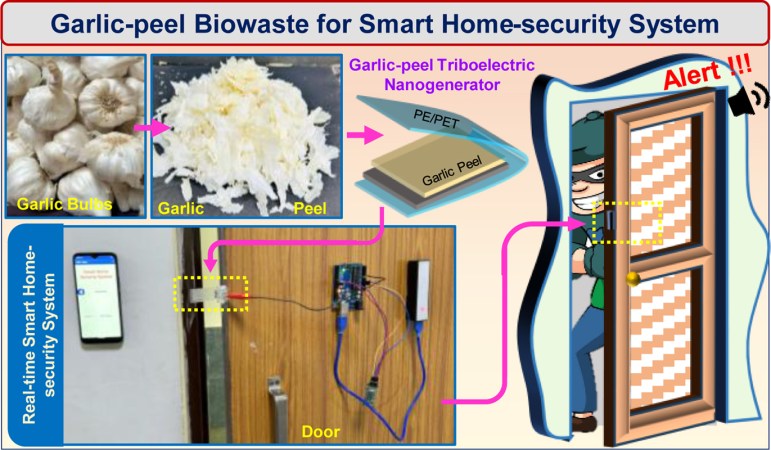
Most home security sensors require a chemical battery or external power source to operate, which can be a point of weakness. If the battery in a window or door sensor dies overnight and nobody is there to swap it, it might miss that one intruder or mess up your carefully curated home automation system. In that sense self-powered sensors are rather interesting, such as this one by [Manas Tiwari] and [Deepak Bharti] that is based around the triboelectric effect.

The research article is sadly paywalled, but the IEEE Spectrum article covers all the salient details. The sensor uses ground up garlic peel for the positive side of this triboelectric nanogenerator (TENG) as they call it, with a sheet of polyethylene (PE) forming the negative side. Once installed on a door frame, opening said door generates about 210 VAC with a 45 µA short circuit current. A dual-side layer of garlic peel bumps this up to 400 VAC and 65 µA.

As installed, the researchers used this generated current to detect changes using a separate MCU running off a powerbank, which obviously does not really solve the ‘running out of charge’ issue. The generated power could conceivably be used to send a brief wireless packet to a receiver elsewhere in the room, somewhat like the Bluetooth link in the example, but more low-power.

The researchers also reported that this sensor was still functional after half a year in storage, and survived 200 stress cycles, which seems like a good start for what appears to be a very cheap sensor to construct.

Scientists Create Hexagonal Packed Ice At Extreme Pressures

One of the problems with planetary science is that you generally cannot easily investigate the exact conditions in their interior, so you’re left to extrapolate what is happening inside them based on surface scans. One of the resulting questions is what ice giants like Neptune and Uranus in Earth’s solar system have exactly at their core. We do know that it is mostly rocks and ice, but what kind of ice you end up with at these intense pressures is a good question that [Alexis Forestier] et al. set out to answer, with their results published in a Physical Review Letter paper (ArXiv preprint).

It’s noteworthy that there isn’t just water ice at these planetary cores, with this study only investigating water ice specifically. In order to get the water to the pressures it would experience courtesy of ice giant gravity, a diamond anvil was used, with synchrotron x-ray diffraction allowing for the changes to the sample to be observed.

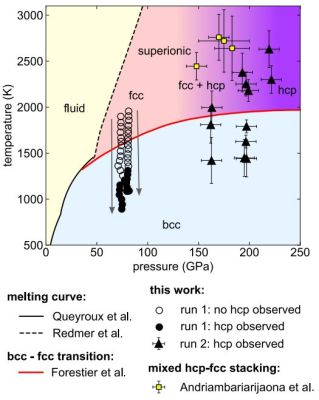
The phase diagram of water includes a number of phases beyond what us Earth-dwellers would call ‘ice’, with at higher pressures above about 80 GPa the formation of ice X, featuring a body-centered cubic (BCC) oxygen sublattice. Subsequent discovered phases were face-centered cubic (FCC) and now hexagonal close-packed (HCP) ice, all differing in the packing of the oxygen sublattice.

In addition to extreme pressures, temperatures also had to be increased by using the laser heating feature of the diamond anvil. At around 2,000K and over 200 GPa the HCP phase was found, with a mixed FCC-HCP phase at intermediate pressures.

Although not immediately providing answers to questions pertaining to the aforementioned ice giants, it gives planetary scientists yet another clue that they can use in future investigations, as well as provide more insight into this most fascinating phase of water that’s actually its own little galaxy of phases.

3D-Printed Filter Removes Most Microplastics From Water

With the rise of synthetic polymers in everywhere from clothing, packaging and beyond, we have also seen a corresponding rise in fragments of these polymers in the environment. These micro- and nanoplastics (MNPs) come in a wide variety of sizes, but have in common that they do not break down very easily, leaving filtration as an important way to keep them out of our potable water sources. A recent paper by [Ethan A. Crawford] et al. in  Separation and Purification Technology details a way to use a low-cost, 3D-printed filtration mesh to filter out up to 90% of MNPs using their prototype.

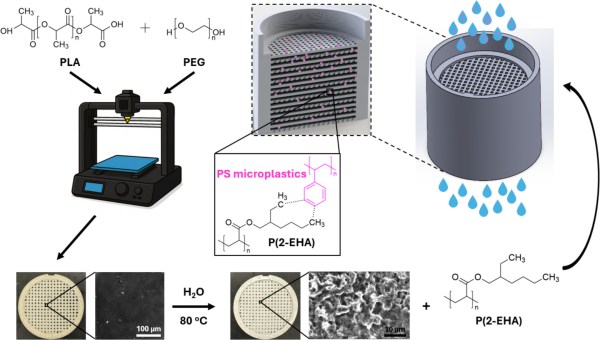
This prototype uses a multi-layer filtration system printed in PLA, creating a flow-through system in which polyethylene glycol (PEG) acts as a sacrificial additive to the PLA. Whereas creating the fine pores required for filtration of MNPs is impossible using FDM printing, the spheres of PEG that form inside the printed filter can be subsequently etched away using nothing but hot (80°C) water, leaving behind a porous surface capable of trapping fine particles.

These pores are characterized in the paper, with the PLA-PEG10 sample showing the best porous structure while maintaining structural integrity of the PLA material. With 20 layers of these filters a filtration efficiency of 90% was achieved, though as the authors note aspects like improving the system and potential reusability still have to be investigated.

We have previously looked at MNPs, including how little we know about how many of them really are inside our bodies right now, and how lab gloves may be contaminating test results.

That’s No Moon… That’s An Exoplanet!

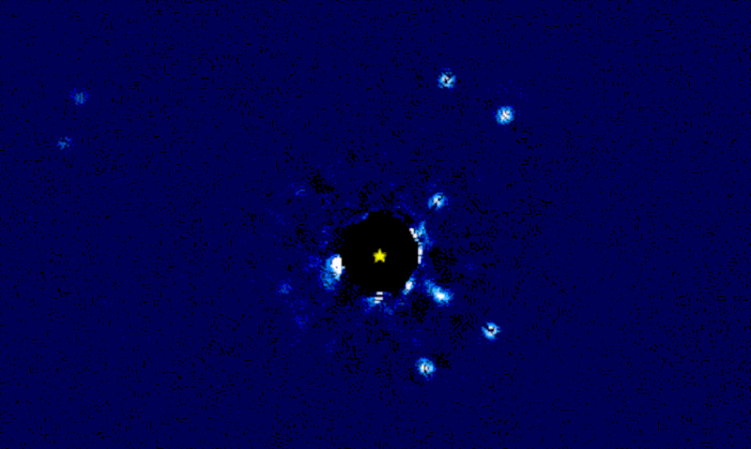
It wasn’t that long ago that a science teacher would have told students that there was no evidence of planets around other star systems. Even more recently, they might have said that while we’ve seen evidence of extra-solar planets, we would never be able to see them directly. But that’s all changed. [Jason Wang] has several videos that use images taken over years to visualize the orbit of several large exoplanets.

Of course, some extrapolation is involved. According to [Jason]:

We unfortunately do not have the luxury of watching these planets every night and record them. However, these planets move slowly, with orbital periods at least decades long, and predictably following Kepler’s laws. We can use a technique called motion interpolation to reconstruct what the image should look like using images taken before and after the date we are interested in. Motion interpolation is a technique commonly found in video editing and in modern TVs.

You have to be a patient photographer, apparently. One video has 30 images taken over 17 years, for example. Another has 10 images from the Keck Observatory taken over 12 years.

The work has fed scientific papers like this one or this one. While it might be more fun to see these star systems from the bridge of your favorite starship, this is probably as close as you are going to get.

We find both the prospect of exoplanets and the technology used to find them exciting