The FPGA Chronicles: Open Source It

Last time, we looked at getting started with the GOWIN tools and a Tang Nano 20K FPGA. The software from GOWIN isn’t bad, but it isn’t open source, and there are a few oddities about it. In addition, simulation is through a third-party simulation package that has undergone some changes since an acquisition. There are tons of free simulation programs that are extremely good, and there is an open-source toolchain for the FPGA.

You could go grab everything you need piece by piece. But you don’t have to. There are several efforts to produce a toolchain from all the different pieces. We’re going to look at APIO.

APIO

APIO isn’t so much an FPGA toolchain project as it is an aggregator of toolchain projects. It reminded us of PlatformIO, and notes that it was inspired by it. It updates the tools you need, includes its own libraries, and gives you a common workflow across the FPGAs it supports.

You can download it for the command line, but you can also install it as a Visual Studio Code extension, which is what I did. You have to create a simple file that describes your project, and that’s about it.

Install Problems

Since APIO has its own libraries, it is possible that you will find some conflicts with your system libraries. In my case, the libreadline.so.8 file (in ~/.apio/bin/_internal) was causing problems that prevented anything from working. I simply renamed it out of the way, or you can just delete it. That took care of the problem.

Keep in mind that APIO just orchestrates a bunch of other tools like Yosys and GTKWave. Even if you have your own versions, APIO expects to use its private copies. For example, GTKWave on my system is a different version than the APIO copy, and if I try to read wave files without using APIO, I get error messages. You can, however, open a shell from the Tools/Misc menu of the APIO panel in Visual Studio Code.

Continue reading “The FPGA Chronicles: Open Source It” →

The FPGA Chronicles: Exploring The Tang Nano 20K

FPGAs used to be mysterious, expensive devices, but these days you can buy surprisingly capable boards for very little money. Some years ago, I did an FPGA Bootcamp over on Hackaday.io. Much of that material still applies, but the hardware is dated. So I decided it was time to update it, using the inexpensive Tang Nano 20K and its GOWIN GW2AR-18 FPGA as the main platform, with perhaps a few excursions into other FPGAs.

History and Motivation

Once upon a time, if you wanted to have a custom IC, you went with a wheelbarrow full of money to a semiconductor company. However, some smart person at a semiconductor fab eventually realized they could make a chip with a lot of uncommitted blocks on it and then, for a custom chip, only design the wiring that connected them together. This still required a wheelbarrow full of money, but it was a smaller wheelbarrow.

Then one day, someone realized they could do the same thing but make the electrical connections between the blocks configurable. Maybe have fuses you can blow, or use EEPROM or RAM cells to remember which blocks are connected to which. It is complicated, sure, but then you can make many of these chips and sell them to people who could, in theory, make their own custom chips without your help.

When do you need an FPGA? A classic classroom exercise for an FPGA, for example, is a traffic light because it shows off how to do state machines, which are important for some kinds of FPGA designs. But other than as a learning example, why would you do this? Even a simple 8-bit CPU can handle a traffic light.

Suppose instead that you have hundreds of digital sensors on a rocket, and any one of them must raise an alarm within a few microseconds. A processor has to sample inputs in groups, service interrupts, or rely on extra hardware. An FPGA can simply implement the equivalent of one enormous OR gate. It watches every input continuously, and unrelated logic elsewhere in the FPGA does not steal execution time from it. Can you do it with a microcontroller? Probably, but not easily. For some classes of problems, an FPGA is the better answer.

Of course, you can also build a CPU on your FPGA and some FPGAs have CPUs in the same package. This is often a sweet spot because then things that are easy to do in software, you do in software. Things that are easier to do in hardware, you do in the FPGA.

Continue reading “The FPGA Chronicles: Exploring The Tang Nano 20K” →

Retro X86 With 486Tang

Tang FPGA boards are affordable, and [nand2mario] has been trying to get an x86 core running on one for a while. Looks like it finally worked out, as there is an early version of the ao486 design on a Tang FPGA board using a Gowin device. That core’s available on the MiSTer platform, which emulates games using an Altera Cyclone device.

Of course, porting something substantial between FPGA architectures is not trivial. In addition, [nand2mario] made some changes. The original core uses DDR3 memory, but for the Tang and the 486, SDRAM makes more sense. The only problem is that the Tang’s SDRAM is 16 bits wide, which would imply you need two cycles per 32-bit access. To mitigate this, the memory system runs at twice the main clock frequency. Of course, that’s kind of double data rate, but not in the same way as DDR memory.

Continue reading “Retro X86 With 486Tang” →

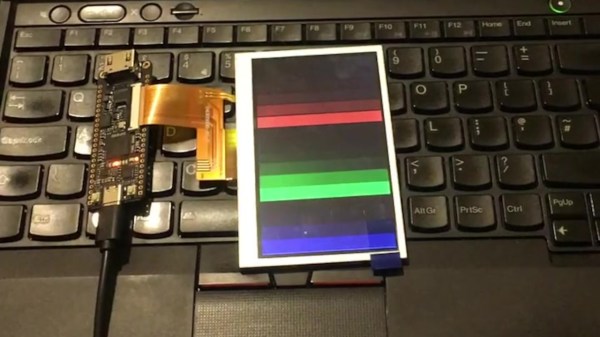
A Sipeed Tang Nano 9k board on a Thinkpad keyboard, with an LCD panel attached to it

An Open Toolchain For Sipeed Tang Nano FPGAs

[Sevan Janiyan] shares their research on putting an open FPGA toolchain together. Specifically, this is an open toolchain for the Sipeed Nano Tang FPGAs, which are relatively cheap offerings by Sipeed from China. The official toolchain is proprietary and requires you to apply for a license that’s to be renewed every year. There’s a limited educational version you can use more freely, but of course, that’s not necessarily sufficient for comfortable work.

This toolchain relies on the apicula project, an effort to reverse-engineer, reimplement and document the Gowin FPGA bitstream format, as well as the gowin integration for nextpnr (an open tool for FPGA place-and-route). With a combination of yosys, apicula, nextpnr and openFPGAloader, [Sevan] put together a set of commands you can use to build gateware for your Nano Tang FPGAs – without any proprietary limitations blocking your way. They show a basic blinkie demo, and also a demo that successfully operates a parallel LCD connected to the board.

The availability of open toolchains for FPGAs has always been somewhat of a sore point. Wondering about open FPGA toolchains? This Supercon 2019 talk by Tim [Mithro] Ansell will get you up to speed!

We thank [feinfinger (sneezing)] for sharing this with us!

Two New FPGA Families, Designed In China

The two largest manufacturers of FPGAs are, by far, Altera and Xilinx. They control over 80% of the market share, with Lattice and others picking up the tail end. The impact of this can be seen in EE labs and alibaba; nearly every FPGA dev board, every instructional, and every bit of coursework is based on Altera or Xilinx chips.

There’s a new contender from the east. Gowin Semiconductor has released two lines of FPGAs (Google translate) in just under two years. That’s incredibly fast for a company that appears to be gearing up to take on the Altera and Xilinx monolith.

The FPGA line released last week, the GW1N family, is comprised of two devices with 1,152 and 8,640 LUTs. These FPGAs are built on a 55nm process, and are meant to compete with the low end of Altera’s and Xilinx’ offerings. This adds to Gowin’s portfolio introduced last May with the GW2A (Google translate) family, featuring devices ranging from 18,000 to 55,000 LUTs and DSP blocks. Packages will range from easily solderable QFN32 and LQFP100, to BGA packages with more pins than an eighteenth century seamstress at the royal ball.

For comparison, Xilinx’ Spartan-6 LX family begins with devices featuring 3,840 LUTs and 216kb of block RAM, with larger devices featuring 147,443 LUTs and up to 268kb of block RAM. Altera’s Cyclone IV E devices are similarly equipped, with devices ranging from 6,272 to 114,480 LUTs. Between the two device families introduced by Gowin recently, nearly the entire market of low-end FPGAs is covered, and they’re improving on the current offerings: the GW1N chips feature random access on-chip Flash memory. Neither the low-end devices from Altera nor devices from Lattice provide random-access Flash.

The toolchain for Gowin’s new FPGAs is based nearly entirely on Synopsys’ Synplify Pro, with dedicated tools from Gowin for transforming HDL into a bitstream for the chip. This deal was inked last year. As for when these devices will make it to market, Gowin is hoping to send out kits to well-qualified devs soon, and the devices may soon show up in the warehouses of distributors.

Gowin’s FPGAs, in contrast to the vast, vast majority of FPGAs, are designed and fabbed in China. This gives Gowin a unique home-field advantage in the land where everything is made. With LVDS, DSP, and other peripherals these FPGAs can handle, Gowin’s offerings open up a wide variety of options to developers and product engineers a few miles away from the Gowin plant.

The GW1N and GW2A families of FPGAs are fairly small when it comes to the world of FPGAs. This limitation is by capability though, and not number of units shipped. It’s nearly tautological that the largest market for FPGAs would be consumer goods, and Gowin is focusing on what will sell well before digging in to higher end designs. We will be seeing these chips show up in devices shortly, and with that comes a new platform to tinker around with.

If you’re looking to make your mark on the world of open source hardware and software, you could do worse than to start digging into the synthesis and bitstream of these Gowin chips. Just months ago, Lattice’s iCE40 bitstream was reverse engineered, and already there are a few boards capitalizing on a fully open source toolchain for programmable logic. With more capable FPGAs coming out of China that could be stuffed into every imaginable product, it’s a golden opportunity for hardware hackers and developers alike.

[Thanks for the tip Antti]