


Tag Archives: MariaDB

MariaDB already allows developers to add new Pluggable Data Types and scalar Plugin Functions. One missing piece has been Pluggable Aggregate Functions operating on PDTs. That matters for functionality such as HyperLogLog, where an extension needs to aggregate values into a custom statistical sketch while preserving its native SQL type.
MDEV-40672 closes that architectural gap. Aggregate functions can now participate in MariaDB’s native aggregation infrastructure, including DISTINCT, window execution, prepared statements and Pluggable Data Types.
MariaDB already supports MariaDB_FUNCTION_PLUGIN, a mechanism for registering SQL functions that create regular server Item objects and can behave almost like built-in functions.
…

Overview
While validating MariaDB RSS stability under stored procedure workloads, I ran into unexpected memory growth. The goal was straightforward: confirm that MariaDB was not leaking memory when running TPROC-C stored procedure workloads. To do this, I used HammerDB TPROC-C SP and added improved RSS monitoring so I could watch memory usage over long-duration runs.
The results were clear. MariaDB RSS stayed stable. HammerDB 5.0 kept growing, and growing.
This led to a deeper investigation into HammerDB itself, and ultimately to an update in TAF to support HammerDB 6.0 and a new RSS logging script.
…
Continue reading “MariaDB Foundation Advances TAF with HammerDB 6.0 and xt_reservoir Integration”

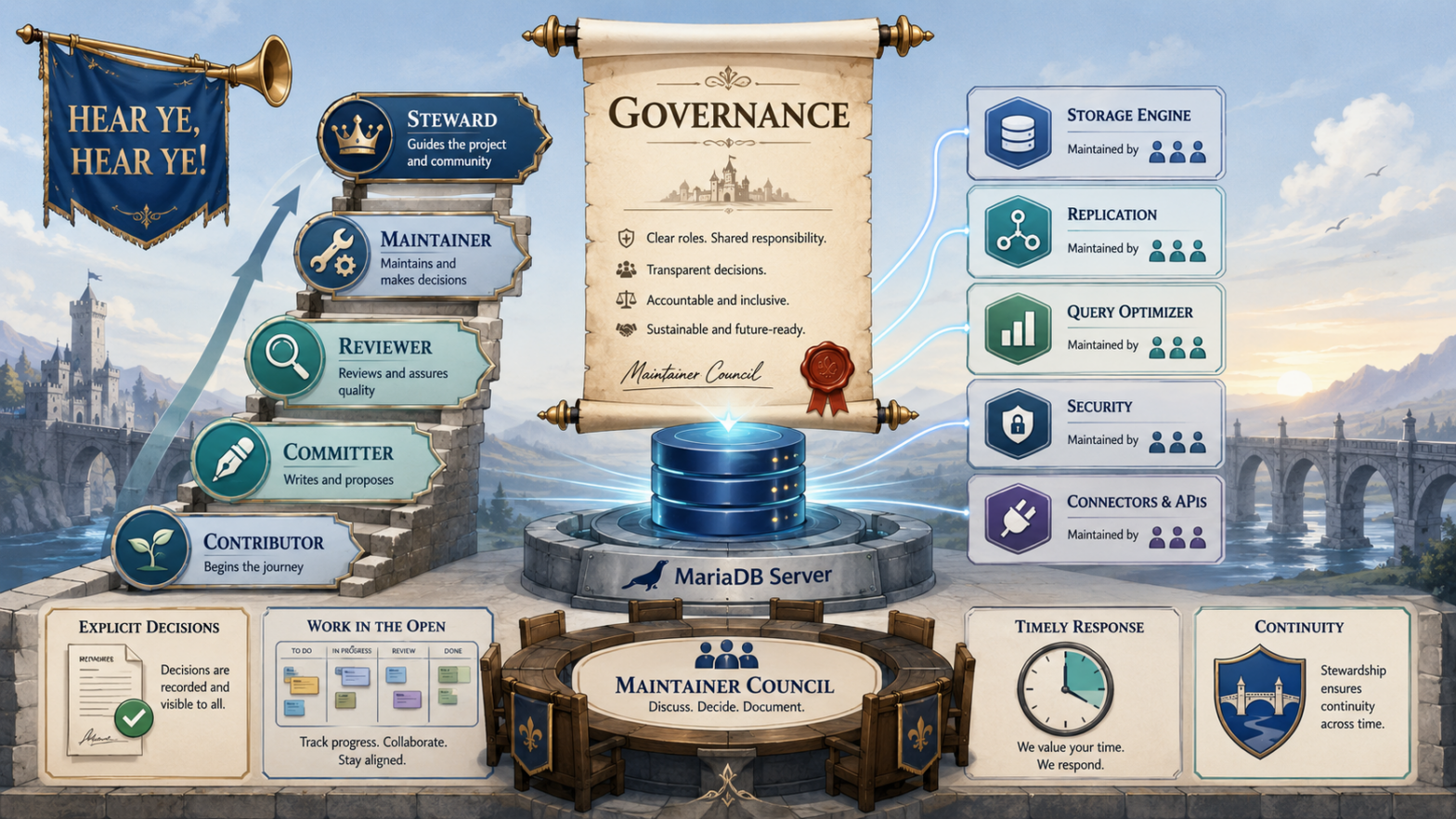
Be it known: MariaDB Server now has a clearer, publicly documented governance framework covering technical roles, subsystem ownership, decision-making, response expectations and continuity.
Open source begins with access to the code. Yet for infrastructure expected to remain dependable for many years, openness must also extend to how responsibility is assigned, how decisions are made, and what happens when people disagree or move on.
The framework formalises much of how the project has long worked, while making its responsibilities, decision paths and commitments clearer and easier to inspect.
The central principle is simple: authority should be visible, earned and connected to responsibility.
…
Continue reading “Hear Ye, Hear Ye: A Guide to MariaDB’s Governance Model”


Names are important.
They help us identify people, projects, products, pets, database servers, and occasionally the correct bug tracker.
This may sound obvious, but the database world has spent more than fifteen years proving that it is not.
MySQL and MariaDB share a substantial amount of history, syntax, tooling, knowledge, applications, and community. They also have similar command names, compatible protocols, familiar configuration variables, and many users who simply say “MySQL” when they actually mean:
Some database server that speaks the MySQL protocol and probably has an executable named mysqld.
And most of the time, everybody understands.
…
Continue reading “Say the Name: MariaDB, MySQL, and the Ecosystem We Share”

MariaDB Foundation is pleased to welcome Continuent as a new Silver Sponsor.
Continuent develops solutions for organizations running business-critical applications on MariaDB and other MySQL-compatible databases. Its flagship product, Tungsten Cluster, helps organizations manage database availability, disaster recovery and distributed deployments across on-premises, cloud and hybrid environments.
The company has worked with open-source database technologies for more than two decades and brings extensive experience from demanding production environments across SaaS, financial services, telecommunications, e-commerce and other industries.
“Continuent has a long history in the MariaDB and wider open-source database ecosystem.
…
Continue reading “Continuent joins MariaDB Foundation as a Silver Sponsor”
MariaDB Foundation is pleased to announce that Nextcloud has renewed its Silver sponsorship for another year.
Nextcloud and MariaDB are widely used together by organisations that want greater control over their data and infrastructure. Both projects form part of a broader open-source ecosystem that enables businesses, public-sector organisations and individuals to build digital services without unnecessary dependence on proprietary platforms.
Over the past year, our collaboration has also developed through the Privacy-First Solution Stack, which brings together Nextcloud, Passbolt and MariaDB Server in a practical open-source architecture for secure collaboration, password management and data storage.
…
Continue reading “Nextcloud renews its Silver sponsorship of MariaDB Foundation”
MariaDB Foundation is pleased to announce that Passbolt has renewed its Silver sponsorship for another year, continuing its long-term support for the MariaDB open-source ecosystem.
Passbolt is an open-source password manager designed for teams, with a strong focus on security, privacy, and user control. Its continued support reflects a shared commitment to building practical, trustworthy open-source infrastructure that organizations can deploy and operate with confidence.
Building on the Privacy-First Stack
During the first year of collaboration, Passbolt became part of the Privacy-First Solution Stack alongside Nextcloud and MariaDB Server.
…
Continue reading “Passbolt renews its support for MariaDB Foundation”
Tracking down changes in database performance is one of the hardest parts of engineering, especially when the change is buried somewhere in a long commit history.
To make this work easier and more repeatable, I put together a small but important tool:
This script does one thing well:
Given a commit hash, it checks out that commit, builds it cleanly, and packages it in a deterministic way so the Test Automation Framework (TAF) can run consistent performance tests.
Why this matters
- When you are bisecting or doing a manual binary search across hundreds of commits, you need reproducible builds.
…
Continue reading “Simple tool to build MariaDB commits for performance-change analysis”


