


The term limit comes about relative to a number of topics from several different branches of mathematics.
A sequence  of elements in a topological space
 is said to have limit
 provided that for each neighborhood
 of
 , there exists a natural number
 so that
 for all
 . This very general definition can be specialized in
the event that
 is a metric space, whence one says that a sequence
 in
 has limit
 if for all
 , there exists a natural
number
 so that
 |
(1)
|
where  is the metric,
and the inequality holds for
all
 . In many commonly-encountered
scenarios, limits are unique, whereby one says that
 is the limit of
 and writes
 |
(2)
|
Limits in a metric space are unique. On the other hand, a sequence in a topological
space  may have several, even infinitely many,
different limits provided that
 is equipped with a topology which fails to be T2.
One reads the expression in (2) as "the limit as
 approaches infinity of
 is
 ."
The topological notion of convergence can be rewritten to accommodate a wider array of topological spaces  by utilizing the language of nets.
In particular, if
 is a net from a directed set
 into
 , then an element
 is said to be the limit of
 iff for every neighborhood
 of
 ,
 is eventually in
 ,
i.e., if there exists an
 so that, for every
 with
 , the point
 lies in
 . This notion is particularly well-purposed for topological
spaces which aren't first-countable.
A function  is said to have a finite limit
 if, for all
 , there exists a
 such that
 whenever
 . This form of definition is sometimes called
an epsilon-delta definition. This can
be adapted to the case of infinite limits as well: The
limit of
 as
 approaches
 is equal to
 (respectively
 ) if for every number
 (respectively
 ), there exists a number
 depending on
 for which
 (respectively,
 ) whenever
 .
Limits may be taken from below
 |
(3)
|
or from above
 |
(4)
|
For a real variable  , if the two are equal, then "the"
limit is said to exist
 |
(5)
|
The expression in (3) is read "the limit as  approaches
 from the left / from below" or "the limit as
 increases to
 ," while (4) is read "the limit as
 approaches
 from the right / from above" or "the limit as
 decreases to
 ." In (5), one simply refers to "the limit as
 approaches
 ."
For a real function  defined for all sufficiently large real
 , a finite real
number
 is its limit at
 iff
 |
(6)
|
where  and
 range over the real numbers
and
 is chosen so that
 is defined for every
 . For a limit at
 , replace
 by
 and require
 to be defined for every
 .
For a function of two real variables, a limit must be independent of the path of approach. For
example, the function  satisfies the inequality
 |
(7)
|
for  . Since
 tends to 0 as
 approaches the origin, the
squeeze theorem gives
 |
(8)
|
In contrast, the function  has different limits along the lines
 and
 :
 |  |  |
(9)
|
 |  |  |
(10)
|
Consequently, its limit at the origin does not exist. The relation  also shows that agreement along both coordinate axes is
insufficient to establish a limit.
Limits are implemented in the Wolfram Language as Limit[f,
x-> x0]. This command also takes the option Direction,
which specifies the direction of approach and can be set to  ,
 ,
I, or -I, among other settings.
Note that the function definition of limit can be thought of as a natural generalization of the sequence definition
due to the fact that a sequence  in a topological
space
 is nothing more than a function
 mapping
 to
 .
For a sequence  of real numbers, its lower
limit
 and upper limit
 are defined in the affinely
extended real numbers by the limits of the tail infima
and suprema:
 |
(11)
|
 |
(12)
|
These values always exist in the affinely extended real numbers and may equal  or
 .
For a bounded sequence, they are the least and
greatest subsequential limits. Thus, in the bounded case,
 is the least real number for
which every
 has
 for infinitely many
 , and
 is the greatest such real number.
Related notions include supremum limit and infimum limit.
Indeterminate forms of types  and
 can often be computed with L'Hospital's
rule. Types
 can be converted to the form
 by writing
 |
(13)
|
For  , types
 ,
 ,
and
 are treated by introducing a dependent variable
 |
(14)
|
so that
 |
(15)
|
then calculating  .
The original limit then equals
 ,
 |
(16)
|
The indeterminate form  is also frequently encountered.
All of the above notions can be generalized even further by utilizing the language of ultrafilters. In particular, if  is a topological space
and if
 is an ultrafilter
on
 , then an element
 is said to be a limit of
 if every neighborhood of
 belongs to
 . Several authors have defined similar ideas relative to filters as well (Stadler and Stadler 2002).
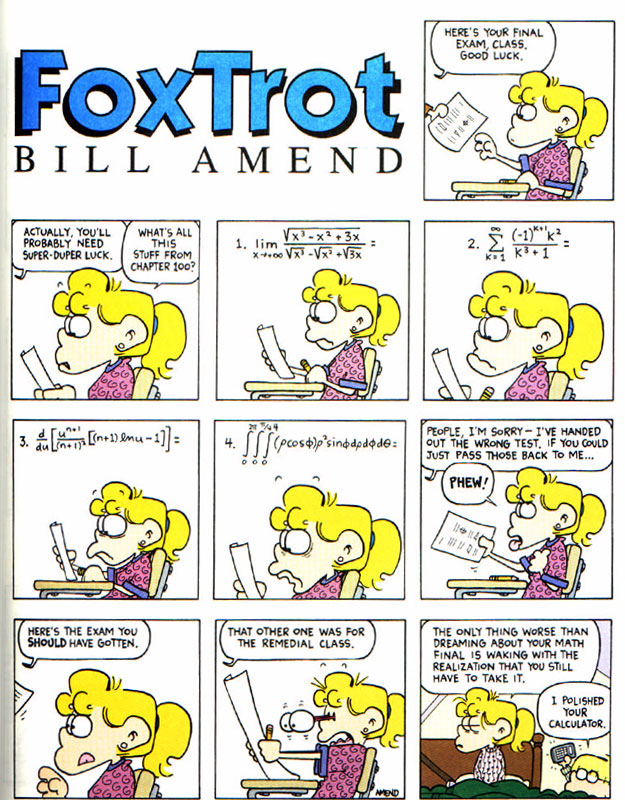
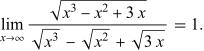
The June 2, 1996 comic strip FoxTrot by Bill Amend (Amend 1998, p. 19; Mitchell 2006/2007) featured the following limit as a "hard" exam problem intended for a remedial math class but accidentally handed out to the normal class:
 |
(17)
|
Reproduced with permission of the author.

 -
 Definition of Limit with Mathematica."
Mathematica Educ. 3, 17-21, 1994.Smith, W. K.
