Two generous, comprehensive and scholarly booklets present all the original album notes alongside special essays. In the first of these, My life with the Marquis, Steven Isserlis opens our eyes to the challenges, obstacles, and myriad joys of tramping the globe with such a priceless instrument. Historian Rowena Anketell then presents a fascinating account, The real Marquis de Corberon, of this particular instrument’s history and its journey after its first owner, from whom it takes its aristocratic name, fell victim the French Revolution’s guillotine. At the Royal Academy of Music gives insights into the challenge of owning a priceless instrument while ensuring its unique voice can remain heard around the world rather being than stuck behind a glassy museum case. And that’s all in addition to 10 CDs of the most gorgeous cello music.
Dvorak (arr Isserlis): Four Romantic Pieces, op 75
Luisa Adolpha Le Beau: Sonata in D, op 17
Ernst David Wagner : Kol Nidrei
Isaac Nathan: Oh! Weep for those
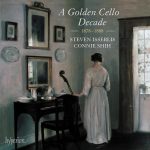
The 1880s were an extraordinary decade for the cello – perhaps the best, until well into the 20th century at least. To that decade we owe the sonatas of Brahms (no 2), Grieg and Franck, as well as many beloved morceaux, including Fauré’s Elegy and Saint-Saens’ The Swan. While avoiding these more famous pieces (all of which I’ve already recorded at least twice), we thought that it would be good to devote a disc to some lesser-known gems from then. (It had to be 1878-1888 rather than 1880-1890, because the Le Beau sonata, which we were very keen to include, dates from 1878.) We really enjoyed plunging into all these pieces, learning the two sonatas especially for the recording. (The first movement of the Strauss is quite similar to the later version, the other movements completely different.) I’ve always loved Bruch’s Kol Nidrei; but have never been that happy with the orchestration – I find it unnecessarily thick. The harp part is beautiful, though, and seems to me to be an essential component. So, rather than have Connie imitate the harp on the piano – as usually happens in performances with piano – we invited Olivia Jageurs to join us for that one piece; I’d like to think that we got the best of both worlds.
The Dvorak pieces were actually written for violin; but I’ve always wanted to steal them – they are so utterly gorgeous, and so well-suited for the cello. The disc ends with two alternative settings of the two main themes on which Bruch based his Kol Nidrei: Isaac Nathan’s Oh! Weep for those, one of the settings he made of Byron’s Hebrew Melodies; and also one of the several versions of Kol Nidrei itself dating from the 19th century. We were going to record that by Lewandowski, one of the most famous Jewish composers of his time (and a distant relative of mine, I believe); but then I came across a setting by Ernst David Wagner. It was Impossible to resist recording that: Kol Nidrei, by Wagner – delicious irony…
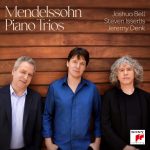
Mendelssohn trios, with Joshua Bell and Jeremy Denk
I’ve been playing with Joshua Bell for over 35 years now – shocking thought! He has also been playing with Jeremy Denk for many years, and some time ago introduced the two of us. We got on brilliantly, having now given several recitals together; so it was only natural that the three of us should play trios. A lengthy tour of the US was arranged; in the middle of this period, it turned out that we had two free days in Los Angeles. I’d have quite happily taken the days off (Jeremy too); but Josh had other ideas, booking a studio there and arranging for his wonderful producer, Adam Abeshouse, to come and direct the sessions. It was hard work; but I think that it was very much worth it in the end – a great chance for us to celebrate our shared love of Mendelssohn. Alas, Adam died just before the CD appeared – a tragic loss. But I’m so glad that we got the chance to work with him on this disc, which he edited while battling with his illness. Farewell, dear Adam – and thank you.
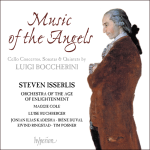
With the Orchestra of the Age of Enlightenment; Maggie Cole (harpsichord); Luise Buchberger (cello); Jonian Ilias Kadesha, Irène Duval (violins), Eivind Ringstad (viola), Tim Posner (cello)
I have always adored the music of Luigi Boccherini. While not going as far as the great, eccentric Anner Bylsma, who considered him a far superior composer to Mozart, I have always been captivated by the elegance, the humour, the subtle passion, the melodiousness and the sheer beauty of his works. There is a huge emotional range to his art – but the sentiments are always expressed as if dressed in the most gorgeous clothes (as it were). The title of the disc was mine, I admit; I hope that it doesn’t seem cheesy – but a) it’s a quotation from an early 19th-century musical encyclopaedia; and b) there IS something truly angelic about all the pieces on this disc. Boccherini was unique; his magical world is utterly different from that of either Haydn or Mozart. Another genius, I’d say.
And at the end of the disc, we couldn’t resist adding the famous Minuet, played by Irène Duval; it has been heard countless times, of course – but there’s a good reason for that… It’s a gem!
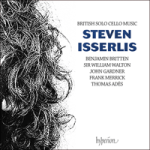
Britten 3rd suite, op 87
(plus four Russian themes on which the suite is based, with Mishka Rushdie Momen, piano)
Britten: Sacher theme
Walton: Passacaglia
Theme for a Prince
John Gardner: Corranto pizzicato
Frank Merrick: Suite in the 18th-century style
Thomas Adès: Sola
Preparing for this disc was one of the projects that kept me (relatively) sane during lockdown. It was recorded at a time when we were still safely distancing ourselves from each other – strange not even to be able to shake the producer’s hand! Although I’d previously recorded the Britten suite, as a coupling for John Tavener’s The Protecting Veil, I’d always wanted to do it again, feeling that I could play it with more passion and commitment. (I HOPE I achieved that.) The disc also gave me the chance to pay tribute to a wonderful pianist/composer called Frank Merrick – famous in his time, but almost completely forgotten today. We used to play together when he was in his late 80s, I in my mid-teens – I adored him!
To be honest, I found this disc quite hard to make – having hardly played for so long, it was a bit difficult to summon up the energy for recording. But things changed – thankfully – on the last day, when Thomas Adès came (on his motorbike!) to oversee the recording of his short piece Sola. Having finished with Sola, I asked Tom if he’d mind staying for a bit – and on receiving an answer in the affirmative, I performed practically the whole programme for him; a lot of the finished recording derives from that playthrough – having a musician whom I respect so much in the hall listening made all the difference! He was fascinated by the Britten – it is SUCH a masterpiece; and also told me (I didn’t know this before) that he adores Walton – quite right.
Another positive offshoot of these sessions was that I invited Mishka Rushdie Momen (with whom I’d played a few times over lockdown) to come and accompany the Russian themes on which Britten based his suite. This was the beginning of what I think will be a long and fruitful collaboration between Mishka and Hyperion Records.
Reynaldo Hahn: Variations chantantes
Fauré: Romance, op 69; Elegie op 24
Saint-Saens: Sonata no 1 op 32 – plus original last movement (premiere recording)
Duparc: Lamento (from cello sonata)
August Holmes: ‘Récitatif et chant’ from La Vision de la Reine (arr Isserlis)
César Franck : Sonata
A few years ago, I embarked upon the major project of reading Proust’s near-endless masterpiece ‘A la recherche du temps perdu’; it took me – with some lengthy breaks – about eighteen months. Amazing though it was, I can’t say that I became a complete Proust nut, as some of my friends have become (the pianist Jeremy Denk, for one). There were some bits I couldn’t wait to finish! But there is so much that is wonderful, almost needless to say – including the descriptions of salon hosts/hostesses and guests listening to music, many of which are absolutely hilarious. But also, Proust’s fanatical devotion to music is inspiring, and prompted me to devote many programmes to the composers he knew and loved (as well as, more recently, to devise an evening of words and music built around Proust and his salons, which we performed at the Wigmore Hall, and will hopefully revive for his centenary). The works on this disc all have a connection with the great man – some pieces closer than others; but it all expresses somehow a similar ethos, originating in that golden age of French music at the end of the 19th century. What beauties that time has left us! And the music on this disc – all 82 minutes + of it! I had no idea we’d be allowed to make such a long disc – is among my favourite written for the cello. Incidentally, this is my third recording of the Franck sonata – maybe that’s a bit self-indulgent; but it was the first sonata that Connie and I played together, and I really wanted to get it onto disc. She does play it like an angel.
John Tavener: ‘No Longer Mourn for Me’ – late works for cello
With: Matthew Rose (bass), Abi Sampa (Sufi singer), Trinity Boys’ Choir, Caroline Dearnley, Chiara Enderle, Matthew Huber, Vashti Hunter, Bartholomew Lafollette, Amy Norrington, David Waterman (cellos), Philharmonia Orchestra, Omer Meir Wellber (conductor)
This was a deeply personal project for me – one I had promised to John a few months before his death, but which took over six years to bring to fruition. As you can see from the above list of musicians, it was complicated – and expensive! But thanks to the great kindness of a few friends, we were able to make the disc in the end – and I’m delighted that we could; it allowed my conscience to breathe! But also – more so, in fact – because it is such wonderful music, John’s late works being among the most beautiful he ever wrote. Each piece has a personal story attached to it, which I recount in the sleeve-notes – I hope it’s not all too personal, in fact! But I’m so happy to have recorded this music; I love it all – but perhaps my very favourite is ‘Preces and Responses’ (a choral work, arranged here for eight cellos), which seems to have been the very last piece John ever completed. Beyond touching…
Debussy: cello sonata
Frank Bridge: cello sonata
Fauré: cello sonata no 1, op 109
Webern: Drei kleine stücke op 11
Saint-Saëns: The Swan
Parry: Jerusalem
Ivor Novello: Keep the home fires burning
God Save the King
Although I play the vast majority of my recitals these days with Connie Shih, I had never recorded with her; so I was glad to be able to correct that with this disc. She is such an extraordinary artist (although she’s always convinced that she’s playing terribly!) And one of the few musicians who feels deeply and naturally the music of Fauré, who is such an important figure in my life. We built this programme around the first world war, which produced so many great works, some offering an escape from the horrors, others mirroring them. All the major works here are extraordinary: Debussy’s magically imaginative sonata; Bridge’s masterpiece, during the course of which his style changes radically; Fauré’s 1st sonata, which took me time to understand, with its unexpected austerity, but which I now adore whole-heartedly; and Webern’s terse, unique little pieces, creating their own world within a mere two minutes of music. The four shorter pieces on the disc were played on a ‘trench cello’, owned by my great friend, the doyen of string instrument experts the world over, Charles Beare. Originally built as a ‘holiday cello’, this little instrument has had a dramatic and fascinating history, having been played in the WW1 trenches. It is in fact just a little box with strings attached; no sound-holes, even, so it shouldn’t produce any sort of tone at all – but it does! I loved it from the first moment I tried it, and it was a thrill to be able to record on it.
Shostakovich/Prokofiev/Kabalevsky disc, with Olli Mustonen
Shostakovich: Sonata in D minor op 40; Moderato
Prokofiev: Ballade op 15; Adagio from Cinderella, op 97b
Kabalevsky: Sonata op 71, Rondo in memory of Prokofiev
Olli Mustonen and I have been close friends since he was 16; and that was some time ago… One of the many things we have in common (apart from a shared love for the film This is Spinal Tap) is an enthusiasm for the music of Shostakovich; his sonata was the first piece we ever played together – what a masterpiece it is! Full of youthful energy, wit and lyricism – sarcastic, yes, but never depressing. We’re both big Prokofiev fans too. Somehow his early Ballade has always been dismissed as an incomprehensible piece – even Prokofiev himself admitted that it didn’t seem to go down well on a first hearing. But we love it! A true Russian ballade, quite grotesque in character, but also deeply expressive. And as for Kabalevsky: he gets a very rough ride nowadays because of his compliance with the Soviet regime – but what a composer! His sonata is cinematic, exciting, dark – and eminently satisfying (we think); I can’t understand why it’s not played more often. We rounded out the disc with three little-known gems, one by each composer; and were very relieved that the whole programme fitted onto the disc (just!)
Chopin Introduction et Polonaise brilliante op 3 ; Sonata op 65 ; ‘Faded and Vanished’ (from Polish songs op 74 – no 13, arr Isserlis); Franchomme Nocturne op 15 no 1; Schubert Arpeggione sonata, ‘Nacht und traüme (arr Isserlis)
The Chopin is one of the most fascinating sonatas in the repertoire, very much a product of his later style, and a work with which he fought long and hard. It is complex, tragic, aristocratic, dramatic – and deeply moving, almost a last testament. As often with Chopin, divining his final intentions is difficult, since he made so many revisions; one has to study multiple sources in order to build up a true picture of the ‘authentic’ version. I have always felt that using a piano from Chopin’s time makes a huge difference in the performance of his music, and that I’d love to play the sonata with such an instrument; my much-loved friend and chamber-music partner Denes agreed enthusiastically with the idea, and we first tried it out at the Chopin festival in Warsaw. Having fallen in love with the sound, we agreed to record it with such a piano. At first, we were supposed to have access to one of Chopin’s own pianos, which would have been exciting; but, shortly before the recording, that plan fell through (long story!) and we were lucky to get hold of the beautiful Erard piano from 1851 which we eventually used (the same instrument on which Emmanuel Ax had earlier recorded the Chopin concertos). I think that the textures that this piano produces make sense of much of the figuration in the sonata, as well as the Introduction and Polonaise – not that a modern piano makes nonsense of them, by any means! But there is an ease and clarity on the Erard that suits the music perfectly, I feel. We also recorded a lovely Nocturne by the dedicatee of the sonata, Chopin’s great friend Auguste Franchomme, and a gorgeous, tragic song by Chopin. The second part of the disc is devoted to Schubert – his poignant, tuneful, infinitely touching ‘Arpeggione’ sonata, one of my very favourite works in the cello repertoire (despite its difficulties – and despite the fact that it’s not actually for cello!), as well as one of Schubert’s most beloved songs, Nacht und Traüme. I don’t actually think that such songs should be played on the cello – but in this case I couldn’t resist…
This one was a bit of a risk, since I recorded the Haydn concertos for RCA some 20 years ago – with the Chamber Orchestra of Europe under Roger Norrington – and that still seems to be somewhat available. But I wanted to record them again, with the uniquely committed, musicianly orchestra with whom I’ve had a long association, the Deutsche Kammerphilharmonie; and this time I directed them myself – in effect, playing the concertos as chamber music on a large scale. I also wanted to add CPE Bach’s glorious concerto in A major – a work of extraordinary beauty, which I hadn’t recorded before. There was still a tiny bit of room available, so we added two little extras: the magical slow movement of Boccherini’s concerto in G, and my own arrangement (made on impulse after I attended the opera) of an aria from Mozart’s youthful masterpiece La Finta Giardiniera. I was a bit nervous about how this album would be received (if it was noticed at all); but I’ve been pleased and reassured by the comments so far. Well, it is all utterly wonderful music; and it was a very special experience to spend time making music with the Deutsche Kammerphilharmonie…
Well! I was very surprised to see the release of this box set mentioned on Twitter – I had had no idea that it was coming out. And at the time of writing this, I have still not been sent a copy! But still, I am very glad that it’s available; these recordings were all like children to me – as recordings are to the musicians who make them – on which we all expended a lot of effort at the time. So I’m very happy that they’re still around, and not just hiding in some dusty secondhand store…
Josh and I have been friends and partners in musical crime for almost 30 years now – another shocking thought. As I often say, he is like a younger brother to me (he likes to lay emphasis on the word ‘younger’ in that sentence…) – with all the closeness and occasional mutual irritation that involves! We’ve been playing the Brahms Double concerto for most of those years, and since the concerto is in a way ‘about’ an old friendship (if abstract music like Brahms’ can be ‘about’ anything), it felt good to tour and then record it. Also, we were able to add a curiosity that I’d noticed in a catalogue of Britten’s unpublished works: a version by Britten of the slow movement of Schumann’s violin concerto, with a short coda by Britten himself. (The original moves straight into the finale.) Many years ago, I nagged Josh until he learned the Schumann concerto; and once he did, he fell in love with it (of course) – so again, it felt right to record this movement, for which I played the opening cello melody as a solo. Finally, we recorded the rarely-heard original version of Brahms’ trio in B, op 8, with Jeremy Denk. Both Josh and I actually prefer this version to the later, more famous and polished one. I THINK that Jeremy was convinced by it in the end; he played it beautifully, anyway.
Shockingly, it has been well over 25 years since I first recorded the Elgar concerto (with the late, much-missed Richard Hickox); so I thought that it was time to do it again. Also, I was very keen to record for the first time one of my very favourite cello concertos, that by William Walton. It is a truly magical masterpiece. Also, since there was time left over on the disc, we were able to add a lovely piece by Gustav Holst, ‘Invocation’. I was invited to give the first modern performance of this by Holst’s daughter, Imogen, whom I knew well. And there was even space on the disc to add a poignant work for solo cello,’ The Fall of the Leaf’, by Imogen herself, which I learned for her 70th birthday concert in Aldeburgh in 1977. About time that I recorded it!
The Bach gamba sonatas do not make a self-contained set, as do the six Bach suites; they are really three individual works. But what works! And it was good finally to record them with Richard Egarr, a wonderful harpsichordist who transcends the limitations of that instrument. It was also satisfying to record Handel’s only sonata for the gamba, and to add an arrangement of an extraordinary violin sonata by Domenico Scarlatti. What a genius he was! And this – one of the very few violin sonatas found among his vast collection of keyboard sonatas – is pure Scarlatti: wild, eccentric and irresistible.
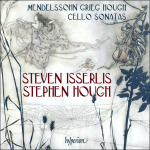
It is always such a pleasure to spend time with my old friend Stephen Hough (PH, as I call him); and this recording was no exception. I am proud to say that on this session there was only one enforced break because of uncontrollable giggling – and he was the first to lose it, not I. We recorded two romantic sonatas that we both love, by Grieg and Mendelssohn; and a fascinating and atmospheric sonata by PH himself, for cello and piano left-hand. I originally suggested the idea of a sonata with piano left-hand, in order to play it with another pianist-friend who had lost the use of his right-hand; but that friend then recovered – so thus far I have only played it with PH. But he does seem to understand the music rather well, for some reason – so that’s no hardship!
‘This disc is rather different from most of my others: for a start, I used steel strings (a first for me) – and somehow the nature of the music here is a lot less lyrical, more percussive than most of the repertoire I enjoy playing. but I love these pieces! The Prokofiev concerto opus 58 is a rarity – not completely unknown, by any means, but somehow unappreciated, I feel. Prokofiev used most of the themes in the concerto for his later Symphony-Concerto (otherwise a very different piece), and somehow the latter work has made it into the standard repertoire while the original concerto has been left in the cold. Many years ago, I made the decision to learn one, but not both, of the two works. It so happened that my great friend Olli Mustonen – whose understanding of Prokofiev’s music is extraordinary – was staying with me; so I gave him the two piano reductions, and told him to decide which I should learn (I hate making decisions). He kindly spent about an hour looking at them – and then advised me to learn the concerto, because he found it to be the more satisfying of the two. And now I really agree with him. Powerful though the Symphony-Concerto is, it seems to me that the Concerto is bolder, more innovative and ultimately even more fascinating than its younger sibling. I would be thrilled if this disc helped the concerto enter the standard repertoire. As for the Shostakovich concerto: is there a more exciting work for cello and orchestra? I doubt it. I find it thrilling to play, thrilling to hear; no sense of experimentation here – just bold mastery. I think that these works go excellently together (well, of course I do – that’s why I recorded them together!), despite the striking differences between the two composers. And it was lovely to record with the Hessische Rundfunk orchestra – the German orchestra with whom I have had the longest relationship – under the amazing Paavo Jarvi, with whom I have been playing (working?) for well over 20 years. So – I hope you like it!’
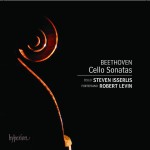
‘Recording the greatest works ever composed forcello and piano is quite a challenge! Although I have played most of the sonatas for more years than I care to remember, it was not until comparatively recently that I became utterly engulfed, entranced, ensnared and enchanted (as well as lets of other words beginning with ‘en’ – but you get the point) by Beethoven. I can’t really pinpoint any moment at which I had an epiphany, and realized that this music had become one of the most important things in life for me – although performing the cycle with Robert Levin for the first time almost ten years ago was certainly a step in that direction. It’s a cliché, but a true one, that Beethoven tends to become more and more important in a musician’s life as he or she grows older. My friend, the much-missed John Tavener, always resisted Beethoven furiously – until his last years when, in frailty and pain, the late quartets became a real lifeline to him.
Playing Beethoven fills me with a joy I find hard to describe. There is a strength to his music, a radiance of spirit, that is like nothing else. The late sonatas are of course the most profound and moving of these cello and piano (or, more accurately, piano and cello) pieces; but the world would be very much poorer without the earlier works, too. The might of Beethoven’s soul permeates every note of all these works. And the glorious A major sonata, the only work from this collection to date from his ‘middle’ period, is a perfect masterpiece.
I was lucky enough to perform the whole cycle with the great performer and scholar Robert Levin five times in the run-up to these recording sessions. We rehearsed and rehearsed – and didn’t stop discussing (and occasionally arguing!) throughout the recording sessions. I HOPE that all this work paid off – that is for the listener to decide. Robert played on a wonderful McNulty copy of an 1805 Walter fortepiano. Of course, for those used to a modern piano, the sound may come as a surprise; but I urge you to keep listening to it. It is not so much the historical accuracy of the sound that convinces me; it is more the clarity, the purity, and the sheer unbridled passion that can be released, without the worry of drowning the cellist that must inhibit every player on a modern instrument. I still enjoy playing these sonatas with modern piano (well, any excuse to play Beethoven is welcome!); but playing with this fortepiano was a different experience, and one that I loved.’
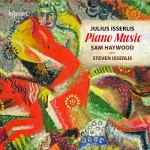
‘Although my only contribution to this disc was torecord one 9-minute piece on this disc, it is a project close to my heart – not surprisingly. The music, of course, is by my grandfather; the producer was my oldest sister Annette; and the sleeve-notes are by our middle sister Rachel. A family affair, in fact. Furthermore, Sam Haywood, whose disc it is, was a favourite pianist of our late father; and his wife Sophia runs this website!
We are very grateful to Sam for falling in love with these pieces, and playing them so persuasively. Everybody who has heard this recording so far seems to have been utterly charmed. The pieces are melodious, warm-hearted and beautifully crafted – and oh, SO Russian! I was always told what a wonderful man Julius was – and one can hear it in this music.’
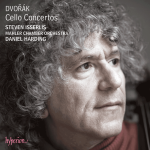
‘I first started learning the great Dvorak concerto at the age of 12 (to my father’s horror! He thought that by attempting it too early I’d ruin any chance I might have of playing it properly one day) and then performed it at the age of 14. But I’ve put off recording it for many years – well, it is the most famous of all cello concertos, so I was right to be wary. But finally I’ve taken the plunge – all I can say, really, is that I hope that people like it! It is one of the most moving and glorious of concertos for any instrument, and has given me so much joy over the years. Also – as a little boy, I was fascinated by the fact that Dvorak had written an earlier concerto; when the Gunther Raphael version (much revised from the original, but to my mind judiciously so) was republished in the late 70s, I eagerly snapped up a copy, and spent my first semester at Oberlin College learning it. Of course it’s not a rival to the great concerto – but it’s a charmer in its own right: warm-hearted, tuneful and loveable. I’m very pleased to have made what seems to be the premiere recording of this version; I hope that other cellists take it up.’
‘This was a disc on which I got to re-record, after some 25 years (gulp), two wonderful works inspired – if that’s the word – by World War 1. Bloch’s Schelomo is the more famous of the two, with its innovative use of Jewish idioms creating a vast, impassioned musical epic. Frank Bridge’s Oration, though, is equally masterly, in its more austere way. I’m glad that I got the chance in the sleeve-notes to set out my personal view of this tragic masterpiece; I can’t understand why it’s not played more often – in its way, it is as great a work, I think, as the Elgar concerto. The disc is completed by a beautiful piece, also rooted in WW1, by my great friend, the irrepressible Mr Hough.’
‘Thomas Adès is a phenomenon: unbelievably gifted composer, wonderful conductor, and amazing pianist. It’s really not fair AT ALL. But still, I was delighted to make this disc with him, of his own irresistible (and hideously difficult!) new piece for cello and piano, Lieux retrouvés, and works by composers who have influenced him: Liszt, Janáček, Fauré and Kurtág. I have been lucky enough to work extensively with the great Hungarian composer Gyorgy Kurtág over many years, and have learnt so much from him (as has Thomas). I am happy to have recorded here four of his miniature masterpieces for solo cello.’
Steven Isserlis with the Tapiola Sinfonietta and Gabor Takacs-Nagy
‘This was a very personal project for me in many ways, partly because all of these transcriptions
were made at my request. They range from Sally Beamish’s witty and charming reconstruction of a lost Debussy suite for cello, to a set of pieces I find as touching as anything written for the cello,
Bloch’s suite ‘From Jewish Life’.
‘For all that Isserlis has made many wonderful recordings, not least his seminal Bach suites, I think this might just be his finest yet’
(Gramophone)
‘Even I don’t quite understand why I’m SO obsessed with Schumann – but I am! I love everything about him, and virtually every note he composed. He is Denes’s most beloved composer too, so it seemed natural for us to do a new disc of all his works for cello and piano, and some arrangements – including my labour-of-love transcription of his rarely-heard third violin sonata, a work which remained unpublished until 100 years after Schumann’s death. An added bonus (for me) for this recording was that I was lucky enough to have two Strad cellos available for it, the ‘De Munck’ and the ‘Marquis de Coberon’. I divided the pieces pretty evenly between them; it would take a VERY sharp pair of ears to differentiate between them, though.’
‘Having not recorded for 2 years or so, it feltvery good to go back into the studio with Stephen and to revisit repertoire that I first recorded 21 years ago – groan. It’s always so wonderful to play with Stephen, on a personal as well as a musical level. Good also to record the Dvorak pieces (we actually recorded his Polonaise as well, but unfortunately discovered subsequently that it couldn’t fit onto the disc) and the little gems by Suk.’
Saint-Saens: Cello Concertos Nos. 1 and 2
With the London Symphony Orchestra and Michael Tilson Thomas
La Muse et el Poete – with Joshua Bell, violin Suite for Cello and Orchestra Op. 16 with NDR Sinfonieorchester and Christoph Eschenbach.
‘This is mostly reissues; but I was glad, several years after it was recorded and edited, BMG managed to locate and then issue the Saint-Saens Suite, Op. 16. At one stage, they seemed to have lost the tapes! It’s a lovely piece.’
‘I first started playing the Rachmaninov Sonata when I was about 11 and used to play it with my Russian Grandmother. She remembered perfectly the performances gave with Brandukov, the work’s dedicatee, so perhaps it’s not surprising that I feel a close affinity to this work.’
Cello World
A selection of short pieces for cello and arrangements, with Thomas Ades, Dame Felicity Lott, Maggie Cole, Michael Tilson Thomas, Dudley Moore
‘Well, I did enjoy making this disc, with so many friends; this is the one I usually give to people I like! And it’s full of my son’s favourite cello pieces, which for me is quite an added attraction.’
Schumann
Cello Concerto, works for cello and piano, ‘Offertorium’ from Mass in C minor; Bargiel: Adagio, with Deutsche Kammerphilharmonie, Christoph Eschenbach, Dame Felicity Lott, David King
‘Being a Schumann nut, I thought long and hard about recording the cello concerto – and I’m glad to say that I found the perfect partners in the DK and Christoph Eschenbach. Also, it was very nice to be able to include a piece by Schumann’s brother-in-law, Bargiel – good to keep it in the family.’
Brahms/Frühling/Schumann
Trios for clarinet, cello and piano, with Michael Collins and Stephen Hough
‘See my “enthusiasms” for my feelings about Mr. Frühling – it was a real thrill to be making the first-ever commercial recording of his music; and Messrs. Collins and Hough are among my most frequent partners in musical crime – so I’m happy that this recording exists.’
Elgar / Bloch / Kabalevsky / Tchaikovsky / R. Strauss
Works with orchestra, with various orchestras and conductors
‘A slightly mixed bag – but it’s cheap, and the pieces are great! The Kabalevsky is a
thrilling concerto, I think – I don’t understand why it’s so rarely played.’
Faure: Complete Works for Cello, with Pascal Devoyon
‘I love Faure so much! Pascal and I recorded a lot of this repertoire for Hyperion, but I was very disappointed with the result, partly because of poor sound; this BMG recording is a huge improvement, I think. For me, the sonatas are among the greatest works for the cello.’
Haydn
Cello Concertos, Sinfonia Concertante, Adagio cantabile, with soloists, Chamber Orchestra of Europe, Sir Roger Norrington
‘This one actually sold some copies! Wonders never cease. I love Haydn’s freshness and humour – what a marvellous man he must have been.’
Janácek / Prokofiev / Shostakovich
Works for cello and piano, with Olli Mustonen
‘It’s always exciting to play with my friend Olli Mustonen – and doubly so in this case, because we were making the first recording of the first version of Janacek’s “Fairy-Tale” ‘
Saint-Saëns
Concerto for Cello No. 2 / La Muse et le Poete / Romance / Cello Sonata No. 2, with ‘Joshua Bell, NDR Orchstra, Christoph Eschenbach
‘Little-known music by Saint-Saëns – all of it is beautiful, but the real gem is the piece for violin, cello and orchestra, “La Muse et le Poete”. It was great that Joshua Bell was transferred from Sony for that one piece!’
Strauss
Don Quixote, Romance, Cello Sonata, with Stephen Hough, Symphonieorchester des BR, Maazel
‘I had never met Maazel before these sessions took place, so I was nervous – but he couldn’t have been more charming! It was a really enjoyable experience. And an added luxury, of course, to record the sonata with the wonderful Stephen Hough – even though he mis-spells his own first name.’
Tavener
The Protecting Veil, Thrinos, Britten: Suite no.3, with LSO, Rozhdestvensky
‘This was called a ‘cult’ recording – hmmm… not by me. For me, “the Protecting Veil”, even without the religious programme, is a gorgeous, romantic piece of music; the first performance was one of the highlights of my concert life – so exciting to realise that the work had captured people’s imaginations.’