Introduction
Linguists are living through a period of profound change. Advances in technology and AI, shifting market demands, new ways of working and downward pressure on remuneration are reshaping the work of linguists.
Industry consolidation and outsourcing of contracts, combined with cuts in languages education and research, and changing public expectations and attitudes towards languages all frame the context linguists now work in. These changes are being experienced differently across different sectors and languages. There is no single story. Linguists are affected in different ways and are responding in different ways too.
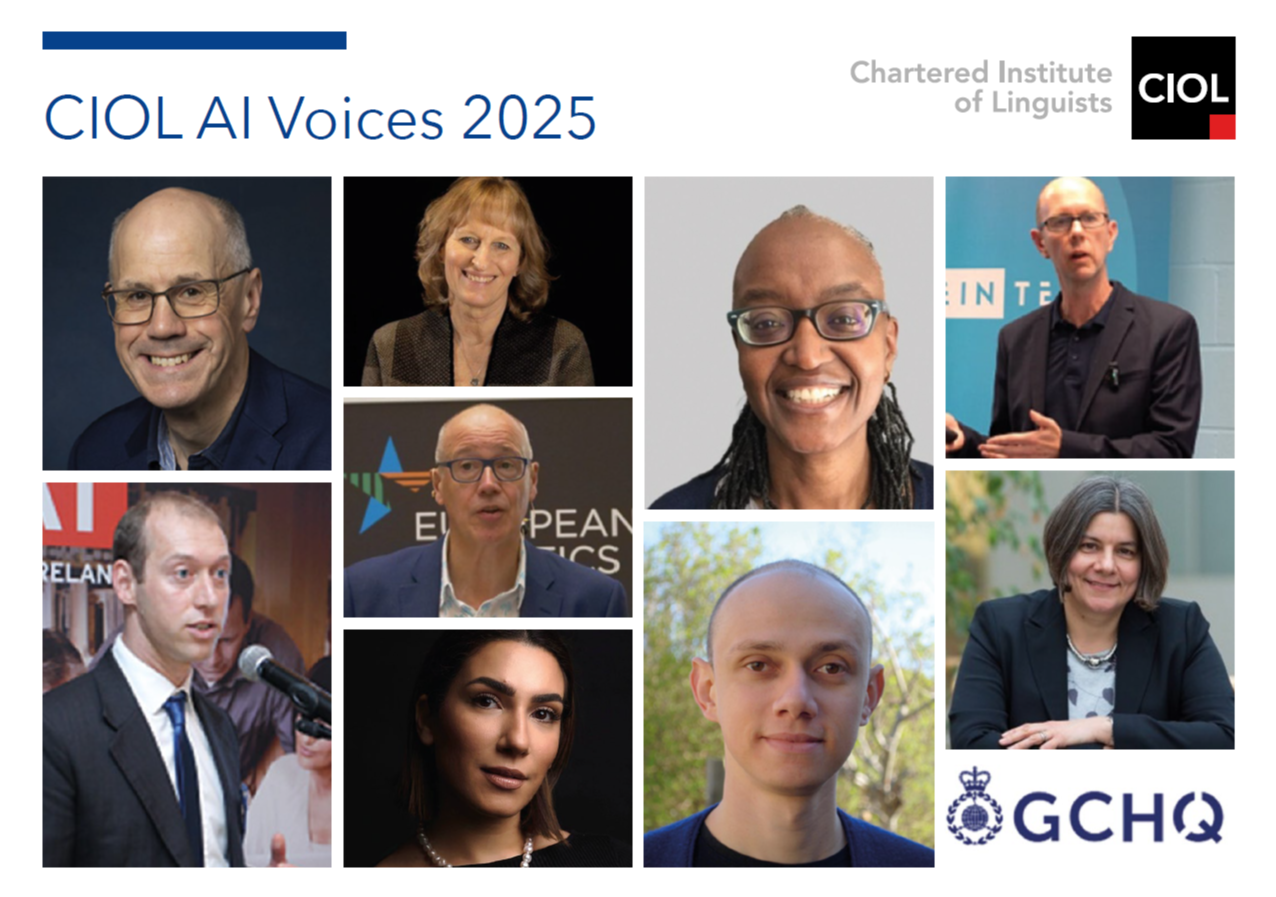
Over six months we have listened to linguists from a variety of backgrounds, sectors and contexts as well as academics, educators and industry experts; and asked if we could share their perspectives. The result is this collection of linguists’ voices. These are personal reflections on the challenges, opportunities and realities of working in languages today. We thank everyone who has contributed for being prepared to share their voices.
Linguists' Voices in brief:
"Again and again, contributors return to the same point: what distinguishes professional linguists is not simply language competence, but judgement, personal responsibility, accountability and trust. Those qualities matter most precisely where language carries risk, sensitivity or consequence and they are not diminished by technology – they are heightened by it."
Anita van Adelsbergen, Chair of CIOL Council
“Avoidance is not an option. Nor is unthinking adoption. As linguists, we need to develop informed, reflective practices that allow us to harness technology without surrendering professional judgement or ethical responsibility.”
Dr Mariam Aboelezz, Vice Chair of CIOL Council and Lecturer in Arabic Translation Studies at the University of Liverpool
“Human expertise is indispensable wherever language carries an ethical, political and social weight. In human rights work, translation shapes how communities understand their rights and how findings are received, whether people feel included or excluded.”
Lucio Bagnulo, Head of Translation and Language Strategy, Amnesty International
“The transferable value of language education can be expressed as the development of a ‘linguistic mindset’. Language subjects are ideal for cultivating modes of thinking that AI cannot do for us, and they offer a critical perspective that is needed in navigating and deploying these tools effectively.”
Megan Bowler, DPhil student and Lecturer in Classics at the University of Oxford
“AI has no agency, no professional agency. AI doesn’t have intentionality. AI models are not reliably culturally or situationally aware. And AI doesn’t have any accountability. Those are not minor technical limitations; they are fundamental differences from human interpreters. That means our methods for evaluating interpreting quality need to make those differences visible rather than obscure them."
Professor Sabine Braun, Professor of Translation Studies; Director, University of Surrey Centre for Translation Studies, Co-Director, Surrey Institute for People-Centred AI.
“The decline in language learning is not a story about what students want. It is a story about what they were offered. Across many education systems, the opportunity to learn languages has been concentrated in particular kinds of schools, particular kinds of communities. That is not falling demand. It is restricted access.”
Professor Marcela Cazzoli, Professor of Spanish and Applied Linguistics at Durham University and member of CIOL Council.
“Even when working with AI technology, the most important thing I bring is what’s in me that the machine cannot reproduce. That is the main ingredient clients seek. The tools are accelerants. They are not the point. Furthermore, as linguists, many of us already care about sustainability in other parts of our lives. It is worth carrying that care into how we use these tools, and which ones.”
Martin Chamorro is a translator, reviewer and facilitator based in Buenos Aires, he is a board member of the Asociación Argentina de Traductores e Intérpretes (AATI), a member of ATA and of CIOL
“AI is a great tool when you know what the outcome should be. If you don’t know what the outcome should be, you can’t judge whether the output is acceptable, risky or even dangerous.”
Emma Gledhill, Head of Localization at Avaloq, CIOL Fellow, Chartered Linguist and Council member and Chair of the CIOL Membership Committee
“Clients don’t buy words, they buy outcomes: clarity, trust, reduced risk, growth. The shift for linguists is from delivering language as a product to applying it as a strategic resource.”
Ilenia Goffredo, co-founder and Managing Director of LingBox, Chartered Linguist and Chair of the CIOL Translating Division Steering Group.
“Work has changed. I’m not purely translating or interpreting. I’m also advising clients, letting them know what solutions are more effective for their communication problems.”
Jaquelina Guardamagna, English and Spanish translator, interpreter and founder of Translator in London Ltd, CIOL Fellow and Chartered Linguist
“The real question isn’t whether AI can translate. It’s whether people can trust the translation enough to act on it – especially when the stakes are high.”
Bokani Hart, French/English translator and interpreter, Chartered Linguist and terminology specialist working in nuclear safety and international environmental law
“Skilled linguists bring something AI doesn’t have: intercultural and contextual understanding. They read the room, the speaker, the cultural register, what isn’t said.”
Dom Hebblethwaite, Head of Membership, Chartered Institute of Linguists
“If AI can translate, what does that make us? I would argue that it makes us more essential, not less. Speed, volume and repetition increasingly go to AI. What remains human is judgement, context, meaning and responsibility. We are moving from translating words to making decisions.”
Ibrahim Kadouni, conference interpreter, translator, business owner and Chartered Linguist working between Arabic and English
“We have always been adaptable. We’ve always been skilled users of technology as well as specialists in languages and cultures, but now we do need to up our game.”
Raisa McNab, Chief Executive, Association of Translation Companies & European Union of Associations of Translation Companies
“It’s an exciting time for research and for current translation graduates. But for our current graduates, the role of language professionals is gradually shifting from pure production to a broader spectrum of language-related services.”
Joss Moorkens, Associate Professor of Translation Studies, Dublin City University
“If you’re looking for a person who will demonise AI, I’m not that person. If you’re looking for a person who says AI is the solution to every single problem, that’s not me either. What I try to do is bring real world cases out into the open and think carefully about the questions we need to be asking.”
Professor Lucas Nunes Vieira, Professor of Translation and Technology, University of Bristol
“Professional judgement is worth dwelling on, because it’s precisely what AI cannot replicate. A machine can produce output that looks fluent and indeed plausible. What it cannot do is weigh up competing considerations, recognise when something feels wrong, understand the consequences of a mistranslation in a particular context, or take responsibility for a decision.”
Sara Robertson, Chief Executive, Institute of Translation and Interpreting (ITI)
“I’ve told all my clients I’m not going to use AI. I don’t want to do any post-editing. That’s not something I enjoy doing. I can still survive, and I think that’s worth saying, because other linguists can too. I don’t talk figures, but I’m still doing well. I’m confident this year is probably going to be better than last year.”
Andrew Simpson, translator and interpreter in the legal and medical sectors, CIOL Fellow and Chartered Linguist and teacher of interpreting on the T&I programme at Newcastle University
“When I started studying languages, I thought I was choosing a profession, which was translation. But little did I realise that you actually choose a lens through which you are going to build your entire career.”
Giulia Tarditi, Head of Function, Localisation, Revolut
“More than half the world’s population is bilingual. The question has never been the human ability to acquire languages. It has always been about opportunity, practice and hours of exposure. And the people who have thousands of hours of exposure to languages banked – in whatever language and for whatever reason – are holding something that AI cannot replicate: the living, responsive, trusted human voice.”
John Worne, Chief Executive, Chartered Institute of Linguists
“As AI can increase productivity in some contexts, translators are often expected to deliver more in less time. This can create pressure and raise concerns about workload, professional recognition, and translators’ health and well-being. It is sometimes assumed that faster work should cost less – but this is a misunderstanding of the profession.”
Xiaojie Zhang, Director, Conference Division, International Maritime Organization (IMO)
CIOL Council’s reflections on AI
The key question is not whether AI will affect languages work, but whether, when and how it should be used responsibly. The onward advance of AI tools and technologies is, in all probability, inevitable and unavoidable. They can help linguists in their work, but not everyone will choose to use them. And we need to highlight and confront the downsides: mistakes, hallucinations, data risks, lack of transparency and accountability, and the very real environmental costs.
AI makes linguists and language skills more critical. As it becomes increasingly hard to detect machine translation at the superficial level, the skills of linguists will be even more valuable. Skilled linguists will make the difference to the end-product, by avoiding the well-hidden errors, stylistic and dialect ‘fails’, and reputation and legal risks inherent in unsupervised use of AI translation.
More content will be AI-translated, needing oversight from linguists. Most content produced worldwide is still not translated. Whilst AI will enable much more content to be translated globally, high-stakes content – legal, medical, creative and commercial – will need to be translated with skilled human oversight and accountability; creating with it opportunities for linguists who can ensure and validate content is fit for purpose.
Professional linguists play a critical role in assuring quality, evaluating risk, interpreting nuance, navigating cultural and contextual complexity, and exercising professional judgement. As AI systems become more capable, the value of these human skills increases rather than diminishes. Linguists are not merely reviewers of machine-generated outputs, they are responsible professionals whose expertise is essential to ensuring that language services are accurate, appropriate, ethical and fit for purpose.
New AI models can create new opportunities for linguists. As AI technologies improve and become ubiquitous, they will also become more useful and accessible for some aspects of the work of linguists. From helping draft client communications, to versioning and terminology, there will be increased possibilities for efficiency and productivity; new business models and ways of working will become possible for individual linguists, freelancers and small businesses.
CIOL promotes the standards and qualifications that help evidence the value of professional linguists, and advocates for the conditions that enable skilled linguists to be properly valued in their work. Sustaining this means investment in language education, early-career opportunities, and the contractual, business and freelancing arrangements that sustain a properly rewarded workforce of linguists with this most vital of human skills, and all the more so given AI.
CIOL Council’s concerns
Machines being left to their own devices – If AI is seen to produce ‘good enough’ content, then companies, public services and governments may be tempted to cut corners and take risks in its widespread and insufficiently monitored use. Without meaningful human oversight and the involvement of skilled linguists, we could see a downward spiral in translation, interpreting and intercultural skills. AI systems cannot themselves be held accountable for the consequences of their outputs; responsibility remains with the organisations and individuals who deploy them. This makes professional judgement and accountability more important, not less.
“As long ago as 1979, IBM warned that computers must not be allowed to make management decisions because they cannot be held accountable. That famous quote seems eerily prescient today, because however AI is used, ultimately it is humans that will be held accountable for the outcome.” CIOL Council Member working in business.
Data runs out of control – Society, organisations and individuals need to be alert to the data we ‘give away’ when we input it into freely available translation tools and generative AI. We all need to be more alert to where data goes, into which jurisdictions, what use is made of it and who profits from it. More and more linguists are becoming concerned about the ethics, environmental costs and societal risks inherent in the uncontrolled use and uploading of text and voice conversations into AI and mainstream translation tools.
AI gives a whole new meaning to ‘fatal errors’ – The errors that translation tools and AI make are more severe in less well-resourced languages. In better-resourced languages, errors also become harder and harder to spot as AI improves (especially in English), and apparent fluency hides mistakes with numbers, names, technical terms and more which are crucial in legal, health, public service, government, diplomacy, security and defence contexts, as well as in marketing, commercial and contractual settings. This makes it vitally important that AI is only used with the oversight of skilled linguists, especially in high-stakes interpreting or translating contexts. This continues to need government, public service and regulatory attention.
“AI introduces completely different errors than a human would. Minor lexical shifts – dosage, acronyms, negation, ‘false friends’ can cause devastating real-world consequences. It is not about more or fewer fatal errors, the reality is that a single fatal error is all it takes.” CIOL Council Member working in interpreting and Higher Education.
An ongoing ‘digital divide’ for less well-resourced languages – Given the overwhelming advantages English has in the amount of digital content and the focus of commercial digital and AI players, there is an ongoing risk that English and the most widely spoken languages will continue to dominate in an AI-led languages paradigm, to the detriment of many other world languages and language communities.
AI hype undermines the value we place on languages and linguists – How languages function, and how linguists work, is often poorly understood in the English-speaking world. The impact of ‘AI hype’ risks persuading people and organisations that algorithms can reliably do things which they can’t, or that we can afford to cut corners for certain languages and language communities. We cannot.
In Summary
Context, Concerns and Opportunities
- Overstated claims about AI risk undermining public understanding of the value of languages, linguists and professional standards.
- Professional human judgement, accountability and trust must remain at the heart of language services, particularly where language carries legal, medical, commercial, diplomatic or societal consequences.
- Inevitably AI will be used in language contexts; but the key question is when it is used - and as importantly when it should not be - and how it is used responsibly.
- As AI becomes more capable, human linguistic expertise becomes more, not less, valuable in assuring quality, interpreting nuance and managing risk.
- Professional linguists should play a central role in shaping, developing, deploying, governing and evaluating AI-enabled language services, not just reviewing their outputs.
- AI is changing the nature of language work, opening new roles for linguists and opportunities in quality assurance, risk management, language technology, governance and multilingual communication.
- AI can create new opportunities for linguists, new services, new business models and greater multilingual access to information.
- Realising these benefits will require continued investment from governments and universities in language education, sustainablerates of pay and working conditions for linguists, a commitment to professional standards and support for the next generation of linguists to launch their careers and navigate these changes.
- Contracts, remuneration, attitudes to risk and approaches to sustainability all need to evolve to maintain a skilled workforce of linguists across the many languages needed to sustain multilingual communication and cross-cultural understanding at a time of major global challenges.
- Governments, businesses and public services must invest in linguists, alongside their investment in AI and technology and contracted language services. There is no sustainable route to the benefits of international trade, diplomacy, and domestic and international prosperity or security without the linguists who enable genuine mutual understanding.
Risks, Responsibility and Regulation
- AI systems cannot be held accountable for their decisions or mistakes; responsibility always remains with the humans and organisations that deploy AI tools.
- Organisations may increasingly rely on apparently “good enough” AI outputs, reducing scrutiny, professional oversight and investment in linguistic expertise.
- Meaningful human oversight is essential in high-stakes translation and interpreting, where a single error can have significant and major real world consequences.
- AI can produce fluent and convincing output that conceals errors in names, numbers, terminology, acronyms or meaning - making mistakes harder to detect.
- Traditional remuneration approaches do not reflect that finding and checking AI errors - the “needle in a haystack” problem - is often harder than translating a text from a clean source.
- AI and contract-driven downward pressure on rates and remuneration for linguists makes it increasingly difficult for many linguists to make a living.
- Data privacy, transparency, ownership and control remain significant concerns when information is entered into AI systems.
- Less-resourced languages risk being left further behind in an AI-driven world, widening existing inequalities between language communities.
- The environmental, ethical and wider societal impacts of large-scale AI deployment require ongoing scrutiny.
- Governments, regulators, businesses and public services all have a role in ensuring AI is used safely, responsibly and in the public interest in language services.
Download CIOL Linguists' Voices
Click the image below or download the PDF here.

To access our previous publications on AI and langauges, click on the image below: