

Transcription is the first step of gene expression in which the genetic information stored in DNA is copied into a complementary RNA molecule with the help of the enzyme RNA polymerase.
- It is an essential biological process that enables the information encoded in genes to be used for protein synthesis.
- Thereby regulating the growth, development, metabolism, and various physiological activities of living organisms.

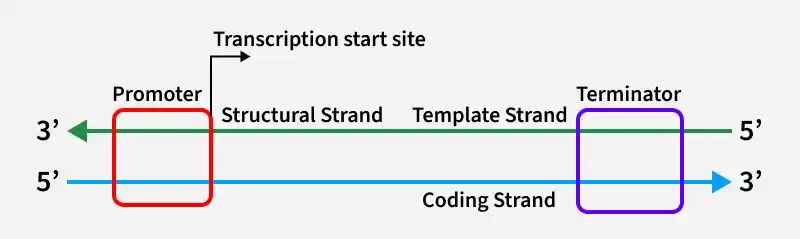
In transcription, only a segment of DNA and only one of the two strands are copied into RNA. The enzyme involved in transcription is DNA-dependent RNA polymerase. The strand with polarity 3’→5’ acts as a template for mRNA synthesis, and the other strand with polarity 5’→ 5'→3' is called the coding strand (it does not code for anything).
Transcriptional Unit
A transcription unit is the segment of DNA that is transcribed into an RNA molecule. Every transcription unit consists of three important regions.
- Promoter: The promoter is a specific DNA sequence located at the beginning of the transcription unit. It serves as the binding site for RNA polymerase and determines the point at which transcription begins. The promoter also determines which DNA strand will function as the template strand.
- Structural Gene: The structural gene is the portion of DNA that contains the genetic information required for the synthesis of RNA. This region is copied during transcription.
- Terminator: The terminator is a specific DNA sequence present at the end of the transcription unit. It signals RNA polymerase to stop RNA synthesis and release the newly formed RNA molecule.
Stages of Transcription
It takes place in the following stages:
Initiation
- Transcription begins when DNA-dependent RNA polymerase binds to the promoter region of DNA. After binding, the enzyme unwinds a short portion of the DNA double helix, exposing the nitrogenous bases of the template strand.
- The promoter determines the exact starting point of transcription and identifies the DNA strand that will serve as the template. Since RNA polymerase can initiate RNA synthesis independently, no primer is required.

Elongation
- During elongation, RNA polymerase moves along the template strand in the 3′ → 5′ direction while synthesising the RNA strand in the 5′ → 3′ direction. As the enzyme moves forward, complementary ribonucleotides are added according to the rules of complementary base pairing.
- The base-pairing rules during transcription are DNA Adenine (A) pairs with RNA Uracil (U), DNA Thymine (T) pairs with RNA Adenine (A), DNA Guanine (G) pairs with RNA Cytosine (C), and DNA Cytosine (C) pairs with RNA Guanine (G).
- RNA polymerase joins adjacent ribonucleotides by forming phosphodiester bonds, thereby elongating the RNA chain. As transcription proceeds, the DNA behind RNA polymerase rewinds to restore the double-helical structure.

Termination
Transcription concludes when the RNA polymerase reaches a specific termination signal on the DNA. This signal instructs the polymerase to release the newly formed RNA molecule. The DNA double helix reforms, and the RNA product is freed. There are two primary methods of transcription termination:
1. Rho-Dependent Termination
In this mechanism, a protein called the Rho factor binds to the newly synthesized RNA and moves along it, eventually catching up to RNA polymerase. The interaction between Rho and RNA polymerase leads to transcription termination.

2. Rho-Independent (Intrinsic) Termination
In this method, a termination signal on the DNA template strand leads to the formation of a hairpin loop in the newly synthesised RNA. This loop disrupts the RNA-DNA hybrid, causing RNA polymerase to pause and then release the RNA molecule.

Post-Transcriptional Modifications (Eukaryotes Only)
The primary RNA transcript in eukaryotes is not immediately functional. It undergoes three important modifications before leaving the nucleus.
- Capping: A modified guanine nucleotide is added to the 5′ end of the RNA molecule. This cap protects the RNA from degradation and helps the ribosome recognize the mRNA during translation.
- Tailing: A long chain of adenine nucleotides known as the poly-A tail is added to the 3′ end of the RNA molecule. This modification increases the stability of the mRNA and facilitates its transport to the cytoplasm.
- Splicing: The primary RNA transcript contains introns (non-coding regions) and exons (coding regions). During splicing, introns are removed and exons are joined together to produce mature messenger RNA capable of directing protein synthesis.
