

A nucleotide is the basic building block (monomer) of DNA and RNA. It consists of three parts: a five-carbon sugar, a phosphate group, and a nitrogenous base.
The sequence of nucleotides in a DNA or RNA molecule stores the genetic information required for inheritance and protein synthesis.
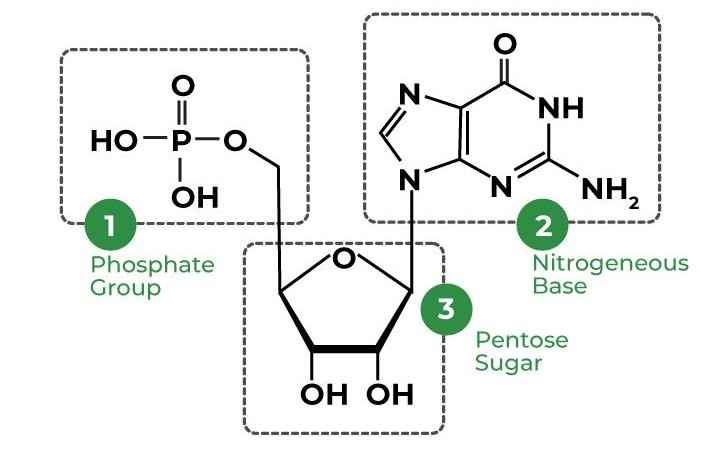
1. Pentose Sugar
Pentose sugar (Deoxyribose in DNA and Ribose in RNA) is a sugar molecule or monosaccharide having five carbon atoms. In nucleic acids, the pentose sugar is an aldose sugar. RNA is a nucleic acid that contains ribose sugar, whereas DNA is a nucleic acid that contains a Beta-2'–deoxyribose sugar. These sugars make bonds with phosphate groups, whereas with nitrogenous bases, they form bonds with the OH groups of the 1' carbon.

Deoxyribose
- Deoxyribose is an aldopentose sugar whose chemical formula is C5H10O4.
- It contains a hydrogen (H) atom at the 2nd carbon.
- Deoxyribose is more stable and less reactive due to the absence of oxygen.
Ribose
- Ribose is an aldopentose sugar whose chemical formula is C5H10O5.
- It contains a hydroxyl (OH) group at the 2nd carbon. This sugar is found in RNA.
- Ribose is less stable and more reactive due to the presence of oxygen.
2. Nitrogenous Bases
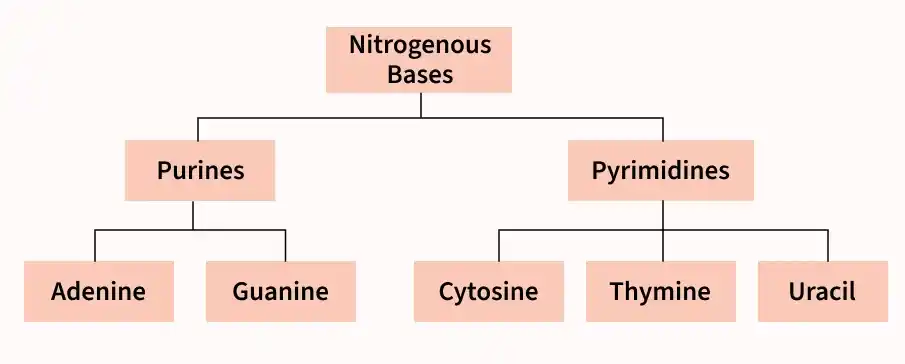
Nitrogenous bases are the components of nucleotides that store genetic information. DNA contains adenine (A), thymine (T), cytosine (C), and guanine (G), while RNA contains adenine (A), uracil (U), cytosine (C), and guanine (G).
Based on their structure, nitrogenous bases are classified into purines (adenine and guanine) and pyrimidines (cytosine, thymine, and uracil).
Pyrimidines
The structure of a pyrimidine is constituted by a six-membered ring made up of carbon and nitrogen atoms. This ring is constituted by four carbon atoms and two nitrogen atoms in its structure. In nucleotides, the primary types of pyrimidines that exist include cytosine and thymine in DNA. Pyrimidines are essential for encoding genetic information and play a crucial role in protein synthesis during transcription, and they provide the template for mRNA formation.
In RNA, uracil is present in place of thymine, which pairs with adenine with two hydrogen bonds. The base pairing is responsible for the stability of these genetic molecules.
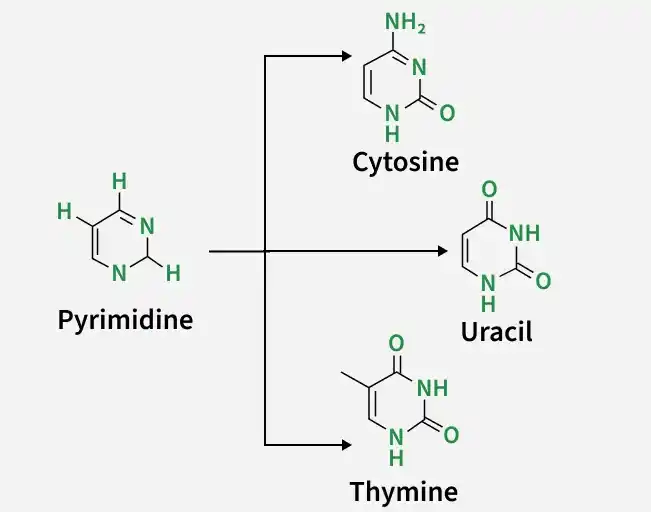
There are three types of pyrimidine bases:
- Cytosine: It is a type of nitrogenous base, and it is paired with guanine in DNA and RNA.
- Thymine: It is a type of nitrogenous base, and it is paired with adenine in DNA. In RNA, it is replaced with uracil.
- Uracil: It is a type of nitrogenous base, and it is paired with adenine in RNA.
Purines
Purine is constituted by a double-ring system, i.e. a pyrimidine ring is fused with an imidazole ring. The pyrimidine ring is a six-membered carbon-nitrogen ring with alternating atoms of carbon and nitrogen, while the imidazole ring contains three carbon atoms and two nitrogen atoms, forming a five-membered ring structure.
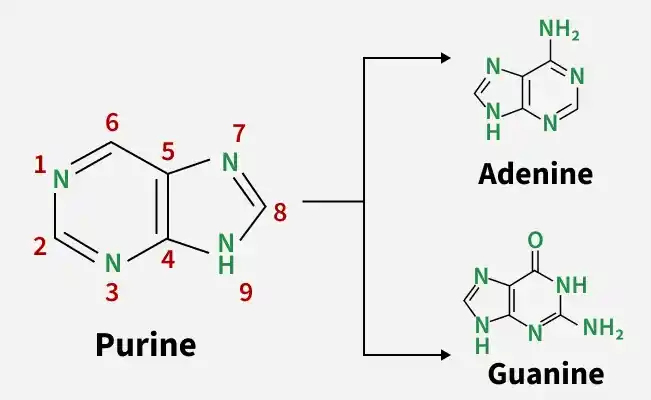
There are two types of purine bases:
- Adenine: It is a type nitrogenous base, and it is paired with thymine in DNA and in RNA, it is paired with uracil in RNA.
- Guanine: It is a type of nitrogenous base, and it is paired with cytosine in DNA and RNA.
In nucleotides, the primary types of purines that exist include adenine and guanine. These are found in both RNA and DNA. Apart from transmitting genetic information, purines function as signalling molecules in processes including neurotransmission and immune response.
3. Phosphate Group
- It is composed of an oxygen molecule and phosphorus and is attached to the ribose sugar.
- The phosphate group is also responsible for the negative charge of nucleic acids.
- Nucleic acids' structure and function depend on this negative charge, which also has an impact on how cells function and interact with other molecules.
- A phosphate group joins the 3' carbon of one deoxyribose molecule to the 5' carbon of the next to create a 3'-5' phosphodiester link.
- Similar to how phosphate groups form phosphodiester bonds between 3' and 5' carbons, ribose is the sugar found in RNA. However, uracil (U) rather than thymine (T) takes the role of one of the nitrogenous bases in RNA.
