

Conductance of electrolytic solutions refers to the ability of electrolyte solutions to conduct electricity through the movement of ions. Electrolytes dissociate into positive and negative ions when dissolved in water or in a molten state. These ions carry electric current through the solution.
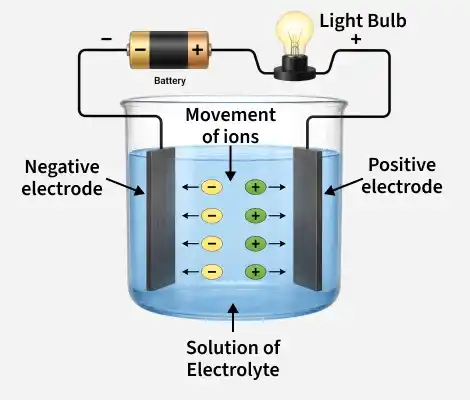
Conductance depends on the resistance offered by the solution to the flow of electric current. It is the reciprocal of resistance. The SI unit of conductance is siemens (S).
G = \frac{1}{R}
Where:
- G = conductance
- R = resistance
Resistance of a conductor depends on its length and area of cross-section and is given by:
R = \rho \frac{l}{A}
Where:
- ρ = resistivity
- l= length of conductor
- A= area of cross-section
Types of Conductors
Substances that allow the flow of electric current through them are called conductors. Depending on the mode of conduction, conductors are classified into two types:
1. Metallic Conductors: Metallic conductors conduct electricity through the movement of electrons without undergoing any chemical change. Metals such as copper, silver, and aluminium are examples of metallic conductors.
2. Electrolytic Conductors: Electrolytic conductors conduct electricity through the movement of ions in molten state or aqueous solution. During conduction, chemical decomposition takes place. Solutions of acids, bases, and salts are examples of electrolytic conductors.
Electrolysis and Movement of Ions
Electrolysis is the process in which chemical decomposition takes place when electric current is passed through an electrolyte in molten state or aqueous solution. When an electrolyte dissolves in water, it dissociates into positively charged ions called cations and negatively charged ions called anions.
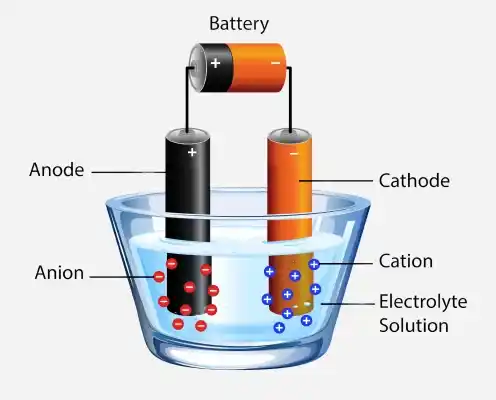
On passing electric current through the solution:
- Cations move towards the cathode and undergo reduction.
- Anions move towards the anode and undergo oxidation.
- Electrolytic conduction involves transfer of matter through ions.
- Conductivity increases with increase in temperature due to increased ionic movement.
Conductivity of Electrolytic Solution
Conductivity (Specific Conductance) is the conductance of a solution placed between two electrodes 1 cm apart with cross-sectional area 1 cm². It is denoted by κ (kappa). The SI unit of conductivity is S m⁻¹ or S cm⁻¹.
\kappa = G \frac{l}{A}
Molar Conductivity
Molar conductivity is defined as the conductance of all the ions produced by one mole of an electrolyte dissolved in a given volume of solution.
- It is represented by Λm.
- The SI unit of molar conductivity is S cm² mol⁻¹.
- Molar conductivity increases with dilution because the ions move more freely and interionic attraction decreases.
\Lambda_m = \frac{\kappa \times 1000}{C}
Where:
- Λm= molar conductivity
- κ = conductivity
- C= concentration of solution in mol L⁻¹
Variation of Conductivity with Concentration
The conductivity and molar conductivity of electrolytic solutions vary with concentration.
1. Conductivity: Conductivity decreases with dilution because the number of ions per unit volume decreases. Therefore, the ability of the solution to conduct electricity decreases on dilution.
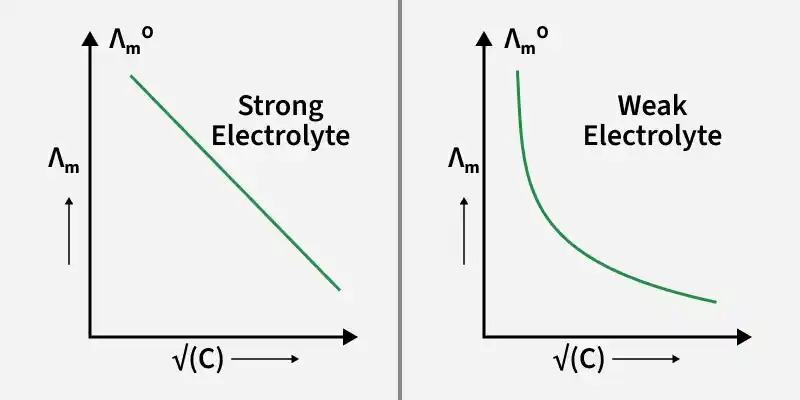
2. Molar Conductivity: Molar conductivity increases with dilution because the ions move more freely and interionic attraction decreases.
3. Strong Electrolytes: For strong electrolytes, molar conductivity increases slowly with dilution because they are almost completely ionized even at higher concentrations.
4. Weak Electrolytes: For weak electrolytes, molar conductivity increases sharply with dilution due to increase in ionization of the electrolyte.
Kohlrausch’s Law of Independent Migration of Ions
According to Kohlrausch’s law, at infinite dilution, each ion of an electrolyte contributes independently towards the molar conductivity of the electrolyte irrespective of the nature of the other ion present with it. Therefore, the limiting molar conductivity of an electrolyte is equal to the sum of the limiting ionic conductivities of its cation and anion.
\Lambda_m^\circ = \lambda_+^\circ + \lambda_-^\circ
Where:
- Λ∘m = limiting molar conductivity of electrolyte
- λ∘+ = limiting ionic conductivity of cation
- λ∘- = limiting ionic conductivity of anion
Factors Affecting Conductance
The conductance of an electrolytic solution depends on various factors that influence the ability of the solution to conduct electric current.
1. Nature of Electrolyte: Strong electrolytes dissociate completely into ions and therefore show higher conductance, whereas weak electrolytes dissociate partially and show lower conductance.
2. Concentration of Solution: Conductance increases with increase in concentration because the number of ions available to carry electric current increases.
3. Temperature: Conductance increases with increase in temperature due to increase in ionic mobility and decrease in interionic attraction.
4. Size and Mobility of Ions: Smaller ions and ions with greater mobility conduct electricity more effectively than larger ions.
5. Nature of Solvent: The conductance depends on the viscosity and dielectric constant of the solvent. Lower viscosity allows ions to move more freely.
Solved Examples
Example 1: The Conductivity of 0.20 m solutions of KCl at 298K is 0.0248 Scm-1. Calculate its molar conductivity.
Solution:
Molar conductivity = (κ × 1000)/Molarity = [(0.0248Scm-1 × 1000cm3 L-1)/ 0.20 molL-1]
= 124 Scm2 mol-1
Example 2: The electrical resistance of a column of 0.05mol/L NaOH solution of diameter 1 cm and length 50 cm is 5.55 × 10³ ohm. Calculate resistivity, conductivity, molar conductivity.
Solution:
Area = πr2 = 3.14 × 0.52 cm2 = 0.785 cm2 = 0.785 ×10⁻⁴ m2, R = 5.55 × 10³ ohm
R = ρ l/A = [(5.55× 103 ohm × 0.785cm2)/50 cm]
= 87.135 ohm cm
Conductivity = κ = 1/ρ = (1/87.135)Scm-1 = 0.01148 Scm-1
Molar Conductivity = [(κ × 1000)/c] cm3L-1 = (0.01148 Scm-1 × 1000 cm3L-1)/0.05molL-1
= 229.6 Scm2 mol-1
