

The dual nature of electromagnetic radiation was an important element in the development of Bohr's model. This indicates that radiations can have both wave-like and particle-like properties.
Wave Nature of Electromagnetic Radiation
- When electrically charged particles travel under acceleration, alternating magnetic and electrical fields are formed and communicated.
- These fields are transferred in the form of waves and are referred to as electromagnetic waves or electromagnetic radiation.
- For many years, scientists have pondered the nature of light as a sort of radiation.
- Initially, scientists assumed that light was made up of particles called corpuscles.
- The wave nature of light was only discovered in the early nineteenth century.
Properties
Electromagnetic Radiation Consists of Electric and Magnetic Fields
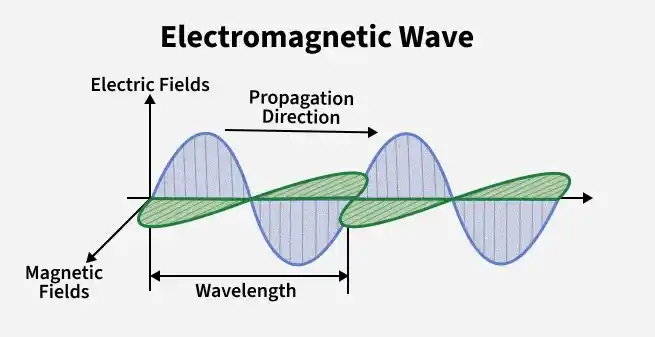
- Electromagnetic waves are made of two mutually perpendicular oscillating fields :Electric field (E) and Magnetic field (B)
- Both fields are perpendicular to each other and also perpendicular to the direction of propagation of the wave.
Transverse Nature
- Electromagnetic waves are transverse waves because the vibrations of electric and magnetic fields occur perpendicular to the direction of wave propagation.
Wavelength (λ)
- Wavelength is the distance between two consecutive crests or troughs of a wave.
- It is denoted by:
\lambda - Unit: meter (m)
Frequency (ν)
- Frequency is the number of waves passing through a point in one second.
- It is denoted by:
\nu - Unit: Hertz (Hz)
Wave Number (νˉ\bar{\nu}νˉ)
- Wave number is the number of waves per unit length.
\bar{\nu} = \frac{1}{\lambda} - Unit:
m^{-1}
Amplitude
- Amplitude is the maximum displacement of a wave from its mean position.
- Higher amplitude means higher intensity (brightness).
Energy of Electromagnetic Radiation
- Energy is directly proportional to frequency.
E=hν
Where:
- E = energy
- h = Planck’s constant
\nu = frequency
Value of Planck’s constant:
h = 6.626 \times 10^{-34} \, Js
Electromagnetic Spectrum
Electromagnetic radiation exists in different regions depending on wavelength and frequency:
- Radio waves
- Microwaves
- Infrared
- Visible light
- Ultraviolet
- X-rays
- Gamma rays
Relationship Between Wavelength and Frequency
Wavelength and frequency are inversely proportional.
c = \lambda \nu
Where:
- c = speed of light
\lambda = wavelength\nu = frequency
Value of speed of light:
c = 3.0 \times 10^{8} \, m/s
Planck’s Quantum Theory
- The phenomena of black-body radiation and the photoelectric effect are not well explained by classical physics or the wave theory of light.
- Atoms or molecules emit or absorb energy only in discrete amounts known as quantum amounts, rather than in a continuous fashion.
- The smallest amount of energy emitted or received in the form of electromagnetic radiation is referred to as a quantum.
- The energy of each quantum is directly proportional to the frequency of radiation.
E∝ ν or E = hν
Where:
- E = energy of radiation
- h = Planck’s constant
- ν = frequency
Photoelectric Effect
- Einstein used Planck's quantum theory to explain the photoelectric effect in 1905.
- According to Planck's quantum theory, firing a light beam on a metal surface is equivalent to shooting a beam of particles or photons at the metal.
- In this situation, when a sufficiently energetic photon collides with an electron in the metal, the photon quickly transmits its energy to the electron, and the electron is ejected without any time lag.
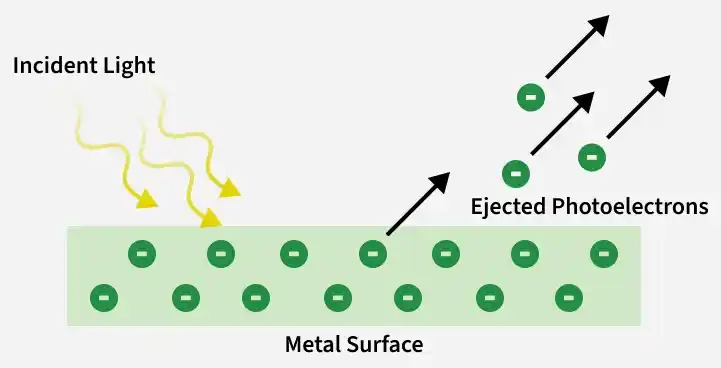
A more intense light beam has a greater number of photons and hence ejects a greater number of electrons.
- Finally, the kinetic energy of the expelled electron increases as the energy carried by a photon increases.
- The kinetic energy of the expelled electron is thus proportional to the frequency of the electromagnetic radiation.
Dual Behaviour Of Electromagnetic Radiation
- The photoelectric effect and black-body radiation are explained by the particle nature of light.
- Interference and diffraction, on the other hand, are explained by the wave nature of light.
- This disparity presented scientists with a quandary.
- Finally, they agreed that light has both wave-like and particle-like features, implying that it has dual behaviour.
- When light propagates, it has wave-like properties, whereas when it interacts with matter, it has particle-like properties.
Line Spectrum of Hydrogen
- The line spectrum of hydrogen is the spectrum obtained when hydrogen gas is excited (for example, in a discharge tube). Instead of giving a continuous spectrum, hydrogen emits light of specific wavelengths only, which appear as bright lines.
- This is called a line (or emission) spectrum.
- Electrons revolve in fixed energy levels.
- When an electron jumps from a higher energy level to a lower one, it emits energy in the form of light.
- The emitted light has a specific wavelength.
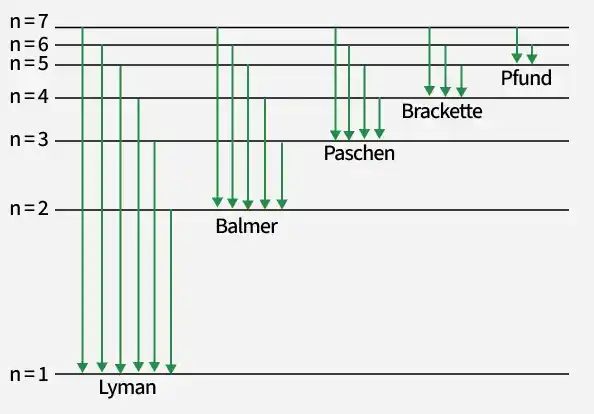
The spectral lines of hydrogen are grouped into different series:
Lyman Series
- Electron falls to n = 1
- Lies in Ultraviolet region
Balmer Series
- Electron falls to n = 2
- Lies in Visible region
- Most important for exams
Paschen Series
- Electron falls to n = 3
- Lies in Infrared region
Brackett Series
- Electron falls to n = 4
Pfund Series
- Electron falls to n = 5
