

Chemical reactions occur at different rates. Some reactions are very fast, such as combustion, while others are extremely slow, such as rusting of iron. The study of the speed of chemical reactions and the factors affecting it is known as chemical kinetics. The rate of a reaction depends on several factors such as concentration, temperature, surface area, catalyst, and nature of reactants.
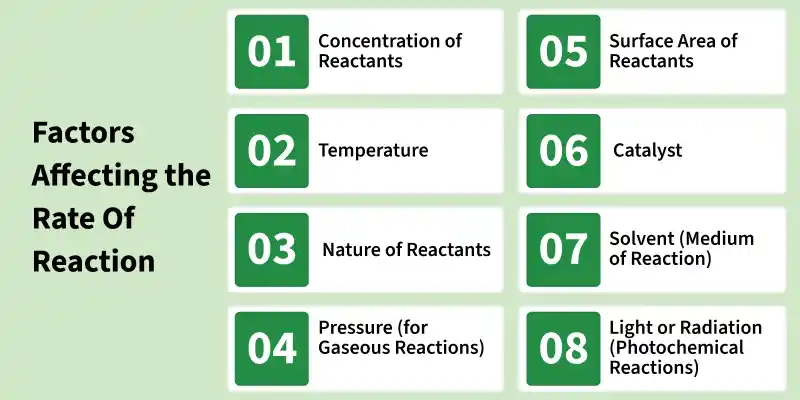
1. Concentration of Reactants
The rate of a chemical reaction depends on how many reacting particles are present in a given volume.
- When the concentration of reactants is increased, the number of molecules per unit volume also increases.
- This leads to a higher frequency of collisions between reactant particles.
- Since more collisions occur in a shorter time, the number of effective collisions also increases, resulting in an increase in the rate of reaction.
2. Temperature
Temperature has a strong effect on the rate of reaction. When temperature increases, the kinetic energy of molecules also increases. This causes molecules to move faster and collide more frequently.
- A greater number of molecules acquire energy equal to or greater than the activation energy required for the reaction.
- As a result, the number of effective collisions increases significantly, and the reaction rate increases.
3. Nature of Reactants
The rate of reaction depends on the chemical nature and bonding in the reactants. Reactions involving ionic compounds are usually faster because ions are already separated and can react directly in solution.
- On the other hand, covalent compounds require bond breaking before new bonds form, which takes more time.
- Stronger bonds, complex molecules, and less reactive substances generally lead to slower reactions.
4. Pressure (for Gaseous Reactions)
In reactions involving gases, increasing pressure reduces the volume available to gas molecules.
- This effectively increases their concentration.
- As a result, gas molecules come closer to each other and collide more frequently.
- This increase in collision frequency leads to an increase in the rate of reaction.
- Pressure has no significant effect on solids and liquids.
5. Surface Area of Reactants
When a solid reactant is involved, the reaction occurs only on its surface. Therefore, if the surface area is increased, more particles become available for collision.
- Finely divided solids react much faster than large solid lumps because they provide a greater exposed surface area.
- For example, powdered calcium carbonate reacts faster with acid than a marble chip.
6. Catalyst
A catalyst increases the rate of reaction without being consumed in the process. It works by providing an alternative reaction pathway with lower activation energy.
- Since more reactant molecules are able to overcome this lower energy barrier, the number of effective collisions increases, and the reaction becomes faster.
- Catalysts do not change the equilibrium position, only the speed of reaching it.
7. Solvent (Medium of Reaction)
The rate of reaction is also influenced by the solvent used. Solvents affect the interaction between reactant molecules, especially in ionic or polar reactions.
- Polar solvents stabilize ions and can increase reaction rate in ionic reactions, while non-polar solvents may slow them down.
- Thus, the nature of the medium plays an important role in determining how easily reactants collide and react.
8. Light or Radiation (Photochemical Reactions)
Some chemical reactions require energy from light to proceed. In such reactions, light provides the energy needed to break chemical bonds and generate reactive species such as free radicals.
- As a result, the reaction either does not occur or occurs very slowly in the absence of light, but proceeds rapidly when exposed to light, especially ultraviolet radiation.
