

Coordination compounds are compounds in which a central metal atom or ion is surrounded by ions or molecules called ligands. These compounds play an important role in chemistry because they show unique properties such as colour, magnetic behaviour, and catalytic activity. To study coordination compounds properly, it is necessary to understand certain basic terms related to their structure and bonding.
1. Coordination Entity
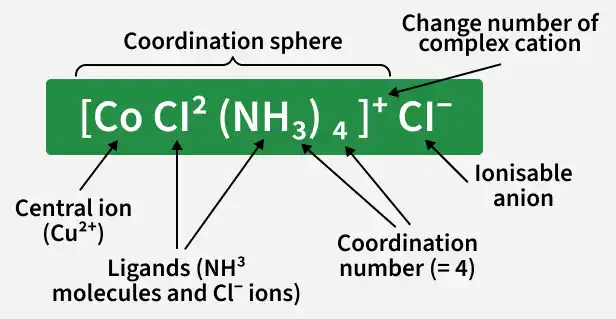
A coordination entity consists of a central metal atom or ion bonded to a fixed number of ligands. The entire unit behaves as a single species in solution.
Example: [Co(NH3)6]3+
In this complex, cobalt is the central metal ion and ammonia molecules act as ligands.
2. Central Metal Atom or Ion
The metal atom or ion to which ligands are attached is called the central metal atom or ion. It is usually a transition metal having vacant orbitals that can accept electron pairs from ligands. The central metal ion forms coordinate bonds with ligands.
Examples: Fe2+ , Co3+ , Cu2+
3. Ligands
Ligands are ions or molecules that donate one or more lone pairs of electrons to the central metal atom or ion. They are also called Lewis bases. Ligands are classified on the basis of the number of donor atoms through which they attach to the metal ion.
Examples: NH3 (ammine) , H2O (aqua) , Cl − (chloro)
4. Coordination Number
The number of ligand donor atoms directly bonded to the central metal atom or ion is called the coordination number. The coordination number depends on the number of coordinate bonds formed by the ligands.
Examples: In [Co(NH3)6] 3+ , coordination number = 6
5. Coordination Sphere
The central metal ion together with the ligands attached to it, enclosed within square brackets, is called the coordination sphere. The ions outside the coordination sphere ionise in solution.
Example: [Co(NH3)6]Cl3
- Coordination sphere: [Co(NH3)6] 3+
- Counter ions: 3Cl -
6. Oxidation Number of Central Metal Atom
The oxidation number of the central metal atom is the charge present on it after considering the charges of ligands and the overall charge on the complex.
Example: [Fe(CN)6] 4−
Let oxidation state of iron = x
x + 6 (−1) = −4 , x + 6 (-1) = - 4 , x = +2
Hence, oxidation number of iron = +2
7. Homoleptic Complex
Complexes containing only one type of ligand are called homoleptic complexes. Only ammonia ligands are present in the complex.
Example: [Co(NH3)6] 3+
8. Heteroleptic Complex
Complexes containing more than one type of ligand are called heteroleptic complexes.
Example: [Co(NH3)4Cl2] +
Both ammonia and chloride ligands are present.
9. Chelate
A ligand that forms ring structures while bonding to the central metal atom is called a chelating ligand, and the complex formed is called a chelate complex. Chelate complexes are generally more stable than complexes containing monodentate ligands.
Example: [Cu(en)2] 2+
Ethane-1,2-diamine forms rings with the copper ion.
10. Counter Ions
Ions present outside the coordination sphere which balance the charge of the complex ion are called counter ions. These ions ionise in aqueous solution.
Example: [Co(NH3)6]Cl3
Cl -acts as the counter ion
11. Double Salts and Complex Compounds
- Double salts dissociate completely into simple ions in aqueous solution.
Example: FeSO4 ⋅ (NH4)2SO4 ⋅ 6H2O
- Complex compounds retain their identity in solution and do not dissociate completely into all constituent ions.
Example: K4[Fe(CN)6]
Only potassium ions ionise, while the complex ion remains intact.
