

The Nernst equation is an important relationship in electrochemistry that connects the electrode potential of an electrochemical cell with the concentration (or activity) of the reacting species. It is used to calculate the actual cell potential under non-standard conditions such as when concentrations, pressures, or temperatures differ from standard values.
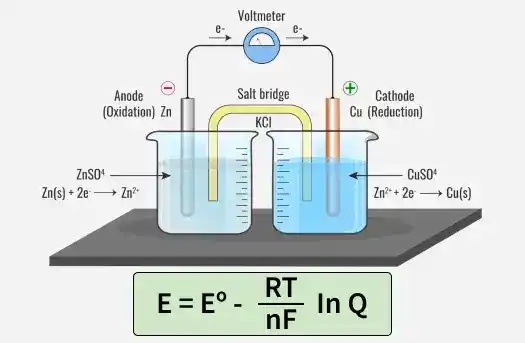
Electrochemical Cell
An electrochemical cell is a device that converts chemical energy into electrical energy through a redox reaction.
A Daniell cell consists of:
- zinc electrode dipped in zinc sulphate solution
- copper electrode dipped in copper sulphate solution
- salt bridge connecting the two half-cells
Anode reaction: Zn (s) → Zn2+ (aq) + 2e−
Cathode reaction: Cu2+ (aq) + 2e− → Cu (s)
Overall cell reaction:
Zn (s) + Cu2+ (aq) → Zn2+ (aq) + Cu (s)
\Delta G = -nFE \\ \Delta G^\circ = -nFE^\circ \\ \Delta G = \Delta G^\circ + RT \ln Q Substituting the values of
\Delta G\ and \ \Delta G^\circ
-nFE = -nFE^\circ + RT \ln Q \\ Rearranging,
-nFE + nFE^\circ = RT \ln Q
nF(E^\circ - E) = RT \ln Q \\ Dividing both sides by nF,
E^\circ - E = \frac{RT}{nF} \ln Q \\ E = E^\circ - \frac{RT}{nF} \ln Q Substituting the values:
R = 8.314 \, J\,mol^{-1}K^{-1} \\ F = 96500 \, C\,mol^{-1} \\ T = 298\,K \\ E = E^\circ - \frac{0.0591}{n} \log Q
Nernst Equation Formula
For an electrochemical reaction, the Nernst equation is:
E_{\text{cell}} = E^\circ_{\text{cell}} - \frac{RT}{nF} \ln Q
Where:
- Ecell = electrode potential under given conditions
- E°cell = standard electrode potential
- R = universal gas constant (8.314 J mol⁻¹ K⁻¹)
- T = temperature in Kelvin
- n = number of electrons transferred in the reaction
- F = Faraday constant (96500 C mol⁻¹)
- Q = reaction quotient
Nernst Equation at 25°C (298 K)
At standard temperature (298 K), the equation becomes simpler:
E_{\text{cell}} = E^\circ_{\text{cell}} - \frac{0.0591}{n} \log Q
Where :
- Ecell = cell potential under non-standard conditions
- E°cell = standard cell potential
- Q = reaction quotient
Determination of Equilibrium Constant Using Nernst Equation
At equilibrium, the cell reaction stops and the cell potential becomes zero.
Therefore:
Ecell = 0
Using the Nernst equation:
0 = E∘cell −0.0591 / n logK
Final Equation
E0cell =0.0591 / nlogK
Where:
- K is the equilibrium constant
- n is the number of electrons transferred
A larger value of standard cell potential indicates a larger equilibrium constant and greater feasibility of the reaction.
Applications of Nernst Equation
- The Nernst equation has many important applications in electrochemistry.
- It is used to calculate the electrode potential of cells under non-standard conditions.
- It helps determine the equilibrium constant of reactions and is also used in concentration cells.
- The equation is useful in determining the pH of solutions and calculating the solubility product of sparingly soluble salts.
Limitations of Nernst Equation
- The Nernst equation is mainly applicable to dilute solutions where ions behave ideally.
- It becomes less accurate at high concentrations because ionic interactions become significant.
- The equation assumes constant temperature and does not account for side reactions occurring in the cell.
Sample Questions
Question 1: Will the Eº value change when the coefficients in the chemical equation change?
Answer: The Eº value does not depend on the coefficient in the chemical equation i.e. when we double or triple the coefficient, the E° value does not change.
For example:
- Zn²+ 2e- → Zn; E° =-0.76 V
- 2Zn²+ 4e- → 2Zn; E° =-0.76 V
- 3Zn²+ 6e- → 3Zn; E° =-0.76 V
In the half-reaction, if the coefficients change, the number of electrons will change to cancel out the effect of the change in n coefficients.
Question 2: Which reference electrode is used to measure the electrode potential of other electrodes?
Answer: The standard hydrogen electrode is used as a reference electrode whose electrode potential is assumed to be zero. The electrode potential of the other electrode is measured concerning it.
Question 3: Zinc rod is dipped in 0.1M solution of ZnSO4. The salt is 95% dissociated at this dilution at 298 K. Calculate the electrode potential given that E (Zn²+ | Zn) = -0.76 V.
Answer: The electrode reaction is :
Zn2+ + 2e- ⇆ Zn(s)
According to Nernst equation, at 298 K
E(Zn2+ |Zn)=E° (Zn2+ |Zn)- (0.059 /n) log [ angle n] [Zn]/[Zn2+ (aq)]
E° (Zn2+ |Zn)=-0.76 V, [Zn] = 1,
[Zn2+(aq)]=0.1*95/100=0.095 M
E(Zn2+ |Zn)=-0.76- (0.009/n )log1/-0.095
=-0.76-0.03=-0.79V
Question 4: What advantage do the fuel cells have over primary and secondary batteries?
Answer: Primary batteries restrain delimited congeries of reactants and are destroyed when the reactants have been consumed. Secondary batteries can be recharged but take a longer to recharge. The fuel cell is conducted consecutive as long as reactants are supplied to it and products are continuously removed.
Question 5: How will the pH of the brine (aq. NaCl solution) be affected when it is electrolyzed?
Answer: Since NaOH is formed during electrolysis, the pH of the brine solution will increase .
Unsolved Problems
- Calculate the cell potential when the reaction reaches equilibrium. What is the value of Ecell at equilibrium?
- Determine the reaction quotient (Q) for the reaction: Zn(s)+Cu2+(aq)→Zn2+(aq)+Cu(s) ,Where
[Zn^{2+}] = 0.5\,M , [Cu^{2+}] = 0.02\,M . - A galvanic cell has a standard cell potential of 1.05 V. If the reaction involves two electrons, calculate the Gibbs free energy change (ΔG°) for the reaction. Given: F=96500Cmol−1 .
- Explain how the cell potential changes when the concentration of the reactants increases or decreases according to the Nernst equation.
