

The carbon–halogen bond (C–X bond) is an important feature of haloalkanes and haloarenes, where X represents a halogen atom such as fluorine (F), chlorine (Cl), bromine (Br), or iodine (I). The nature of this bond greatly influences the physical and chemical properties of these compounds. Since halogen atoms are more electronegative than carbon, the C–X bond is polar in nature.
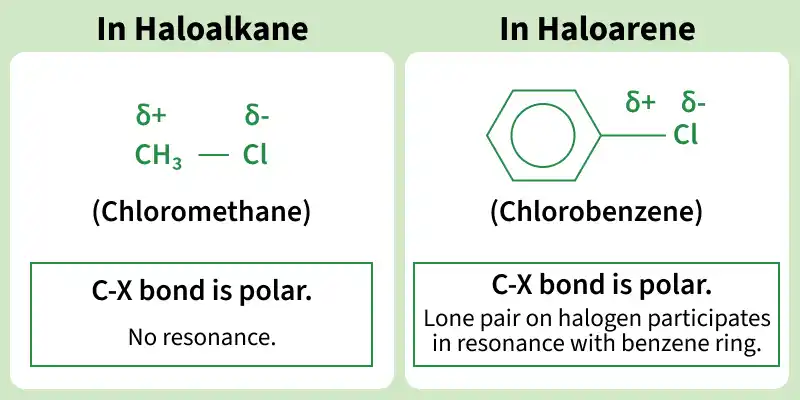
Polar Nature of C–X Bond
In haloalkanes and haloarenes, the carbon atom is bonded to a halogen atom through a carbon–halogen (C–X) bond. Halogen atoms such as fluorine, chlorine, bromine, and iodine are more electronegative than carbon. Therefore, the shared pair of electrons in the C–X bond is attracted more strongly towards the halogen atom.
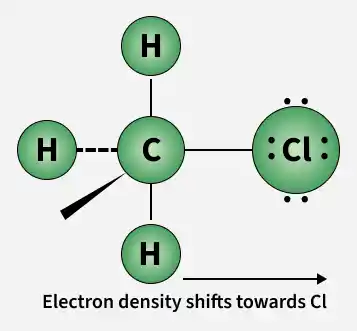
As a result:
- The carbon atom acquires a partial positive charge (δ⁺).
- The halogen atom acquires a partial negative charge (δ⁻).
C δ+ − X δ−
Bond Length of C–X Bond
The bond length of the carbon–halogen (C–X) bond depends upon the size of the halogen atom. As the atomic size of the halogen increases from fluorine to iodine, the bond length also increases.
Order of bond length: C − F < C − Cl < C − Br < C − I
- Fluorine is the smallest halogen atom, so the C–F bond has the shortest bond length.
- On the other hand, iodine is the largest halogen atom, so the C–I bond has the greatest bond length.
- As bond length increases, the overlap between the orbitals of carbon and halogen decreases, resulting in weaker bonds.
Bond Strength
The strength of the carbon–halogen (C–X) bond is measured in terms of bond dissociation enthalpy. Bond dissociation enthalpy is the amount of energy required to break one mole of C–X bonds in the gaseous state.
Order of bond strength: C − F > C − Cl > C − Br > C − I
- The bond strength depends mainly on the bond length. Shorter bonds are stronger, while longer bonds are weaker.
- The C–F bond is the strongest because fluorine is very small in size, resulting in effective overlap between the orbitals of carbon and fluorine.
- On the other hand, iodine is much larger in size, so the overlap between carbon and iodine orbitals is weaker.
Reactivity of Haloalkanes
The reactivity of haloalkanes mainly depends on the strength of the carbon–halogen (C–X) bond. During most chemical reactions of haloalkanes, the C–X bond breaks to form products. Therefore, weaker C–X bonds break more easily and react faster.
Order of reactivity: RI > RBr > RCl > RF
- Since the bond strength decreases from C–F to C–I, the reactivity of haloalkanes increases in the same order.
- Iodoalkanes are the most reactive because the C–I bond is weakest and can be broken easily.
- On the other hand, fluoroalkanes are the least reactive because the C–F bond is very strong and difficult to break.
Nature of C–X Bond in Haloarenes
In haloarenes, the halogen atom is attached directly to an sp² hybridised carbon atom of the aromatic ring. The nature of the carbon–halogen (C–X) bond in haloarenes is different from that in haloalkanes.
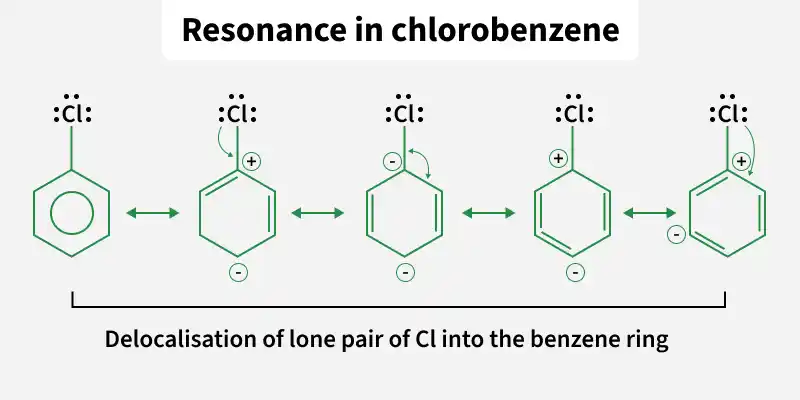
- In haloarenes, the lone pair of electrons present on the halogen atom interacts with the π-electrons of the benzene ring.
- This interaction results in resonance between the halogen atom and the aromatic ring.
- Due to resonance, the C–X bond acquires a partial double bond character.
As a result:
- The C–X bond in haloarenes becomes shorter than expected.
- The bond becomes stronger and more difficult to break.
Salient Features of the C–X Bond in Haloarenes
The carbon–halogen (C–X) bond in haloarenes shows certain special features due to the presence of the aromatic ring and resonance effect. These features make haloarenes behave differently from haloalkanes.
1. Halogen is Attached to an sp² Hybridised Carbon Atom: In haloarenes, the halogen atom is directly attached to an sp² hybridised carbon atom of the benzene ring. The sp² hybridised carbon atom is more electronegative than the sp³ hybridised carbon atom present in haloalkanes.
2. Resonance in Haloarenes: The lone pair of electrons present on the halogen atom overlaps with the π-electrons of the benzene ring and participates in resonance. Because of resonance, the electron density is delocalised over the aromatic ring.
3. Difficult Cleavage of C–X Bond: Since the C–X bond in haloarenes is stronger and has partial double bond character, it is difficult to break. Therefore, haloarenes do not undergo nucleophilic substitution reactions easily.
4. Less Reactive Nature of Haloarenes: Haloarenes are less reactive towards nucleophilic substitution reactions compared to haloalkanes because the C–X bond is stronger , the bond has partial double bond character. , the bond cleavage becomes difficult.
5. Shorter Bond Length: The carbon–halogen bond length in haloarenes is shorter than that in haloalkanes due to resonance and partial double bond character.
