

The Modern Periodic Table is a systematic arrangement of elements based on their atomic number. It is based on the modern periodic law, which states that the physical and chemical properties of elements are periodic functions of their atomic numbers. This table was developed after the modification of earlier periodic tables to remove their limitations. The elements in the modern periodic table are arranged in rows called periods and columns called groups. Elements in the same group have similar chemical properties.
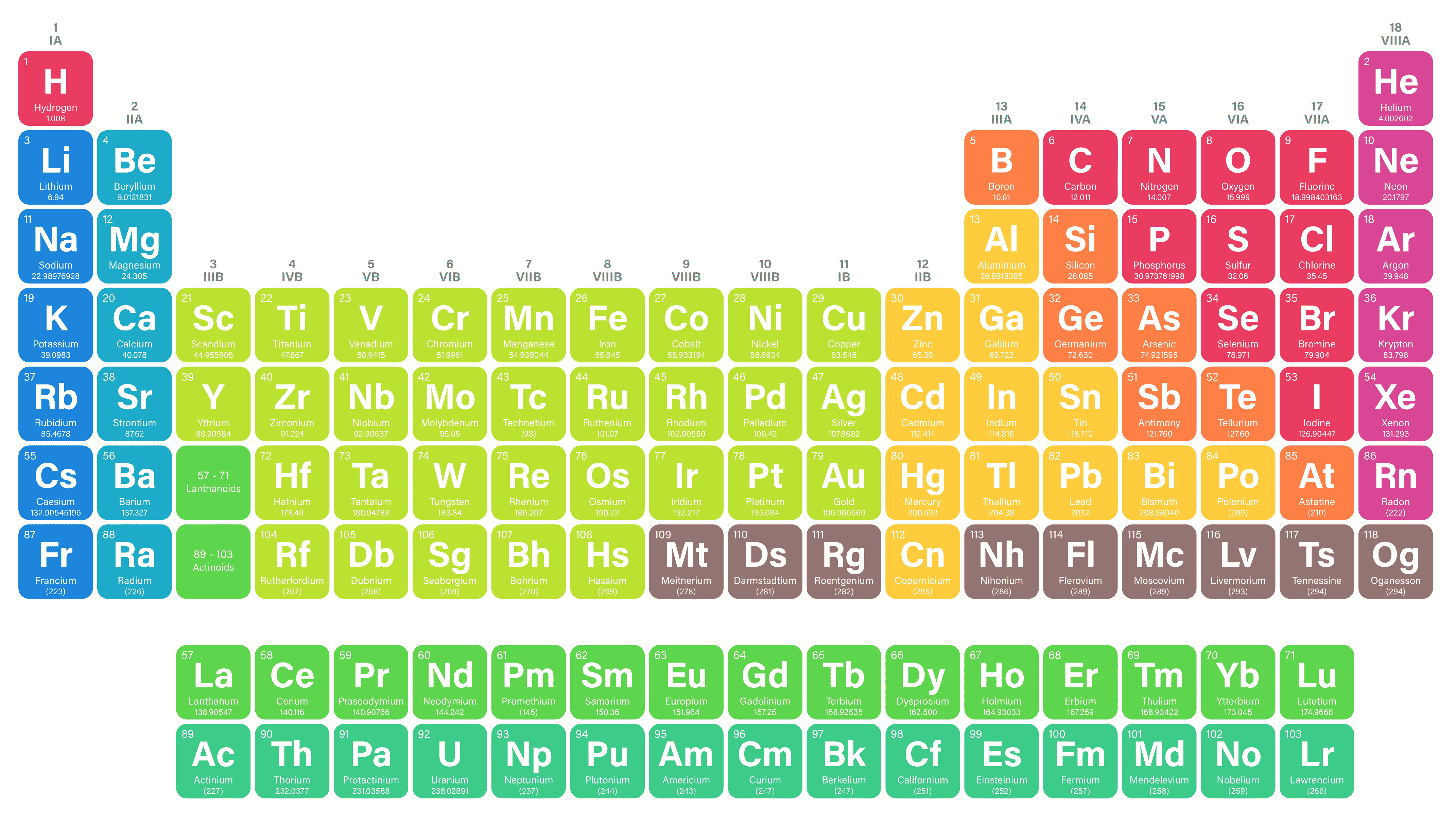
List of Periodic Table Elements
Few of the elements listed are arranged according to the increasing order of atomic number.
Elements in Periodic Table with Atomic Mass | |||
|---|---|---|---|
| Atomic Number | Chemical Element Name | Symbol | Atomic Mass (amu) |
| 1 | Hydrogen | H | 1.0079 |
| 2 | Helium | He | 4.0026 |
| 3 | Lithium | Li | 6.941 |
| 4 | Beryllium | Be | 9.0122 |
| 5 | Boron | B | 10.811 |
| 6 | Carbon | C | 12.0107 |
| 7 | Nitrogen | N | 14.0067 |
| 8 | Oxygen | O | 15.9994 |
| 9 | Fluorine | F | 18.9984 |
| 10 | Neon | Ne | 20.1797 |
| 11 | Sodium | Na | 22.9897 |
| 12 | Magnesium | Mg | 24.305 |
| 13 | Aluminum | Al | 26.9815 |
| 14 | Silicon | Si | 28.0855 |
| 15 | Phosphorus | P | 30.9738 |
| 16 | Sulfur | S | 32.065 |
| 17 | Chlorine | Cl | 35.453 |
| 18 | Argon | Ar | 39.948 |
| 19 | Potassium | K | 39.0983 |
| 20 | Calcium | Ca | 40.078 |
Important Terms in Periodic Table
Terms | Description |
|---|---|
Atomic Number | The number of protons that constitutes an element's nucleus is called its Atomic Number (Z). e.g. Carbon contains 6 protons then, so its atomic number must be 6 only. |
Atomic Mass | It is defined as the average mass of the atoms of an element. It is measured on the basis of the relative natural abundance of the isotopes of the element. Atomic mass is also termed Atomic Weight (A). It is measured in the atomic mass unit (amu). |
Period | The horizontal rows from left to right in a periodic table are called Periods. There are a total of 7 periods in the periodic table. Elements in a period are arranged based on increasing atomic number. Properties change gradually, not similarly.. |
Group | The vertical columns from top to bottom in a periodic table are called Groups. There is a total of 18 groups in the periodic table. The elements are arranged vertically due to their similarities in properties, as they have the similar valence shell electronic configuration. |
Symbol of an Element | A symbol is a notion that is used to represent a chemical element using a letter or a combination of letters. e.g. The chemical symbol of Carbon is C, while Fe is used for Iron and so on. |
Classification of Elements in Periodic Table
The 118 elements are arranged in 7 periods and 18 groups as shown above. Further, the elements are divided into different blocks.
| Block | Elements Included | Last Electron Subshell Filled |
|---|---|---|
| s-block | Group 1 (Alkali Metals) | s-subshell |
| Group 2 (Alkaline Earth Metals) | ||
| p-block | Group 13 (Boron Family) | p-subshell |
| Group 14 (Carbon Family) | ||
| Group 15 (Nitrogen Family) | ||
| Group 16 (Oxygen Family) | ||
| Group 17 (Halogen Family) | ||
Group 18 (Noble Gas Family) | ||
| d-block | Groups 3 to 12 (Transition Elements) | d-subshell |
| f-block | Lanthanides (Rare Earth Elements) | f-subshell |
| Actinides |
Mendeleev Periodic Table
Dmitri Mendeleev proposed the periodic table in 1869 to arrange elements in a systematic way based on their properties. He arranged elements in order of increasing atomic mass and grouped them according to similarities in their chemical properties.
In this table, elements were placed in rows called periods and columns called groups. Elements in the same group showed similar chemical behaviour.

- Each group was divided into A (main elements) and B (transition elements).
- He left gaps for undiscovered elements and predicted their properties correctly.
- A regular pattern was observed in the formation of oxides and hydrides.
- The position of hydrogen was not fixed as it shows properties of two groups.
- Isotopes could not be placed properly since they have different atomic masses but similar properties.
- Some elements were not arranged in increasing atomic mass order (e.g., Co and Ni).
