

Amines possess physical properties that are influenced by the presence of the amino group (-NH₂, -NHR, or -NR₂). The ability of nitrogen to form hydrogen bonds significantly affects their boiling points, solubility, and physical state. The physical properties of amines vary with molecular mass and the nature of the alkyl or aryl groups attached to the nitrogen atom.
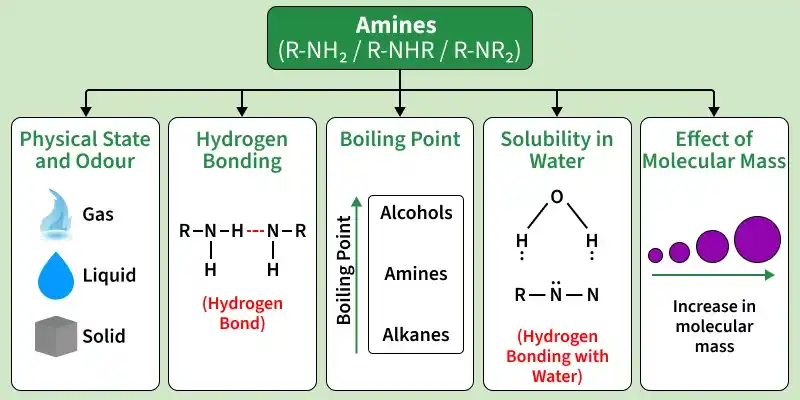
1. Physical State and Odour
Lower aliphatic amines are gases at room temperature and possess a characteristic ammoniacal or fishy odour.
- Amines containing a greater number of carbon atoms exist as liquids, while higher members are generally solids.
- Aromatic amines are usually colourless liquids or solids, although they may become coloured upon exposure to air due to oxidation.
Examples:
- Methylamine and ethylamine are gases.
- Propylamine and butylamine are liquids.
- Higher amines are solids.
2. Hydrogen Bonding
Primary and secondary amines contain N–H bonds and can form intermolecular hydrogen bonds.
- As a result, their molecules are associated with one another, leading to stronger intermolecular forces.
- Tertiary amines do not possess an N–H bond and therefore cannot form intermolecular hydrogen bonds among themselves.
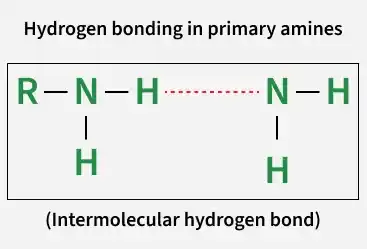
The extent of hydrogen bonding follows: Primary amines > Secondary amines > Tertiary amines
3. Boiling Points
The boiling points of amines are higher than those of corresponding alkanes because amines exhibit intermolecular hydrogen bonding. However, the hydrogen bonding in amines is weaker than that in alcohols because nitrogen is less electronegative than oxygen.
For isomeric amines: Primary amine > Secondary amine > Tertiary amine
For compounds of comparable molecular mass : Alcohols > Amines > Alkanes
- Primary amines have two hydrogen atoms attached to nitrogen and can form the maximum number of hydrogen bonds.
- Secondary amines have only one N–H bond and form fewer hydrogen bonds.
- Tertiary amines lack N–H bonds and therefore exhibit the weakest intermolecular attraction.
4. Solubility in Water
Lower amines are soluble in water because they can form hydrogen bonds with water molecules. The lone pair of electrons on nitrogen and the N–H bonds facilitate this interaction.
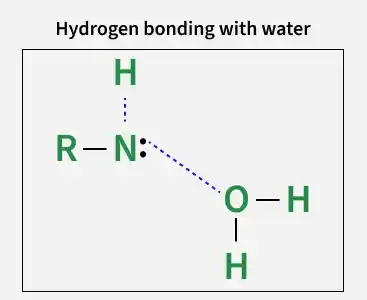
- The amino group forms hydrogen bonds with water, making dissolution possible.
- However, as the hydrocarbon chain length increases, the non-polar character of the molecule increases and solubility decreases.
- Solubility decreases as molecular mass increases
Examples:
- Methylamine, ethylamine and propylamine are highly soluble in water.
- Higher amines are only sparingly soluble.
5. Effect of Molecular Mass
As the molecular mass of amines increases, van der Waals forces become stronger. Consequently, boiling points increase while water solubility decreases.
- Increase in molecular mass lead to increase in boiling point
- Increase in molecular mass lead to Decrease in water solubility
