

d- and f-block elements, also known as transition and inner transition elements, respectively, occupy an important position in the periodic table. These elements are characterized by the gradual filling of (n−1)d and (n−2)f orbitals in their atoms. Because of these unique characteristics, d- and f-block elements have diverse applications in modern chemistry and industry.
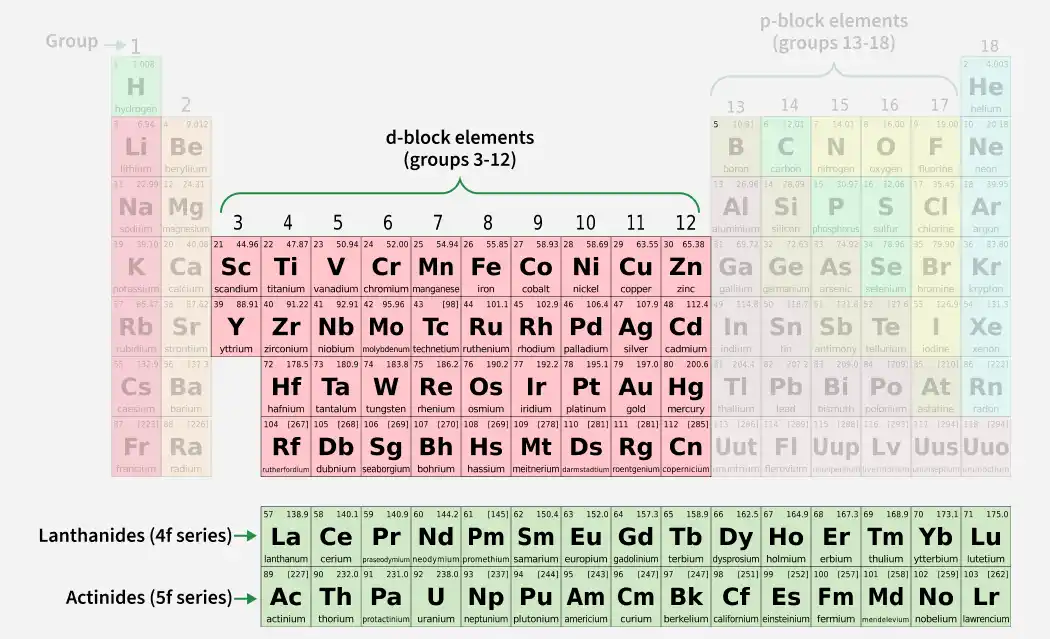
Applications of d-Block Elements
Due to their variable oxidation states, catalytic activity, and ability to form alloys and coloured compounds, d-block elements have numerous industrial and technological applications.
1. Catalysts in Industrial Processes
Transition metals and their compounds are extensively used as catalysts because they can show variable oxidation states and easily form intermediate compounds during chemical reactions. These properties help in increasing the rate of reactions without being consumed.
- Iron is used in the Haber process for the manufacture of ammonia.
- Nickel, platinum, and palladium are used in hydrogenation reactions of vegetable oils and organic compounds.
2. Formation of Alloys
d-block elements readily form alloys because their atomic sizes are similar. These alloys are generally hard, strong, and resistant to corrosion.
- Stainless steel, made from iron, chromium, and nickel, is used in utensils, machinery, and construction work.
- Brass (Cu + Zn) and bronze (Cu + Sn) are important industrial alloys.
3. Electrical and Thermal Conductivity
Most transition metals are good conductors of heat and electricity due to the presence of free electrons.
- Copper and silver are widely used in electrical wiring.
- Gold is used in electronic circuits because it resists corrosion.
- Tungsten is used in electric bulb filaments because of its very high melting point.
4. Formation of Coloured Compounds and Pigments
Many d-block elements form colored ions and compounds due to electronic transitions between d-orbitals. Because of this property, they are used in pigments, paints, dyes, and ceramics.
- Titanium dioxide (TiO₂) is used as a white pigment in paints.
- Chromium oxide (Cr₂O₃) is used as a green pigment.
- Potassium dichromate and potassium permanganate are widely used as coloring and oxidizing agents.
5. Magnetic Materials
Several transition elements exhibit magnetic behavior because of unpaired electrons in d-orbitals.
- Iron, cobalt, and nickel are ferromagnetic substances.
- These metals are used in transformers, electric motors, loudspeakers, and magnetic storage devices.
Application of f-Block Elements
F-block elements are widely used in nuclear energy, electronics, magnetic materials, and glass industries because of their radioactive nature and special electronic properties.
1. Nuclear Energy Applications
Actinoids are highly radioactive and are important in nuclear energy production.
- Uranium-235 and plutonium-239 are used as nuclear fuels in reactors.
- These elements undergo nuclear fission and release enormous amounts of energy.
- Some actinoids are also used in nuclear research and defense applications.
2. Manufacture of Alloys
Lanthanoids are used in making special alloys with improved properties.
- Misch metal, an alloy containing lanthanoids, is used in lighter flints.
- Lanthanoid alloys are used to improve hardness, strength, and resistance of metals.
3. Electronics and Magnetic Devices
Certain lanthanoids are widely used in modern electronic devices because of their magnetic and optical properties.
- Neodymium is used in powerful permanent magnets found in speakers, microphones, and motors.
- Europium and terbium are used in phosphors for LED lights, fluorescent lamps, and television screens.
4. Glass and Ceramic Industry
Lanthanoid compounds are useful in manufacturing high-quality glass and ceramics.
- Cerium oxide is used for polishing glass surfaces.
- Some lanthanoids are used to provide color and optical properties to special glasses and lenses.
5. Medicinal and Scientific Uses
Some f-block elements are used in medicine and scientific research.
- Radioactive isotopes are used in cancer treatment and diagnostic techniques.
- Certain actinoids are used in scientific investigations related to nuclear chemistry and atomic structure.
