

The rate of a chemical reaction depends on various factors such as concentration, catalyst, surface area, and temperature. Among these, temperature has a significant effect on the rate of reaction. In general, the rate of a reaction increases with increase in temperature because reacting molecules gain more kinetic energy and collide more frequently and effectively.
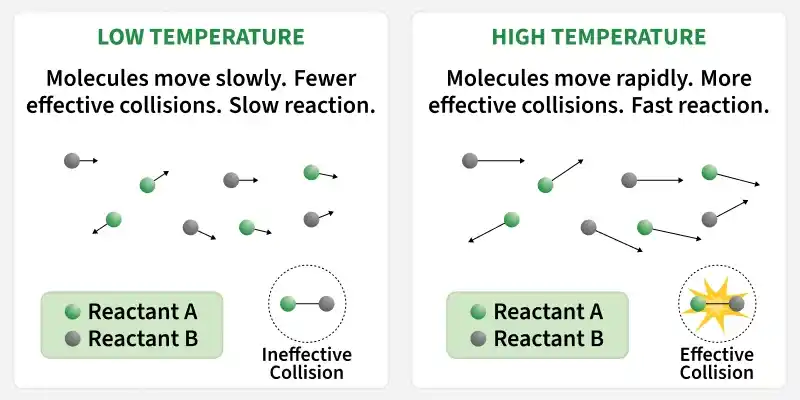
Effect of Temperature on Reaction Rate
Temperature has a great influence on the rate of a chemical reaction. In general, the rate of a reaction increases with increase in temperature. It is observed that for many reactions, the reaction rate becomes nearly double or triple for every 10∘C rise in temperature.
When temperature is increased, the kinetic energy of reacting molecules also increases. As a result:
- molecules move more rapidly,
- frequency of collisions increases,
- and collisions become more energetic.
Collision Theory and Temperature
According to collision theory, chemical reactions occur when reacting particles collide with each other. However, every collision does not result in the formation of products.
- For a reaction to take place, the colliding molecules must possess sufficient energy, and proper orientation.
- The minimum energy required by reacting molecules to form products is called activation energy (Ea).
- Only those collisions in which molecules have energy equal to or greater than activation energy are called effective collisions.
Activation Energy
Activation energy is the minimum amount of energy required by reacting molecules to undergo a chemical reaction and form products. It is represented by Ea.
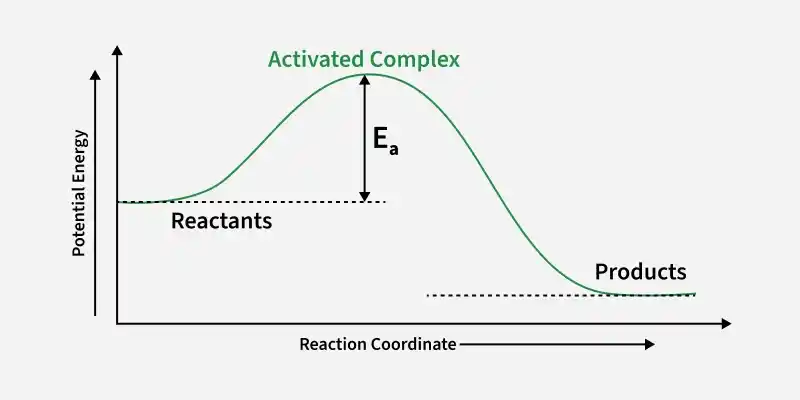
- During a chemical reaction, reactant molecules collide with each other.
- However, only those molecules that possess energy equal to or greater than the activation energy can form products.
- Molecules having energy less than activation energy undergo ineffective collisions and return unchanged.
The relation can be represented as: E ≥ Ea
Where:
- E = kinetic energy of reacting molecules
- Ea = activation energy
Arrhenius Equation
The relationship between the rate constant of a reaction and temperature was given by Arrhenius in the form of the Arrhenius equation. According to this equation, the rate constant increases exponentially with increase in temperature. The Arrhenius factor (A) represents the frequency of collisions and proper orientation of reacting molecules.
k = A e^{-\frac{E_a}{RT}}
Where:
- k = rate constant
- A = Arrhenius factor or frequency factor
- Ea = activation energy
- R = gas constant
- T = temperature in kelvin
Logarithmic Form of Arrhenius Equation
Taking logarithm of the Arrhenius equation:
\log k = \log A - \frac{E_a}{2.303RT}
- This equation is called the logarithmic form of the Arrhenius equation.
- It is useful because it converts the exponential equation into a linear form.
Graph Between log k and 1/T
A graph between logk and 1 / T gives a straight line called the Arrhenius plot. The Arrhenius plot shows that the logarithm of the rate constant varies linearly with the reciprocal of temperature.
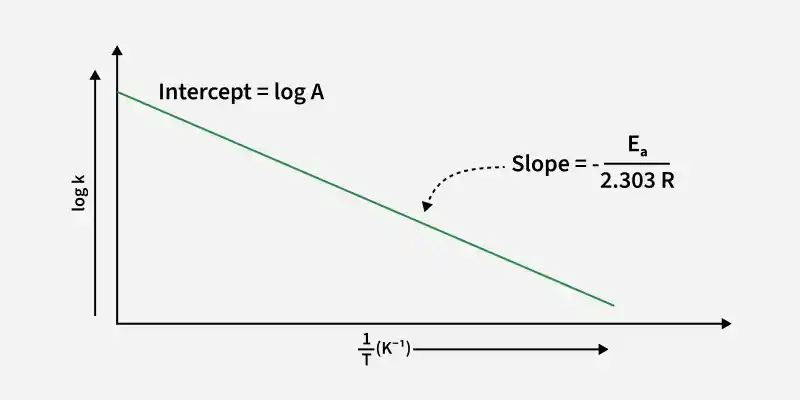
- As temperature increases, the value of 1 / T decreases.
- The rate constant k increases.
- Therefore, reaction rate increases with increase in temperature.
- The slope of the graph helps in calculating the activation energy of the reaction.
Importance of Temperature Dependence of Reaction Rate
The study of temperature dependence of reaction rate is very important in chemical kinetics. Understanding this relationship helps in controlling and applying reactions effectively in daily life as well as in industrial processes.
1. Industrial Applications: Many industrial chemical reactions are carried out at suitable temperatures to obtain products at a faster rate and in higher yield. Control of temperature helps in increasing the efficiency of industrial processes.
2. Food Preservation: Lowering the temperature decreases the rate of chemical and biological reactions responsible for food spoilage. Therefore, refrigeration and cold storage help in preserving food for a longer time.
3. Biological Reactions: The rate of enzyme-catalysed reactions in living organisms depends strongly on temperature. Very high temperatures may denature enzymes and slow down biological activities.
4. Storage of Chemicals and Medicines: Certain medicines and chemicals decompose rapidly at high temperatures. Therefore, they are stored at low temperatures to reduce the rate of decomposition reactions.
5. Study of Activation Energy: Temperature dependence of reaction rate helps in determining the activation energy of a reaction using the Arrhenius equation and Arrhenius plot.
6. Understanding Chemical Kinetics: It helps in understanding reaction mechanisms, effective collisions, activation energy, and factors affecting reaction rates.
7. Environmental Importance: Temperature affects many environmental processes such as atmospheric reactions, decomposition of pollutants, and ozone layer reactions.
