

The surface area of a solid of revolution is the curved surface formed when a plane curve is rotated about a fixed axis. It is calculated using definite integrals and represents the total outer surface of the resulting three-dimensional object. This concept is widely used in engineering, physics, and manufacturing to design and analyse objects with curved surfaces, such as pipes, tanks, and machine components.
Surface Area when Rotating Around the X-Axis
Let y = f(x) be a continuous and differentiable function on the interval [a, b]. When the curve is rotated about the x-axis, the curved surface area of the resulting solid is given by:
S = 2\pi \int_a^b f(x) \sqrt{1 + \left( \frac{dy}{dx} \right)^2} \, dx Where,
- f(x) is the radius of rotation.
- dy/dx is the derivative of the function.
- √(1 + (dy/dx)²) dx represents the differential arc length.
Surface Area when Rotating Around the Y-Axis
Let x = g(y) be a continuous and differentiable function on the interval [c, d]. When the curve is rotated about the y-axis, the curved surface area of the resulting solid is given by:
S = 2\pi \int_c^d g(y) \sqrt{1 + \left( \frac{dx}{dy} \right)^2} \, dy Where,
- g(y) is the radius of rotation.
- dx/dy is the derivative of the function.
- √(1 + (dx/dy)²) dy represents the differential arc length.
Consider a plane y = f(x) in the x-y plane between ordinates x = a and x = b. A solid of revolution is generated if a certain portion of this curve is revolved about an axis.
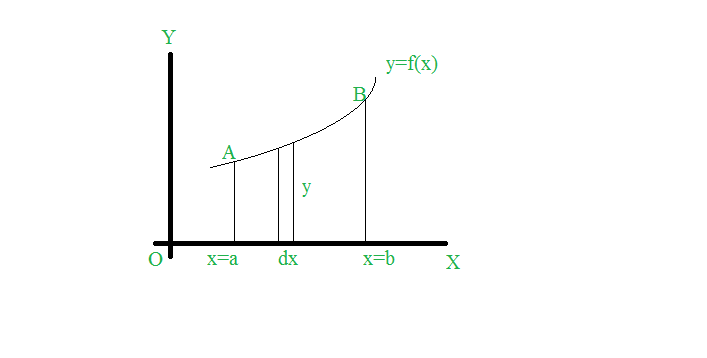
We can calculate the area of this revolution in various ways such as:
Cartesian Form
Area of solid formed by revolving the arc of the curve about the x-axis is:
S= \int_{x=a}^{x=b} 2\pi y\sqrt{1+(\frac{dy}{dx})^2}dx
Area of revolution by revolving the curve about y-axis is:
S= \int_{y=c}^{y=d} 2\pi x \sqrt{1+(\frac{dx}{dy})^2}dy
Parametric Form
If the curve is represented parametrically as: x = x(t), y = y(t), t₁ ≤ t ≤ t₂
About the x-axis:
S=\int_{t=t_{1}}^{t=t_{2}} 2\pi y(t) \sqrt{(\frac{dx}{dt})^2+(\frac{dy}{dt})^2}dt
About the y-axis:
S=\int_{t=t_{1}}^{t=t_{2}} 2\pi x(t) \sqrt{(\frac{dx}{dt})^2+(\frac{dy}{dt})^2}dt
Polar Form
If the curve is represented in polar coordinates as: r = f(θ), θ₁ ≤ θ ≤ θ₂
About the x-axis:
S = 2\pi \int_{\theta_1}^{\theta_2} \left(f(\theta)\sin\theta\right)\sqrt{\left(f(\theta)\right)^2+\left(\frac{dr}{d\theta}\right)^2}\,d\theta
About the y-axis:
S = 2\pi \int_{\theta_1}^{\theta_2} \left(f(\theta)\cos\theta\right)\sqrt{\left(f(\theta)\right)^2+\left(\frac{dr}{d\theta}\right)^2}\,d\theta
Surface Area About Any Axis or Line
If a curve is revolved about any line L, the surface area is given by:
S = 2\pi \int (PM)\,ds where,
- PM is the perpendicular distance from a point P on the curve to the axis of rotation.
- ds is the differential arc length.
Using x as the Variable:
S = 2\pi \int_{a}^{b} (PM)\sqrt{1+\left(\frac{dy}{dx}\right)^2}\,dx where PM is expressed in terms of x.
Using y as the Variable:
S = 2\pi \int_{c}^{d} (PM)\sqrt{1+\left(\frac{dx}{dy}\right)^2}\,dy where PM is expressed in terms of y.
Solved examples
Example 1: Find the surface area when y = 2x is revolved about the x-axis from x = 0 to x = 3.
Solution:
f(x) = 2x
f'(x) = 2
S = 2π ∫[0 to 3] 2x √(1 + 2²) dx
= 2π ∫[0 to 3] 2x √5 dx
= 2π√5 ∫[0 to 3] 2x dx
= 2π√5 [x²][0 to 3]
= 2π√5 (9 - 0) = 18π√5 ≈ 126.65 square units
Example 2: Find the surface area when y = √x is revolved about the x-axis from x = 0 to x = 4.
Solution:
f(x) = √x
f'(x) = 1/(2√x)
S = 2π ∫[0 to 4] √x √[1 + 1/(4x)] dx
= 2π ∫[0 to 4] √x √[(4x + 1)/(4x)] dx
= 2π ∫[0 to 4] √[(x(4x + 1))/4] dx
= π ∫[0 to 4] √(4x² + x) dx
= π [(2x²/3 + x/2) √(4x² + x) + (1/8) ln(√(4x² + x) + 2x)][0 to 4]
≈ 70.21 square units
Example 3: Find the surface area when y = x² is revolved about the x-axis from x = 0 to x = 2.
Solution:
f(x) = x²
f'(x) = 2x
S = 2π ∫[0 to 2] x² √(1 + 4x²) dx
= 2π [x³√(1 + 4x²)/3 + (1/24)ln(2x + √(1 + 4x²))][0 to 2]
≈ 45.35 square units
Example 4: Find the surface area when y = sin(x) is revolved about the x-axis from x = 0 to x = π.
Solution:
f(x) = sin(x)
f'(x) = cos(x)
S = 2π ∫[0 to π] sin(x) √(1 + cos²(x)) dx
= 2π ∫[0 to π] sin(x) √(2 - sin²(x)) dx
= 2π [√2 - 2][0 to π] ≈ 26.32 square units
Example 5: Find the surface area when y = ex is revolved about the x-axis from x = 0 to x = 1.
Solution:
f(x) = e^x
f'(x) = e^x
S = 2π ∫[0 to 1] e^x √(1 + e^(2x)) dx
= 2π [√(1 + e^(2x))/2][0 to 1]
= π [√(1 + e²) - √2] ≈ 23.82 square units
Example 6: Find the surface area when y = 3 - x² is revolved about the x-axis from x = -1 to x = 1.
Solution:
f(x) = 3 - x²
f'(x) = -2x
S = 2π ∫[-1 to 1] (3 - x²) √(1 + 4x²) dx
= 2π [3x√(1 + 4x²)/2 - x³√(1 + 4x²)/6 + (3/8)arcsinh(2x)][-1 to 1]
≈ 24.13 square units
Example 7: Find the surface area when y = x³ is revolved about the x-axis from x = 0 to x = 2.
Solution:
f(x) = x³
f'(x) = 3x²
S = 2π ∫[0 to 2] x³ √(1 + 9x⁴) dx
This integral doesn't have an elementary antiderivative. We can evaluate it numerically:
S ≈ 67.02 square units
Example 8: Find the surface area when y = ln(x) is revolved about the x-axis from x = 1 to x = e.
Solution:
f(x) = ln(x)
f'(x) = 1/x
S = 2π ∫[1 to e] ln(x) √(1 + 1/x²) dx
= 2π [x ln(x) √(1 + 1/x²) - ∫ √(1 + 1/x²) dx][1 to e]
= 2π [x ln(x) √(1 + 1/x²) - x√(1 + 1/x²) + arcsinh(1/x)][1 to e]
≈ 30.68 square units
Example 9: Find the surface area when y = 1/x is revolved about the x-axis from x = 1 to x = 2.
Solution:
f(x) = 1/x
f'(x) = -1/x²
S = 2π ∫[1 to 2] (1/x) √(1 + 1/x⁴) dx
= 2π [√(x² + 1)/x][1 to 2]
= 2π (√5/2 - √2) ≈ 5.13 square units
Example 10: Find the surface area when y = cos(x) is revolved about the x-axis from x = 0 to x = π/2.
Solution:
f(x) = cos(x)
f'(x) = -sin(x)
S = 2π ∫[0 to π/2] cos(x) √(1 + sin²(x)) dx
= 2π ∫[0 to π/2] cos(x) √(2 - cos²(x)) dx
= 2π [√2 - 1] ≈ 7.19 square units
