

Kali Linux includes hundreds of cybersecurity tools and several of them are specifically designed for vulnerability exploitation, payload delivery, web exploitation, wireless attacks and penetration testing operations. After reconnaissance, information gathering and vulnerability assessment, the next phase in penetration testing is exploitation. Exploitation tools are software utilities used by penetration testers, security researchers and ethical hackers to:
- Exploit identified vulnerabilities.
- Validate security findings.
- Test application and system security.
- Simulate real-world attacks in controlled environments.
- Assess the impact of security weaknesses.
Top Kali Linux Exploitation Tools
Kali Linux provides numerous exploitation frameworks and utilities that help security professionals perform these tasks efficiently. common Exploitation Tools are:
1. Metasploit Framework
Metasploit Framework is one of the most powerful and widely used exploitation frameworks available in cybersecurity. It helps security professionals discover, exploit, validate and test vulnerabilities across networks, applications and operating systems.
- Extensive exploit database.
- Payload generation and delivery.
- Post-exploitation capabilities.
- Multi-platform support.
- Regularly updated modules.
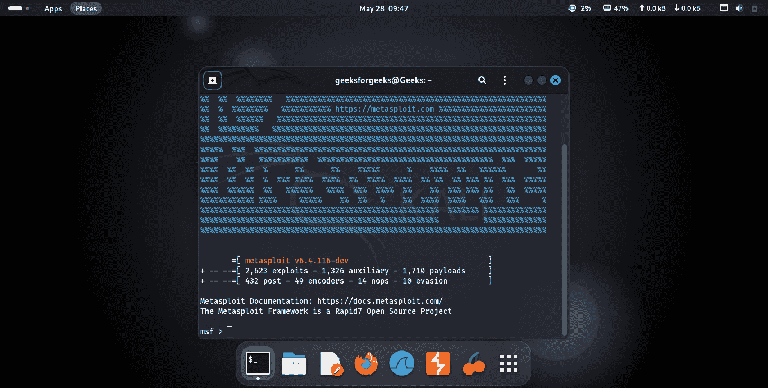
Use of Metasploit: Metasploit comes pre-installed in Kali Linux. Open the terminal and run
msfconsoleOutput:
Example:
msfconsole
search smb
use exploit/windows/smb/ms17_010_eternalblue
show options
set RHOSTS <target-ip>
run
Output:
2. BeEF (Browser Exploitation Framework)
BeEF (Browser Exploitation Framework) is a specialized penetration testing framework focused on web browser exploitation. Unlike traditional exploitation tools that target servers or operating systems, BeEF targets the browser as the attack surface. It allows penetration testers to evaluate client-side security risks by interacting with hooked browsers in controlled testing environments.
- Browser-focused attack simulation.
- Client-side security testing.
- Web session interaction.
- Command execution modules.
- Integration with other testing workflows.
Use of BeEF: Launch BeEF from the terminal. After startup, access the management interface through the browser.
beef-xssOutput:
3. Armitage
Armitage is a graphical cybersecurity tool built for the Metasploit Framework. It provides a visual interface that simplifies exploitation tasks, target management and collaborative red-team operations. For users who prefer graphical environments over command-line workflows, Armitage can make exploit management easier.
- Graphical user interface for Metasploit.
- Network visualization.
- Exploit recommendations.
- Team collaboration support.
- Target management dashboard.
Use of Armitage: Start Armitage using
armitageOutput:
4. SQLMap
SQLMap is a powerful open-source tool used to automate SQL Injection testing and exploitation. It helps security testers identify injectable parameters and perform database assessment tasks with minimal manual effort. SQLMap supports multiple database technologies including: MySQL, PostgreSQL, Oracle, Microsoft SQL Server, SQLite.
- Database fingerprinting.
- Database enumeration.
- Data extraction capabilities.
- Broad database support.
Use of SQLMap: Basic syntax
sqlmap -u "http://target-site.com/page?id=1"Output:
5. Aircrack-ng
Aircrack-ng is a popular wireless security auditing suite used for Wi-Fi security testing. It includes tools for: Packet capture, Network monitoring, Wireless analysis, WEP/WPA/WPA2 testing, Password auditing.
- Wireless packet analysis.
- Handshake capture support.
- Password auditing capabilities.
- Multiple wireless protocol support.
- Network monitoring tools.
Use of Aircrack-ng: Launch the tool
aircrack-ngOutput:
Choosing the Right Kali Linux Exploitation Tool
Different tools serve different security testing needs. Selecting the right tool depends on the target environment, testing objectives and assessment scope.
- Metasploit: Vulnerability exploitation and penetration testing
- BeEF: Browser and client-side testing
- Armitage: GUI-based Metasploit management
- SQLMap: SQL injection automation
- Aircrack-ng: Wireless security auditing
Best Practices
- Perform testing only with proper authorization.
- Use isolated lab environments for practice.
- Keep tools updated regularly.
- Document findings during assessments.
- Validate vulnerabilities responsibly.
