

Real-time operating systems (RTOS) are used in environments where a large number of events, mostly external to the computer system, must be accepted and processed in a short time or within certain deadlines. Such applications are industrial control, telephone switching equipment, flight control, and real-time simulations.
- Designed to respond to tasks quickly and predictably.
- Ensures tasks are completed within a fixed time limit (deadline).
- Used in systems where timing is critical (e.g., robots, medical devices, cars).
- Supports multitasking with precise scheduling.
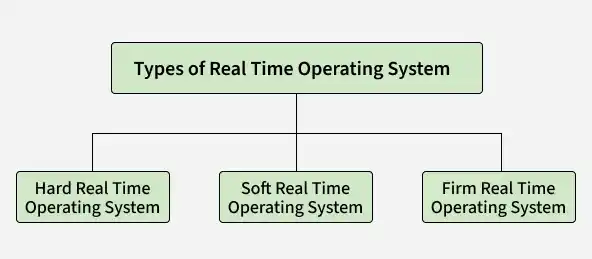
Types of Real-Time Operating System
The real-time operating systems can be of 3 types:
1. Hard Real-Time OS
- Deadlines must be met; missing one can cause system failure.
- Examples: Industrial control, medical systems, robots, air traffic control.
2. Soft Real-Time OS
- Deadlines are desirable, but occasional delays are acceptable and mainly reduce performance/quality.
- Examples: Digital audio, video streaming, multimedia systems.
3. Firm Real-Time OS
- Deadlines are important, but an occasional missed deadline makes the result useless rather than catastrophic.
- Examples: Multimedia applications, some transaction systems.
Purpose of RTOS
- Ensures time-sensitive tasks are completed within strict deadlines.
- Provides predictable and reliable system responses.
- Manages multiple tasks efficiently with priority-based scheduling.
- Ensures efficient use of CPU, memory, and other resources.
- Provides fast and reliable hardware control.
- Maintains system performance under heavy workloads.
Advantages
- Maximum Consumption: Maximum utilization of devices and systems. Thus more output from all the resources.
- Task Shifting: Time assigned for shifting tasks in these systems is very less. For example, in older systems, it takes about 10 microseconds. Shifting one task to another and in the latest systems, it takes 3 microseconds.
- Focus On Application: Focus on running applications and less importance to applications that are in the queue.
- Real-Time Operating System In Embedded System: Since the size of programs is small, RTOS can also be embedded systems like in transport and others.
- Error Free: These types of systems are error-free.
- Memory Allocation: Memory allocation is best managed in these types of systems.
Disadvantages
- Limited Tasks: Very few tasks run simultaneously, and their concentration is very less on few applications to avoid errors.
- Use Heavy System Resources: Sometimes the system resources are not so good and they are expensive as well.
- Complex Algorithms : The algorithms are very complex and difficult for the designer to write on.
- Device Driver And Interrupt Signals: It needs specific device drivers and interrupts signals to respond earliest to interrupts.
- Thread Priority: It is not good to set thread priority as these systems are very less prone to switching tasks.
- Minimum Switching: RTOS performs minimal task switching.
