

A Common Table Expression (CTE) is a temporary result set in SQL that you can reference within a single query. CTEs simplify complex queries, make them easier to read and can be reused multiple times within the same query. It is used for:
- Performing recursive operations, such as traversing hierarchical data.
- Breaking down multi-step calculations into manageable parts.
- Replacing nested subqueries in complex data retrieval tasks.
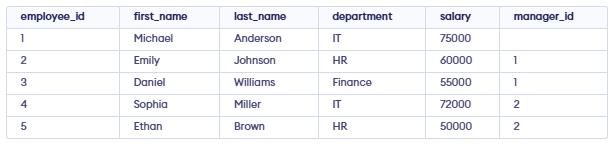
Consider an employees table containing employee details such as employee_id, name, department, salary and manager_id. We will use this table to demonstrate Common Table Expression (CTE) examples.
This table represents the hierarchical structure of employees within an organization, based on a recursive CTE query.
Example: Calculate Average salary by department
This example uses a CTE to find the average salary of each department, making the query simpler and easier to read.
Query:
WITH avg_salary_by_dept AS (
    SELECT department, AVG(salary) AS avg_salary
    FROM employees
    GROUP BY department
)
SELECT *
FROM avg_salary_by_dept;
Output:

- The WITH clause defines a CTE named avg_salary_by_dept.
- The main query references this CTE to retrieve the average salary for each department.
Syntax
WITH cte_name AS (
    SELECT query
)
SELECT *
FROM cte_name;
- cte_name: A unique name for the CTE expression.
- query: A valid SQL query that returns a result set, which will be treated as a virtual table within the main query.
- SELECT: The main query that can reference the CTE by its name.
Recursive Common Table Expression
A recursive CTE references itself to retrieve hierarchical data, such as employee-manager relationships. Use MAXRECURSION to prevent infinite loops. It consist of two parts:
- Anchor member: The initial query that selects the base case (e.g., top-level managers).
- Recursive member: The query that references the CTE itself, pulling the next level of data.
Example: Hierarchical Employee Data
WITH RECURSIVE cte_reports
(employee_id, first_name, last_name, manager_id, emp_level) AS (
    SELECT employee_id, first_name, last_name, manager_id, 1
    FROM employees
    WHERE manager_id IS NULL

    UNION ALL

    SELECT e.employee_id, e.first_name, e.last_name,
           e.manager_id, r.emp_level + 1
    FROM employees e
    INNER JOIN cte_reports r
        ON e.manager_id = r.employee_id
)
SELECT first_name || ' ' || last_name AS full_name,
       emp_level,
       (
           SELECT first_name || ' ' || last_name
           FROM employees
           WHERE employee_id = cte_reports.manager_id
       ) AS manager
FROM cte_reports
ORDER BY emp_level, manager_id;
Output:
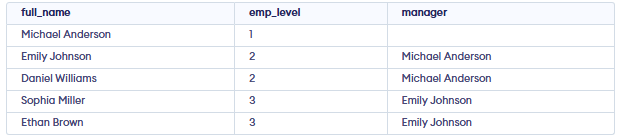
- Michael Anderson is at Level 1 with no manager.
- Emily Johnson and Daniel Williams are at Level 2 reporting to him.
- Sophia Miller and Ethan Brown are at Level 3 reporting to Emily Johnson.
Uses of CTEs
CTEs (Common Table Expressions) help simplify and organize complex SQL queries.
- Breaks complex queries into small, reusable parts.
- Makes queries easier to read and understand.
- Helps work with hierarchical data using recursion.
Limitations
While useful, CTEs come with a few practical constraints.
- Temporary: A CTE works only while the query runs, then it disappears.
- Performance: On very large data, CTEs can be slower if reused many times.
- Restrictions: Some databases limit using CTEs with INSERT, UPDATE or DELETE.
CTE vs. Subqueries
| CTE | Subquery |
|---|---|
| Can be referenced multiple times. | Typically used once. |
| Improves readability for complex queries. | Can become difficult to read when nested. |
| Optimized for multiple references. | May be less efficient for repeated operations. |
