
Hainite-(Y)
A valid IMA mineral species - grandfathered
This page is currently not sponsored. Click here to sponsor this page.

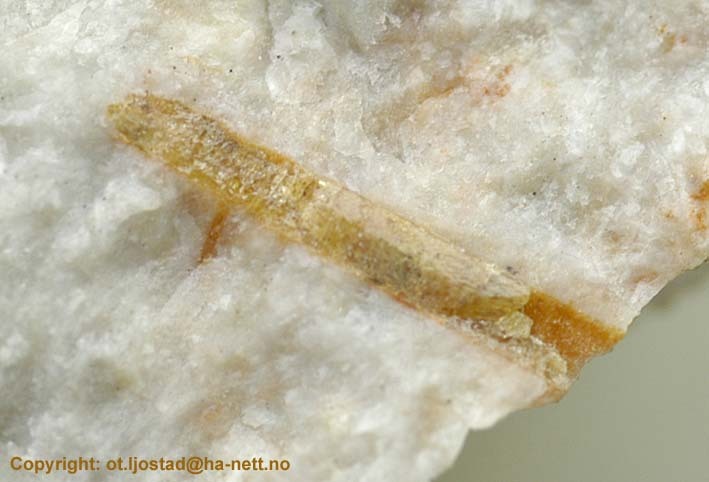


About Hainite-(Y)
Formula:
Na2Ca4(Y,REE)Ti(Si2O7)2OF3
Colour:
Wine-yellow, honey-yellow; milk white, brownish, pale pink
Lustre:
Adamantine, Vitreous
Hardness:
5
Specific Gravity:
3.157-3.274 (Calculated)
Crystal System:
Triclinic
Member of:
Name:
For the type locality, (Hohe) Hain Mountain, plus the "-(Y)" suffix due to the dominance of yttrium in the composition. It was first described by Josef Blumrich in 1893 under the name hainite [hainit]. The name was changed by IMA in 2016 to hainite-(Y) (IMA 16-A).
Chemically close to fogoite-(Y).
Long regarded as a doubtful species, said to be related to rosenbuschite, but an independent species after all (Christiansen et al., 2003). The crystal structure of the type material has been determined by Giester et al. (2005).
Long regarded as a doubtful species, said to be related to rosenbuschite, but an independent species after all (Christiansen et al., 2003). The crystal structure of the type material has been determined by Giester et al. (2005).
Unique Identifiers
Mindat ID:
1798
Long-form identifier:
mindat:1:1:1798:1
Similar Names
| Hauynit | A synonym of 'Haüynite' | |
| Hauynita | A synonym of Haüyne | |
| Hayyanite | A valid IMA mineral species - pending publication | Cu5Ag11Pb76Sb71As17(As2+)8S224 |
| Huenite | A valid IMA mineral species | Cu4(MoO4)3(OH)2 |
| Kainite | A valid IMA mineral species - grandfathered | KMg(SO4)Cl · 3H2O |
| Painite | A valid IMA mineral species - grandfathered | CaZrAl9(BO3)O15 |
IMA Classification of Hainite-(Y)
Approved, 'Grandfathered' (first described prior to 1959)
IMA status notes:
Redefined by the IMA, Renamed by the IMA
IMA Formula:
Ca2(CaY)Na(NaCa)Ti4+(Si2O7)2(OF)F2
First published:
1893
Approval history:
2016: Redefined. Name changed from hainite to hainite-(Y) (IMA 16-A).
Classification of Hainite-(Y)
9.BE.22
9 : SILICATES (Germanates)
B : Sorosilicates
E : Si2O7 groups, with additional anions; cations in octahedral [6] and greater coordination
9 : SILICATES (Germanates)
B : Sorosilicates
E : Si2O7 groups, with additional anions; cations in octahedral [6] and greater coordination
56.2.4.9
56 : SOROSILICATES Si2O7 Groups, With Additional O, OH, F and H2O
2 : Si2O7 Groups and O, OH, F, and H2O with cations in [4] and/or >[4] coordination
56 : SOROSILICATES Si2O7 Groups, With Additional O, OH, F and H2O
2 : Si2O7 Groups and O, OH, F, and H2O with cations in [4] and/or >[4] coordination
Mineral Symbols
As of 2021 there are now IMA–CNMNC approved mineral symbols (abbreviations) for each mineral species, useful for tables and diagrams.
| Symbol | Source | Reference for Standard |
|---|---|---|
| Hai-Y | IMA–CNMNC | Warr, L.N. (2021). IMA–CNMNC approved mineral symbols. Mineralogical Magazine, 85(3), 291-320. doi:10.1180/mgm.2021.43 |
Physical Properties of Hainite-(Y)
Adamantine, Vitreous
Transparency:
Transparent
Colour:
Wine-yellow, honey-yellow; milk white, brownish, pale pink
Comment:
Light wine-yellow in thin section. Altered hainite-(Y9 shows a brown colour
Streak:
White
Hardness:
5 on Mohs scale
Tenacity:
Brittle
Cleavage:
Perfect
Rather perfect, {010}; also faint on {100}
Rather perfect, {010}; also faint on {100}
Fracture:
Irregular/Uneven
Density:
3.157-3.274(17) g/cm3 (Calculated)
Optical Data of Hainite-(Y)
Type:
Biaxial (+)
RI values:
nα = 1.663(2) nβ = 1.664(2) nγ = 1.675(2)
2V:
Measured: 30° to 45°, Calculated: 33.7°
Birefringence:
~0.012
Max. Birefringence:
δ = 0.012
Based on recorded range of RI values above.
Based on recorded range of RI values above.
Interference Colours:
The colours simulate birefringence patterns seen in thin section under crossed polars. They do not take into account mineral colouration or opacity.
Michel-Levy Bar The default colours simulate the birefringence range for a 30 µm thin-section thickness. Adjust the slider to simulate a different thickness.
Grain Simulation You can rotate the grain simulation to show how this range might look as you rotated a sample under crossed polars. Each grain retains its interference colour (retardation) while its brightness falls to black at extinction and reaches a maximum between extinction positions.
The colours simulate birefringence patterns seen in thin section under crossed polars. They do not take into account mineral colouration or opacity.
Michel-Levy Bar The default colours simulate the birefringence range for a 30 µm thin-section thickness. Adjust the slider to simulate a different thickness.
Grain Simulation You can rotate the grain simulation to show how this range might look as you rotated a sample under crossed polars. Each grain retains its interference colour (retardation) while its brightness falls to black at extinction and reaches a maximum between extinction positions.
Surface Relief:
Moderate
Dispersion:
relatively strong (r > v)
Pleochroism:
Visible
Comments:
colorless (X), colorless to pale yellow (Y), wine-yellow (Z)
Comments:
2V(meas.): large
Chemistry of Hainite-(Y)
Mindat Formula:
Na2Ca4(Y,REE)Ti(Si2O7)2OF3
Element Weights:
Common Impurities:
Mn,Ce,La,Fe,Nb,Ta,Al
Chemical Analysis
Oxide wt%:
| 1 | |
|---|---|
| SiO2 | 30.50 % |
| Al2O3 | 0.05 % |
| TiO2 | 8.16 % |
| ZrO2 | 3.96 % |
| HfO2 | 0.08 % |
| Nb2O5 | 1.23 % |
| Ta2O5 | 0.03 % |
| MnO | 0.73 % |
| FeO | 0.69 % |
| CaO | 29.64 % |
| SrO | 0.08 % |
| Na2O | 7.45 % |
| Y2O3 | 4.35 % |
| La2O3 | 0.63 % |
| Ce2O3 | 1.67 % |
| Nd2O3 | 0.71 % |
| Gd2O3 | 0.20 % |
| Dy2O3 | 0.98 % |
| Er2O3 | 0.59 % |
| Yb2O3 | 0.74 % |
| F | 7.81 % |
| O=F | -3.29 % |
| Total: | 96.99 % |
Crystallography of Hainite-(Y)
Crystal System:
Triclinic
Class (H-M):
1 - Pinacoidal
Space Group:
P1
Cell Parameters:
a = 9.594 Å, b = 5.702 Å, c = 7.288 Å
α = 89.89(4)°, β = 101.09(4)°, γ = 101.17(4)°
α = 89.89(4)°, β = 101.09(4)°, γ = 101.17(4)°
Ratio:
a:b:c = 1.683 : 1 : 1.278
Unit Cell V:
383.55 ų
Z:
1
Twinning:
on {100}
Comment:
parameters of the TL material: a=5.676(2), b=7.259(3), c=9.586(3), α=101.08(4), β=101.14(4), γ=90.27(4)
X-Ray Powder Diffraction
Powder Diffraction Data:
| d-spacing | Intensity |
|---|---|
| 2.961 Å | (100) |
| 3.073 Å | (90) |
| 1.896 Å | (70) |
| 3.961 Å | (50) |
| 2.628 Å | (50) |
| 2.493 Å | (50) |
| 1.822 Å | (50) |
Comments:
TL material
Geological Environment
Paragenetic Mode(s):
| Paragenetic Mode | Earliest Age (Ga) |
|---|---|
| Stage 4b: Highly evolved igneous rocks | >3.0 |
| 35 : Ultra-alkali and agpaitic igneous rocks |
Type Occurrence of Hainite-(Y)
General Appearance of Type Material:
Crystals, less than 1 mm, needles and plates, [001] elongation; {010}, {100}, and {_110} faces present (TL material)
Geological Setting of Type Material:
Cavities and groundmass of phonolites (TL material); carbonatites
Associated Minerals at Type Locality:
Synonyms of Hainite-(Y)
Other Language Names for Hainite-(Y)
Relationship of Hainite-(Y) to other Species
Member of:
Other Members of Rinkite Group:
| Batievaite-(Y) | Y2Ca2Ti(Si2O7)2(OH)2(H2O)4 | Tric. 1 : P1 |
| Bortolanite | Ca2(Ca1.5Zr0.5)Na(NaCa)Ti(Si2O7)2(OF)F2 | Tric. 1 : P1 |
| Fogoite-(Y) | Na3Ca2Y2Ti(Si2O7)2OF3 | Tric. 1 : P1 |
| Götzenite | NaCa6Ti(Si2O7)2OF3 | Tric. 1 : P1 |
| Grenmarite | Na4MnZr3(Si2O7)2O2F2 | Mon. 2/m : P2/b |
| Kochite | Na3Ca2MnZrTi(Si2O7)2OF3 | Tric. 1 : P1 |
| Mosandrite-(Ce) | (Ca3REE)[(H2O)2Ca0.5◻0.5]Ti(Si2O7)2(OH)2(H2O)2 | Mon. 2/m : P21/b |
| Nacareniobsite-(Ce) | Na3Ca3(Ce,REE)Nb(Si2O7)2OF3 | Mon. 2/m : P21/b |
| Nacareniobsite-(Y) | Na3Ca3YNb(Si2O7)2OF3 | Mon. 2/m : P21/b |
| Rinkite-(Ce) | (Ca3Ce)Na(NaCa)Ti(Si2O7)2(OF)F2 | Mon. 2/m : P21/b |
| Rinkite-(Y) | Na2Ca4YTi(Si2O7)2OF3 | Mon. 2/m : P21/b |
| Rosenbuschite | Na6Ca6Zr3Ti(Si2O7)4O2F6 | Tric. 1 : P1 |
| Roumaite | (Ca,Na,REE,◻)7(Nb,Ti)[Si2O7]2OF3 | Mon. m : Bb |
| Seidozerite | Na4MnZr2Ti(Si2O7)2O2F2 | Mon. 2/m : P2/b |
| 'Unnamed (Ca-deficient Mosandrite)' | (Ca1.2REE0.9Th0.1Zn0.1Al0.1Na0.2K0.1)((H2O)2◻)(Ti,Nb)(Si2O7)2(OH,F,Cl)2(H2O)2 |
Common Associates
Associations Based on Photo Data:
| 5 photos of Hainite-(Y) associated with Tuperssuatsiaite | Fe3+Fe3+2(Na◻)◻2Si8O20(OH)2(H2O)4 · 2H2O |
| 3 photos of Hainite-(Y) associated with Microcline | K(AlSi3O8) |
| 2 photos of Hainite-(Y) associated with Villiaumite | NaF |
| 2 photos of Hainite-(Y) associated with Makatite | Na2Si4O8(OH)2 · 4H2O |
| 2 photos of Hainite-(Y) associated with Fluorapophyllite-(K) | KCa4(Si8O20)(F,OH) · 8H2O |
| 1 photo of Hainite-(Y) associated with K Feldspar | |
| 1 photo of Hainite-(Y) associated with Götzenite | NaCa6Ti(Si2O7)2OF3 |
| 1 photo of Hainite-(Y) associated with Gaidonnayite | Na2Zr(Si3O9) · 2H2O |
| 1 photo of Hainite-(Y) associated with Calcite | CaCO3 |
| 1 photo of Hainite-(Y) associated with Feldspar Group |
Related Minerals - Strunz-mindat Grouping
| 9.BE. | Zinkgruvanite | Ba4Mn2+4Fe3+2(Si2O7)2(SO4)2O2(OH)2 |
| 9.BE. | Calciomurmanite | (Na,◻)2Ca(Ti,Mg,Nb)4[Si2O7]2O2(OH,O)2(H2O)4 |
| 9.BE. | Cámaraite | Ba3Na(Fe2+,Mn)8Ti4(Si2O7)4O4(OH,F)7 |
| 9.BE. | Alfredcasparite | Sr2TiO(Si2O7) |
| 9.BE. | Batievaite-(Y) | Y2Ca2Ti(Si2O7)2(OH)2(H2O)4 |
| 9.BE. | Nacareniobsite-(Y) | Na3Ca3YNb(Si2O7)2OF3 |
| 9.BE. | Alexkuznetsovite-(Ce) | Ce2Mn(CO3)(Si2O7) |
| 9.BE. | Bobshannonite | Na2KBa(Mn,Na)8(Nb,Ti)4(Si2O7)4O4(OH)4(O,F)2 |
| 9.BE. | Paralomonosovite | Na6◻4Ti4(Si2O7)2[PO3OH][PO2(OH)2]O2(OF) |
| 9.BE. | Madeiraite | Na2Ca2Fe2Zr2(Si2O7)2O2F2 |
| 9.BE. | Bortolanite | Ca2(Ca1.5Zr0.5)Na(NaCa)Ti(Si2O7)2(OF)F2 |
| 9.BE. | Longshoushanite-(Ce) | Ce4MgAl2Ti2(Si2O7)2O8 |
| 9.BE. | Moxuanxueite | NaCa6Zr(Si2O7)2OF3 |
| 9.BE. | Delhuyarite-(Ce) | Ce4Mg(Fe3+,W)3◻(Si2O7)2O6(OH)2 |
| 9.BE. | Christofschäferite-(Ce) | Ce3CaMnTiFe3+Ti2(Si2O7)2O8 |
| 9.BE.X | Asimowite | Fe2+4O(Si2O7) |
| 9.BE. | Biraite-(La) | La2Fe2+(CO3)(Si2O7) |
| 9.BE. | Pilanesbergite | Na2Ca2Fe2Ti2(Si2O7)2O2F2 |
| 9.BE.02 | Wadsleyite | Mg4O(Si2O7) |
| 9.BE.02 | Ohtaniite | Mg3(Si0.5◻0.5)Si2O8 |
| 9.BE.05 | Lawsonite | CaAl2(Si2O7)(OH)2 · H2O |
| 9.BE.05 | Hennomartinite | SrMn3+2(Si2O7)(OH)2 · H2O |
| 9.BE.05 | Cortesognoite | CaV2(Si2O7)(OH)2 · H2O |
| 9.BE.05 | Noelbensonite | BaMn3+2(Si2O7)(OH)2 · H2O |
| 9.BE.05 | Itoigawaite | SrAl2(Si2O7)(OH)2 · H2O |
| 9.BE.07 | Ilvaite | CaFe3+Fe2+2(Si2O7)O(OH) |
| 9.BE.07 | Amamoorite | CaMn2+2Mn3+(Si2O7)O(OH) |
| 9.BE.07 | Manganilvaite | CaFe2+Fe3+Mn2+(Si2O7)O(OH) |
| 9.BE.10 | Suolunite | Ca2(H2Si2O7) · H2O |
| 9.BE.12 | Jaffeite | Ca6(Si2O7)(OH)6 |
| 9.BE.15 | Fresnoite | Ba2Ti(Si2O7)O |
| 9.BE.17 | Janhaugite | (Na,Ca)3(Mn2+,Fe2+)3(Ti,Zr,Nb)2(Si2O7)2O2(OH,F)2 |
| 9.BE.17 | Burpalite | Na2CaZr(Si2O7)F2 |
| 9.BE.17 | Niocalite | (Ca,Nb)4(Si2O7)(O,OH,F)2 |
| 9.BE.17 | Normandite | NaCa(Mn,Fe)(Ti,Nb,Zr)(Si2O7)OF |
| 9.BE.17 | Hiortdahlite | Na2Ca4(Ca0.5Zr0.5)Zr(Si2O7)2OF3 |
| 9.BE.17 | Låvenite | Na2Ca2Mn2Zr2(Si2O7)2O2F2 |
| 9.BE.17 | Cuspidine | Ca8(Si2O7)2F4 |
| 9.BE.17 | Wöhlerite | Na2Ca4ZrNb(Si2O7)2O3F |
| 9.BE.17 | Baghdadite | Ca6Zr2(Si2O7)2O4 |
| 9.BE.20 | Nacareniobsite-(Ce) | Na3Ca3(Ce,REE)Nb(Si2O7)2OF3 |
| 9.BE.20 | Roumaite | (Ca,Na,REE,◻)7(Nb,Ti)[Si2O7]2OF3 |
| 9.BE.20 | Rinkite-(Ce) | (Ca3Ce)Na(NaCa)Ti(Si2O7)2(OF)F2 |
| 9.BE.20 | Nacareniobsite-(Nd) | Ca2(CaNd)Na3Nb(Si2O7)2(OF)F2 |
| 9.BE.20 | Rinkite-(Y) | Na2Ca4YTi(Si2O7)2OF3 |
| 9.BE.20 | Mosandrite-(Ce) | (Ca3REE)[(H2O)2Ca0.5◻0.5]Ti(Si2O7)2(OH)2(H2O)2 |
| 9.BE.22 | Rosenbuschite | Na6Ca6Zr3Ti(Si2O7)4O2F6 |
| 9.BE.22 | Götzenite | NaCa6Ti(Si2O7)2OF3 |
| 9.BE.22 | Fogoite-(Y) | Na3Ca2Y2Ti(Si2O7)2OF3 |
| 9.BE.22 | Kochite | Na3Ca2MnZrTi(Si2O7)2OF3 |
| 9.BE.23 | Dovyrenite | Ca6Zr(Si2O7)2(OH)4 |
| 9.BE.25 | Lamprophyllite | (Na,Mn2+)3(Sr,Na)2(Ti,Fe3+)3(Si2O7)2O2(OH,O,F)2 |
| 9.BE.25 | Seidozerite | Na4MnZr2Ti(Si2O7)2O2F2 |
| 9.BE.25 | Nabalamprophyllite | (BaNa)Ti2Na3Ti(Si2O7)2O2(OH)2 |
| 9.BE.25 | Schüllerite | Ba2Na(Mn,Ca)(Fe3+,Mg,Fe2+)2Ti2(Si2O7)2(O,F)4 |
| 9.BE.25 | Ericssonite | BaMn2+2Fe3+(Si2O7)O(OH) |
| 9.BE.25 | Grenmarite | Na4MnZr3(Si2O7)2O2F2 |
| 9.BE.25 | Kazanskyite | BaNa3Ti2Nb(Si2O7)2O2(OH)2(H2O)4 |
| 9.BE.25 | Saamite | Ba◻Na3Ti2Nb(Si2O7)2O2(OH)F(H2O)2 |
| 9.BE.25 | Emmerichite | Ba2Na(Na,Fe2+)2(Fe3+,Mg)Ti2(Si2O7)2O2F2 |
| 9.BE.25 | Barytolamprophyllite | (Ba,Na)2(Na,Ti,Fe3+)4Ti2(Si2O7)2O(OH,F) |
| 9.BE.25 | 'Ericssonite-2O' | BaMn2+2Fe3+(Si2O7)O(OH) |
| 9.BE.25 | Fluorbarytolamprophyllite | (Ba,Sr)2[(Na,Fe2+)3(Ti,Mg)F2][Ti2(Si2O7)2O2] |
| 9.BE.25 | Fluorlamprophyllite | Na3(SrNa)Ti3(Si2O7)2O2F2 |
| 9.BE.25 | Lileyite | Ba2(Na,Fe,Ca)3MgTi2(Si2O7)2O2F2 |
| 9.BE.27 | Kolskyite | CaNa2Ti4(Si2O7)2O4(H2O)7 |
| 9.BE.27 | Vigrishinite | NaZnTi4(Si2O7)2O3(OH)(H2O)4 |
| 9.BE.27 | Selivanovaite | NaFe3+Ti4(Si2O7)2O4(H2O)4 |
| 9.BE.27 | Murmanite | Na2Ti2(Si2O7)O2 · 2H2O |
| 9.BE.30 | Epistolite | (Na◻)Nb2Na3Ti(Si2O7)2O2(OH)2(H2O)4 |
| 9.BE.32 | Lomonosovite | Na5Ti2(Si2O7)(PO4)O2 |
| 9.BE.35 | Vuonnemite | Na11Ti4+Nb2(Si2O7)2(PO4)2O3(F,OH) |
| 9.BE.37 | Sobolevite | Na13Ca2Mn2Ti3(Si2O7)2(PO4)4O3F3 |
| 9.BE.40 | Ferroinnelite | Ba4Ti2Na(NaFe2+)Ti(Si2O7)2[(SO4)(PO4)]O2[O(OH)] |
| 9.BE.40 | Phosphoinnelite | Na3Ba4Ti3(Si2O7)2(PO4,SO4)2O2F |
| 9.BE.40 | Innelite | Ba4Ti2Na(NaMn2+)Ti(Si2O7)2[(SO4)(PO4)]O2[O(OH)] |
| 9.BE.42 | Yoshimuraite | Ba2Mn2Ti(Si2O7)(PO4)O(OH) |
| 9.BE.42 | Horiite | Ba2Mn2Mn4Ti2(Si2O7)2(PO4)2O2(OH)2 |
| 9.BE.45 | Quadruphite | Na6Na2(CaNa)2Na2Ti2Na2Ti2(Si2O7)2(PO4)4O4F2 |
| 9.BE.47 | Polyphite | Na5(Na4Ca2)Ti2(Si2O7)(PO4)3O2F2 |
| 9.BE.50 | Shkatulkalite | Na2Nb2Na3Ti(Si2O7)2O2(FO)(H2O)4(H2O)3 |
| 9.BE.50 | Bornemanite | Na6BaTi2Nb(Si2O7)2(PO4)O2(OH)F |
| 9.BE.55 | Hejtmanite | Ba2Mn2+4Ti2(Si2O7)2O2(OH)2F2 |
| 9.BE.55 | Bykovaite | (Ba,Na,K)2(Na,Ti,Mn)4(Ti,Nb)2(Si2O7)2O2(H2O,F,OH)2 · 3.5H2O |
| 9.BE.55 | Nechelyustovite | (Ba,Sr,K)2(Na,Ti,Mn)4(Ti,Nb)2(Si2O7)2O2(O,H2O,F)2 · 4.5H2O |
| 9.BE.55 | Bafertisite | Ba2Fe2+4Ti2(Si2O7)2O2(OH)2F2 |
| 9.BE.60 | Delindeite | (Na,K)2(Ba,Ca)2(Ti,Fe,Al)3(Si2O7)2O2(OH)2 · 2H2O |
| 9.BE.62 | 'Orthochevkinite' | (Ce,La,Ca,Na,Th)4(Fe2+,Mg)2(Ti,Fe3+)3Si4O22 |
| 9.BE.62 va | 'Strontium Perrierite' | (Ce,Sr,La,Ca)4Fe2+(Ti,Zr,Fe)2Ti2(Si2O7)2O8 |
| 9.BE.62 | 'Chevkinite-(Nd)' | (Nd,REE)4(Fe2+,Mg)(Fe2+,Ti,Fe3+)2(Ti,Fe3+)2(Si2O7)2O8 ? |
| 9.BE.62 | 'Perrierite-(Nd)' | Nd4MgFe3+2Ti2(Si2O7)2O8 ? |
| 9.BE.65 | Bussenite | Na2Ba2Fe2+Ti(Si2O7)(CO3)(OH)3F |
| 9.BE.67 | Jinshajiangite | BaNaFe2+4Ti2(Si2O7)2O2(OH)2F |
| 9.BE.67 | Perraultite | BaNaMn2+4Ti2(Si2O7)2O2(OH)2F |
| 9.BE.70 | Dingdaohengite-(Ce) | (Ce,La)4Fe2+(Ti,Fe2+,Mg,Fe3+)2Ti2(Si2O7)2O8 |
| 9.BE.70 | Perrierite-(Ce) | Ce4MgFe3+2Ti2(Si2O7)2O8 |
| 9.BE.70 | Karnasurtite-(Ce) | (Ce,La,Th)(Ti,Nb)(Al,Fe)(Si2O7)(OH)4 · 3H2O |
| 9.BE.70 | Maoniupingite-(Ce) | (Ce,Ca)4(Fe3+,Ti,Fe2+,◻)(Ti,Fe3+,Fe2+,Nb)4(Si2O7)2O8 |
| 9.BE.70 | Matsubaraite | Sr4Ti5(Si2O7)2O8 |
| 9.BE.70 | Rengeite | Sr4ZrTi4(Si2O7)2O8 |
| 9.BE.70 | Polyakovite-(Ce) | (Ce,Ca)4(Mg,Fe2+)(Cr3+,Fe3+)2(Ti,Nb)2(Si2O7)2O8 |
| 9.BE.70 | Hezuolinite | (Sr,REE)4Zr(Ti,Fe3+)4(Si2O7)2O8 |
| 9.BE.70 | 'UM2008-53-SiO:SrTiZr' | Sr4ZrTi4(Si2O7)2O8 |
| 9.BE.70 | Chevkinite-(Ce) | Ce4(Ti,Fe2+,Fe3+)5O8(Si2O7)2 |
| 9.BE.70 | Perrierite-(La) | (La,Ce,Ca)4(Fe2+,Mn)(Ti,Fe3+,Al)4[(Si2O7)O4]2 |
| 9.BE.70 | Strontiochevkinite | (Sr,La,Ce,Ca)4Fe2+(Ti,Zr)2Ti2(Si2O7)2O8 |
| 9.BE.72 | Fersmanite | Ca4(Na,Ca)4(Ti,Nb)4(Si2O7)2O8F3 |
| 9.BE.75 | Belkovite | Ba3(Nb,Ti)6(Si2O7)2O12 |
| 9.BE.77 | Nasonite | Pb6Ca4(Si2O7)3Cl2 |
| 9.BE.80 | Melanotekite | Pb2Fe3+2(Si2O7)O2 |
| 9.BE.80 | Kentrolite | Pb2Mn3+2(Si2O7)O2 |
| 9.BE.82 | Alexkuznetsovite-(La) | La2Mn(CO3)(Si2O7) |
| 9.BE.82 | Tilleyite | Ca5(Si2O7)(CO3)2 |
| 9.BE.85 | Killalaite | Ca6.4(H0.6Si2O7)2(OH)2 |
| 9.BE.87 | Stavelotite-(La) | (La,Nd,Ca)3Mn2+3Cu(Mn3+,Fe3+,Mn4+)26(Si2O7)6O30 |
| 9.BE.90 | Magnesiorowlandite-(Y) | Y4(Mg,Fe)(Si2O7)2F2 |
| 9.BE.90 | Biraite-(Ce) | Ce2Fe2+(Si2O7)(CO3) |
| 9.BE.92 | Cervandonite-(Ce) | (Ce,Nd,La)(Fe3+,Fe2+,Ti,Al)3O2(Si2O7)(As3+O3)(OH) |
| 9.BE.92 | Chirvinskyite | (Na,Ca)13(Fe,Mn,◻)2(Ti,Zr)5(Si2O7)4(OH,O)12 · 2H2O |
| 9.BE.95 | Rusinovite | Ca10(Si2O7)3Cl2 |
| 9.BE.95 | Batisivite | BaV3+8Ti6(Si2O7)O22 |
| 9.BE.97 | Schlüterite-(Y) | (Y,REE)2AlSi2O7(OH)2F |
Other Information
Notes:
Fluoresces under electron beam.
Health Risks:
No information on health risks for this material has been entered into the database. You should always treat mineral specimens with care.
Internet Links for Hainite-(Y)
mindat.org URL:
https://www.mindat.org/min-1798.html
Please feel free to link to this page.
Please feel free to link to this page.
Search Engines:
External Links:
Mineral Dealers:
References for Hainite-(Y)
Reference List:
Atencio, D., Coutinho, J. M. C., Ulbrich, M. N. C., Vlach, S. R. F., Rastvetaeva, R. K., Pushcharovsky, D. Yu. (1999) Hainite from Poços de Caldas, Minas Gerais, Brazil. The Canadian Mineralogist, 37 (1) 91-98
Christiansen, C. C., Johnsen, O., Makovicky, E. (2003) Crystal chemistry of the rosenbuschite group. The Canadian Mineralogist, 41 (5) 1203-1224 doi:10.2113/gscanmin.41.5.1203
Sokolova, E. (2006) From structure topology to chemical composition. I. Structural hierarchy and stereochemistry in titanium disilicate minerals. The Canadian Mineralogist, 44 (6) 1273-1330 doi:10.2113/gscanmin.44.6.1273
Lyalina, L., Zolotarev, A., Selivanova, E., Savchenko, Ye., Zozulya, D., Krivovichev, S., Mikhailova, Yu. (2015) Structural characterization and composition of Y-rich hainite from Sakharjok nepheline syenite pegmatite (Kola Peninsula, Russia) Mineralogy and Petrology, 109 (4) 443-451 doi:10.1007/s00710-015-0377-3
Anthony, John W., Bideaux, Richard A., Bladh, Kenneth W., Nichols, Monte C. - Eds. (2016) Handbook of Mineralogy. https://www.handbookofmineralogy.org/
Sokolova, E.; Cámara, F. (2017) The seidozerite supergroup of TS-block minerals: nomenclature and classification, with change of the following names: rinkite to rinkite-(Ce), mosandrite to mosandrite-(Ce), hainite to hainite-(Y) and innelite-1T to innelite-1A. Mineralogical Magazine, 81 (6). p.1457-1484. doi:10.1180/minmag.2017.081.010
Localities for Hainite-(Y)
Showing 16 localities.
 symbol to view information about a locality.
The
symbol to view information about a locality.
The Locality List
 - This locality has map coordinates listed.
- This locality has estimated coordinates.
ⓘ - Click for references and further information on this occurrence.
? - Indicates mineral may be doubtful at this locality.
- This locality has map coordinates listed.
- This locality has estimated coordinates.
ⓘ - Click for references and further information on this occurrence.
? - Indicates mineral may be doubtful at this locality.
 - Good crystals or important locality for species.
 - World class for species or very significant.
(TL) - Type Locality for a valid mineral species.
(FRL) - First Recorded Locality for everything else (eg varieties).
- World class for species or very significant.
(TL) - Type Locality for a valid mineral species.
(FRL) - First Recorded Locality for everything else (eg varieties).
All localities listed without proper references should be considered as questionable.
Brazil | |
| Atencio et al. (1999) |
| Atencio et al. (1999) | |
| Atencio et al. (1999) +3 other references | |
| Rosa et al. (2018) |
Czech Republic | |
| Krmíčková et al. (2022) |
| Blumrich (1893) +1 other reference |
| Pazdernik (1997) |
Greenland | |
| Lyalina et al. (2015) |
Italy | |
| Melluso et al. (2014) |
Libya | |
| Lustrino et al. (2012) |
Morocco | |
| Berger et al. (2009) | |
Norway | |
| Christiansen et al. (2003) |
| Christiansen et al. (2003) +1 other reference | |
| Andersen et al. (2013) | |
Russia | |
| Lyalina et al. (2015) +1 other reference |
Spain | |
| Dill et al. (2023) |
Quick NavTopAbout Hainite-(Y)Unique IdentifiersSimilar NamesIMA Classification Classification Mineral SymbolsPhysical Properties Optical Data Chemistry Chemical AnalysisCrystallography X-Ray Powder DiffractionGeological EnvironmentType Occurrence SynonymsOther LanguagesRelationshipsCommon AssociatesStrunz-MindatOther InformationInternet Links References Localities Locality List

Poços de Caldas alkaline complex, Minas Gerais, Brazil