
Uvite
A valid IMA mineral species
This page is currently not sponsored. Click here to sponsor this page.


About Uvite
Formula:
CaMg3(Al5Mg)(Si6O18)(BO3)3(OH)3(OH)
Colour:
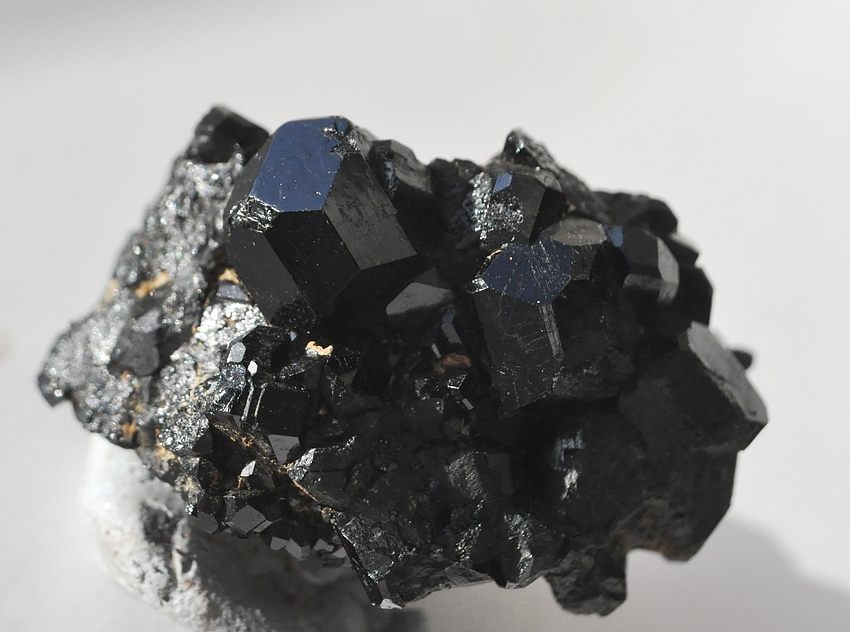
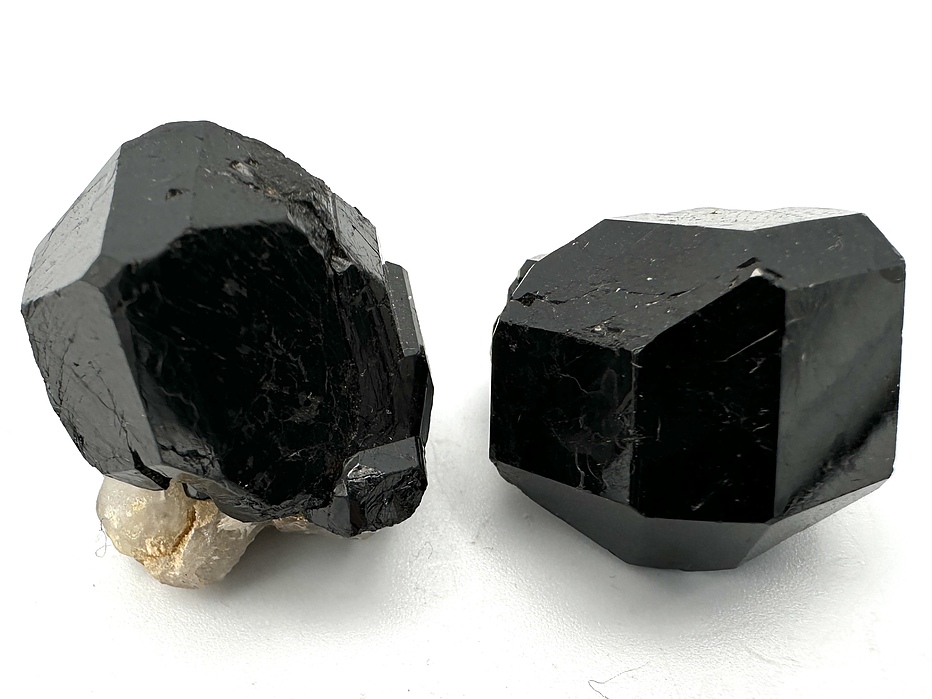
brown, green, black, red
Lustre:
Vitreous
Hardness:
7½
Specific Gravity:
3.115 (Calculated)
Crystal System:
Trigonal
Member of:
Name:
Named for Uva Province, Sri Lanka, the first reported occurrence.
Originally redefined in 2010 by IMA, as a part of a nomenclature revision of the Tourmaline group. The approval was subsequently withdrawn by IMA in 2018 (IMA 2000-030a), since analytical work showed the type material to be a potentially new oxy-tourmaline.
Finally approved, with a different type locality (Elba, Italy) in 2020.
Originally redefined in 2010 by IMA, as a part of a nomenclature revision of the Tourmaline group. The approval was subsequently withdrawn by IMA in 2018 (IMA 2000-030a), since analytical work showed the type material to be a potentially new oxy-tourmaline.
Finally approved, with a different type locality (Elba, Italy) in 2020.
Notes:
— The official IMA name for this mineral species was uvite, redefined as part of a nomenclature revision of the tourmaline group (Henry et al., 2011). However, the approval was withdrawn by IMA in 2018 (IMA 2000-030a), since analysis showed that the type material may be a potentially new oxy-tourmaline. Uvite was finally approved in 2020 (IMA 2019-113), with the type locality on Elba, Italy.
— Most specimens historically designated as uvite are actually, as analyses have shown, the F-dominant end member, i.e., fluor-uvite, which is much more common than uvite.
— Without analysis, a 'uvite' specimen should be added as Fluor-uvite-Uvite Series.
Forms a series with feruvite.
Note that although Brumado, Brazil, was once (Henry et al., 2011) defined the type locality for uvite, it is not possible to assign "uvites" from Brumado to this species without a reliable analysis, as specimens have been analysed with both OH- and F-dominant compositions.
Relation of uvite to fluor-uvite: W(OH)– <-> WF–.
Relation of uvite to feruvite: YMg2+ <-> YFe2+.
The holotype uvite originated from interaction of B-rich fluids released within the crystallization of LCT pegmatites and surrounding metaserpentinites.
— The official IMA name for this mineral species was uvite, redefined as part of a nomenclature revision of the tourmaline group (Henry et al., 2011). However, the approval was withdrawn by IMA in 2018 (IMA 2000-030a), since analysis showed that the type material may be a potentially new oxy-tourmaline. Uvite was finally approved in 2020 (IMA 2019-113), with the type locality on Elba, Italy.
— Most specimens historically designated as uvite are actually, as analyses have shown, the F-dominant end member, i.e., fluor-uvite, which is much more common than uvite.
— Without analysis, a 'uvite' specimen should be added as Fluor-uvite-Uvite Series.
Forms a series with feruvite.
Note that although Brumado, Brazil, was once (Henry et al., 2011) defined the type locality for uvite, it is not possible to assign "uvites" from Brumado to this species without a reliable analysis, as specimens have been analysed with both OH- and F-dominant compositions.
Relation of uvite to fluor-uvite: W(OH)– <-> WF–.
Relation of uvite to feruvite: YMg2+ <-> YFe2+.
The holotype uvite originated from interaction of B-rich fluids released within the crystallization of LCT pegmatites and surrounding metaserpentinites.
Unique Identifiers
Mindat ID:
54355
Long-form identifier:
mindat:1:1:54355:6
Similar Names
| Juvite | A rock subtype | |
| Tuvite | Co As O ? | |
| Ulvite | A synonym of Ulvöspinel | |
| Umite | A synonym of Humite | |
| Uvita | A synonym of 'Fluor-uvite-Uvite Series' |
IMA Classification of Uvite
Approved
IMA Formula:
CaMg3(Al5Mg)(Si6O18)(BO3)3(OH)3OH
Approval year:
2019
Approval history:
proposal no. 2019-113
Classification of Uvite
9.CK.05
9 : SILICATES (Germanates)
C : Cyclosilicates
K : [Si6O18]12- 6-membered single rings, with insular complex anions
9 : SILICATES (Germanates)
C : Cyclosilicates
K : [Si6O18]12- 6-membered single rings, with insular complex anions
Mineral Symbols
As of 2021 there are now IMA–CNMNC approved mineral symbols (abbreviations) for each mineral species, useful for tables and diagrams.
Please only use the official IMA–CNMNC symbol. Older variants are listed for historical use only.
Please only use the official IMA–CNMNC symbol. Older variants are listed for historical use only.
| Symbol | Source | Reference for Standard |
|---|---|---|
| Uvt | IMA–CNMNC | Warr, L.N. (2021). IMA–CNMNC approved mineral symbols. Mineralogical Magazine, 85(3), 291-320. doi:10.1180/mgm.2021.43 |
| Utv | The Canadian Mineralogist (2019) | The Canadian Mineralogist (2019) The Canadian Mineralogist list of symbols for rock- and ore-forming minerals (December 30, 2019). download |
Physical Properties of Uvite
Vitreous
Transparency:
Translucent
Colour:
Brown, green, black, red
Streak:
Grey
Hardness:
7½ on Mohs scale
Comment:
ca.
Tenacity:
Brittle
Cleavage:
None Observed
Fracture:
Conchoidal
Density:
3.115 g/cm3 (Calculated)
Optical Data of Uvite
Type:
Uniaxial (-)
RI values:
nω = 1.660(5) nε = 1.640(5)
Max. Birefringence:
δ = 0.020
Based on recorded range of RI values above.
Based on recorded range of RI values above.
Interference Colours:
The colours simulate birefringence patterns seen in thin section under crossed polars. They do not take into account mineral colouration or opacity.
Michel-Levy Bar The default colours simulate the birefringence range for a 30 µm thin-section thickness. Adjust the slider to simulate a different thickness.
Grain Simulation You can rotate the grain simulation to show how this range might look as you rotated a sample under crossed polars. Each grain retains its interference colour (retardation) while its brightness falls to black at extinction and reaches a maximum between extinction positions.
The colours simulate birefringence patterns seen in thin section under crossed polars. They do not take into account mineral colouration or opacity.
Michel-Levy Bar The default colours simulate the birefringence range for a 30 µm thin-section thickness. Adjust the slider to simulate a different thickness.
Grain Simulation You can rotate the grain simulation to show how this range might look as you rotated a sample under crossed polars. Each grain retains its interference colour (retardation) while its brightness falls to black at extinction and reaches a maximum between extinction positions.
Surface Relief:
High (positive)
Relative to Canada balsam mounting medium (n ≈ 1.537).
Relative to Canada balsam mounting medium (n ≈ 1.537).
This shows the grain boundary and Becke line effect under plane-polarised
light, based on the contrast between this mineral's average refractive
index and the mounting medium. It does not take into account mineral
colouration.
In focus
Interference Figure:
This shows the idealized uniaxial interference figure - the conoscopic
(convergent-light, Bertrand-lens-in) view, for a grain cut with the optic axis
centred and vertical. The coloured rings are isochromatics, computed with the
same physics as the Michel-Lévy bar above; the dark cross is the isogyre.
For a genuinely uniaxial mineral viewed this way, that cross stays perfectly stationary if you rotate the stage - unlike a biaxial mineral, where it splits apart on rotation. That invariance is itself the standard diagnostic test for telling uniaxial and biaxial minerals apart at the microscope.
For a genuinely uniaxial mineral viewed this way, that cross stays perfectly stationary if you rotate the stage - unlike a biaxial mineral, where it splits apart on rotation. That invariance is itself the standard diagnostic test for telling uniaxial and biaxial minerals apart at the microscope.
Pleochroism:
Visible
Comments:
O = greenish brown, E = pale yellow, with O > E.
Chemistry of Uvite
Mindat Formula:
CaMg3(Al5Mg)(Si6O18)(BO3)3(OH)3(OH)
Element Weights:
Crystallography of Uvite
Crystal System:
Trigonal
Class (H-M):
3m - Ditrigonal Pyramidal
Space Group:
R3m
Cell Parameters:
a = 15.9519(10) Å, c = 7.2222(5) Å
Ratio:
a:c = 1 : 0.453
Unit Cell V:
1597.3 ų
Z:
3
Morphology:
Lozenge shaped to stubby prisms.
X-Ray Powder Diffraction
Powder Diffraction Data:
| d-spacing | Intensity |
|---|---|
| 4.237 Å | (49) |
| 3.994 Å | (51) |
| 3.497 Å | (57) |
| 2.973 Å | (88) |
| 2.584 Å | (100) |
| 2.047 Å | (53) |
| 1.925 Å | (37) |
| 1.666 Å | (26) |
Geological Environment
Paragenetic Mode(s):
| Paragenetic Mode | Earliest Age (Ga) |
|---|---|
| Stage 4a: Earth’s earliest continental crust | >4.4-3.0 |
| 19 : Granitic intrusive rocks | |
| Near-surface Processes | |
| 23 : Subaerial aqueous alteration by non-redox-sensitive fluids (see also #47) | |
| 26 : Hadean detrital minerals | |
| Stage 4b: Highly evolved igneous rocks | >3.0 |
| 34 : Complex granite pegmatites | |
| Stage 5: Initiation of plate tectonics | <3.5-2.5 |
| 40 : Regional metamorphism (greenschist, amphibolite, granulite facies) |
Type Occurrence of Uvite
General Appearance of Type Material:
euhedral crystals, up to 1 cm
Place of Conservation of Type Material:
mineralogical collections of the (1) Museo Civico di Storia Naturale, Corso Venezia 55, 20121 Milan, Italy, catalogue number M38848, and (2) the Museo di Storia Naturale, Università di Pisa, Via Roma 79, 56011 Calci (PI), Italy, catalogue number 19911
Geological Setting of Type Material:
holotype (2022 paper's) material: "center of a narrow (2-3 cm wide) vein" comprising aggregates of dark-coloured tourmaline, penetrating magnesite- and dolomite-bearing hydrothermally altered metaserpentinite
Synonyms of Uvite
Other Language Names for Uvite
Relationship of Uvite to other Species
Member of:
Other Members of Tourmaline:
| Adachiite | CaFe3Al6(Si5AlO18)(BO3)3(OH)3(OH) | Trig. 3m : R3m |
| Alumino-oxy-rossmanite | ◻Al3Al6(Si5AlO18)(BO3)3(OH)3O | Trig. 3m : R3m |
| Bosiite | NaFe3+3(Al4Mg2)(Si6O18)(BO3)3(OH)3O | Trig. 3m : R3m |
| Celleriite | ◻(Mn2+2Al)Al6(Si6O18)(BO3)3(OH)3(OH) | Trig. 3m : R3m |
| Chromium-dravite | NaMg3Cr3+6(Si6O18)(BO3)3(OH)3(OH) | Trig. 3m : R3m |
| Chromo-alumino-povondraite | NaCr3(Al4Mg2)(Si6O18)(BO3)3(OH)3O | Trig. 3m : R3m |
| Darrellhenryite | Na(Al2Li)Al6(Si6O18)(BO3)3(OH)3O | Trig. 3m : R3m |
| Dravite | NaMg3Al6(Si6O18)(BO3)3(OH)3(OH) | Trig. 3m : R3m |
| Dutrowite | Na(Fe2+2.5Ti0.5)Al6(Si6O18)(BO3)3(OH)3O | Trig. 3m : R3m |
| Elbaite | Na(Li1.5Al1.5)Al6(Si6O18)(BO3)3(OH)3(OH) | Trig. 3m : R3m |
| Ertlite | NaAl3Al6(Si4B2O18)(BO3)3(OH)3O | Trig. 3m : R3m |
| Ferro-bosiite | NaFe3+3(Al4Fe2+2)(Si6O18)(BO3)3(OH)3O | Trig. 3m : R3m |
| Feruvite | CaFe2+3(Al5Mg)(Si6O18)(BO3)3(OH)3(OH) | Trig. 3m : R3m |
| Fluor-buergerite | NaFe3+3Al6(Si6O18)(BO3)3O3F | Trig. 3m : R3m |
| Fluor-dravite | NaMg3Al6(Si6O18)(BO3)3(OH)3F | Trig. 3m : R3m |
| Fluor-elbaite | Na(Li1.5Al1.5)Al6(Si6O18)(BO3)3(OH)3F | Trig. 3m : R3m |
| Fluor-liddicoatite | Ca(Li2Al)Al6(Si6O18)(BO3)3(OH)3F | Trig. 3m : R3m |
| Fluor-rossmanite | ◻(Al2Li)Al6(Si6O18)(BO3)3(OH)3F | Trig. 3m(32/m) : R3m |
| Fluor-schorl | NaFe2+3Al6(Si6O18)(BO3)3(OH)3F | Trig. 3m : R3m |
| Fluor-tsilaisite | NaMn2+3Al6(Si6O18)(BO3)3(OH)3F | Trig. 3m : R3m |
| Fluor-uvite | CaMg3(Al5Mg)(Si6O18)(BO3)3(OH)3F | Trig. 3m : R3m |
| Foitite | ◻(Fe2+2Al)Al6(Si6O18)(BO3)3(OH)3(OH) | Trig. 3m : R3m |
| Liddicoatite | Ca(Li2Al)Al6(Si6O18)(BO3)3(OH)3(OH) | Trig. 3m : R3m |
| Lucchesiite | CaFe2+3 Al6(Si6O18)(BO3)3(OH)3O | Trig. 3m : R3m |
| Magnesio-dutrowite | Na(Mg2.5Ti0.5)Al6(Si6O18)(BO3)3(OH)3O | Trig. 3m : R3m |
| Magnesio-foitite | ◻(Mg2Al)Al6(Si6O18)(BO3)3(OH)3(OH) | Trig. 3m : R3m |
| Magnesio-lucchesiite | CaMg3Al6(Si6O18)(BO3)3(OH)3O | Trig. 3m : R3m |
| Maruyamaite | K(Al2Mg)(Al5Mg)(Si6O18)(BO3)3(OH)3O | Trig. 3m : R3m |
| Olenite | NaAl3Al6(Si6O18)(BO3)3O3(OH) | Trig. 3m : R3m |
| Oxy-chromium-dravite | NaCr3(Cr4Mg2)(Si6O18)(BO3)3(OH)3O | Trig. 3m : R3m |
| Oxy-dravite | Na(Al2Mg)(Al5Mg)(Si6O18)(BO3)3(OH)3O | Trig. 3m : R3m |
| Oxy-foitite | ◻(Fe2+Al2)Al6(Si6O18)(BO3)3(OH)3O | Trig. 3m(32/m) : R3m |
| Oxy-schorl | Na(Fe2+2Al)Al6(Si6O18)(BO3)3(OH)3O | Trig. 3m : R3m |
| Oxy-vanadium-dravite | NaV3(V4Mg2)(Si6O18)(BO3)3(OH)3O | Trig. 3m : R3m |
| Povondraite | NaFe3+3(Mg2Fe3+4)(Si6O18)(BO3)3(OH)3O | Trig. 3m : R3m |
| Princivalleite | Na(Mn2Al)Al6(Si6O18)(BO3)3(OH)3O | Trig. 3m : R3m |
| Rossmanite | ◻(LiAl2)Al6(Si6O18)(BO3)3(OH)3(OH) | Trig. 3m : R3m |
| Schorl | NaFe2+3Al6(Si6O18)(BO3)3(OH)3(OH) | Trig. 3m : R3m |
| Tsilaisite | NaMn2+3Al6(Si6O18)(BO3)3(OH)3(OH) | Trig. 3m : R3m |
| 'UM2000-64-SiO:BFeHKMg' | (K,Na)Fe3+3(Mg2Fe3+4)Si6O18(BO3)3(OH)3O | |
| 'UM2008-52-SiO:AlBCaFFeHLiMgNa' | (Ca,Na,◻)(Al,Li,Fe,Mg)3Al6[Si6O18](BO3)3(OH,O)3(F,O) | |
| 'Unnamed (F analogue of feruvite)' | CaFe2+3(Al5Mg)(Si6O18)(BO3)3(OH)3F | |
| 'Unnamed (Mn2+-F-analogue of foitite)' | ◻(Mn2+2Al)Al6(Si6O18)(BO3)3(OH)3F ? | |
| 'Unnamed (Pb-analogue of Fluor-liddicoatite)' | Pb(Li2Al)Al6(Si6O18)(BO3)3(OH)3F | |
| Vanadio-oxy-chromium-dravite | NaV3(Cr4Mg2)(Si6O18)(BO3)3(OH)3O | Trig. 3m : R3m |
| Vanadio-oxy-dravite | NaV3(Al4Mg2)(Si6O18)(BO3)3(OH)3O | Trig. 3m : R3m |
Forms a series with:
Common Associates
Associations Based on Photo Data:
| 17 photos of Uvite associated with Magnesite | MgCO3 |
| 7 photos of Uvite associated with Quartz | SiO2 |
| 4 photos of Uvite associated with Serendibite | Ca4[Mg6Al6]O4[Si6B3Al3O36] |
| 3 photos of Uvite associated with Spinel | MgAl2O4 |
| 3 photos of Uvite associated with Florencite-(Ce) | CeAl3(PO4)2(OH)6 |
| 3 photos of Uvite associated with Dravite | NaMg3Al6(Si6O18)(BO3)3(OH)3(OH) |
| 2 photos of Uvite associated with Woodhouseite | CaAl3(PO4)(SO4)(OH)6 |
| 1 photo of Uvite associated with Calcite | CaCO3 |
| 1 photo of Uvite associated with Pyroxene Group | ADSi2O6 |
| 1 photo of Uvite associated with 'Sapphire' | Al2O3 |
Related Minerals - Strunz-mindat Grouping
| 9.CK. | Adachiite | CaFe3Al6(Si5AlO18)(BO3)3(OH)3(OH) |
| 9.CK. | Magnesio-dutrowite | Na(Mg2.5Ti0.5)Al6(Si6O18)(BO3)3(OH)3O |
| 9.CK. | Darrellhenryite | Na(Al2Li)Al6(Si6O18)(BO3)3(OH)3O |
| 9.CK. | Fluor-schorl | NaFe2+3Al6(Si6O18)(BO3)3(OH)3F |
| 9.CK. | Princivalleite | Na(Mn2Al)Al6(Si6O18)(BO3)3(OH)3O |
| 9.CK. | Alumino-oxy-rossmanite | ◻Al3Al6(Si5AlO18)(BO3)3(OH)3O |
| 9.CK. | Dutrowite | Na(Fe2+2.5Ti0.5)Al6(Si6O18)(BO3)3(OH)3O |
| 9.CK. | Ferro-bosiite | NaFe3+3(Al4Fe2+2)(Si6O18)(BO3)3(OH)3O |
| 9.CK. | Bosiite | NaFe3+3(Al4Mg2)(Si6O18)(BO3)3(OH)3O |
| 9.CK. | Celleriite | ◻(Mn2+2Al)Al6(Si6O18)(BO3)3(OH)3(OH) |
| 9.CK.05 | Feruvite | CaFe2+3(Al5Mg)(Si6O18)(BO3)3(OH)3(OH) |
| 9.CK.05 | Chromium-dravite | NaMg3Cr3+6(Si6O18)(BO3)3(OH)3(OH) |
| 9.CK.05 | Fluor-rossmanite | ◻(Al2Li)Al6(Si6O18)(BO3)3(OH)3F |
| 9.CK.05 | Oxy-schorl | Na(Fe2+2Al)Al6(Si6O18)(BO3)3(OH)3O |
| 9.CK.05 | Fluor-elbaite | Na(Li1.5Al1.5)Al6(Si6O18)(BO3)3(OH)3F |
| 9.CK.05 | Dravite | NaMg3Al6(Si6O18)(BO3)3(OH)3(OH) |
| 9.CK.05 | Fluor-uvite | CaMg3(Al5Mg)(Si6O18)(BO3)3(OH)3F |
| 9.CK.05 | Foitite | ◻(Fe2+2Al)Al6(Si6O18)(BO3)3(OH)3(OH) |
| 9.CK.05 | Vanadio-oxy-dravite | NaV3(Al4Mg2)(Si6O18)(BO3)3(OH)3O |
| 9.CK.05 | Fluor-buergerite | NaFe3+3Al6(Si6O18)(BO3)3O3F |
| 9.CK.05 | 'Unnamed (F analogue of feruvite)' | CaFe2+3(Al5Mg)(Si6O18)(BO3)3(OH)3F |
| 9.CK.05 | Ertlite | NaAl3Al6(Si4B2O18)(BO3)3(OH)3O |
| 9.CK.05 | Tsilaisite | NaMn2+3Al6(Si6O18)(BO3)3(OH)3(OH) |
| 9.CK.05 | Fluor-liddicoatite | Ca(Li2Al)Al6(Si6O18)(BO3)3(OH)3F |
| 9.CK.05 | Elbaite | Na(Li1.5Al1.5)Al6(Si6O18)(BO3)3(OH)3(OH) |
| 9.CK.05 | Fluor-tsilaisite | NaMn2+3Al6(Si6O18)(BO3)3(OH)3F |
| 9.CK.05 | Oxy-foitite | ◻(Fe2+Al2)Al6(Si6O18)(BO3)3(OH)3O |
| 9.CK.05 | Liddicoatite | Ca(Li2Al)Al6(Si6O18)(BO3)3(OH)3(OH) |
| 9.CK.05 | Vanadio-oxy-chromium-dravite | NaV3(Cr4Mg2)(Si6O18)(BO3)3(OH)3O |
| 9.CK.05 | Rossmanite | ◻(LiAl2)Al6(Si6O18)(BO3)3(OH)3(OH) |
| 9.CK.05 | Oxy-vanadium-dravite | NaV3(V4Mg2)(Si6O18)(BO3)3(OH)3O |
| 9.CK.05 | Olenite | NaAl3Al6(Si6O18)(BO3)3O3(OH) |
| 9.CK.05 | 'UM2000-64-SiO:BFeHKMg' | (K,Na)Fe3+3(Mg2Fe3+4)Si6O18(BO3)3(OH)3O |
| 9.CK.05 | Magnesio-lucchesiite | CaMg3Al6(Si6O18)(BO3)3(OH)3O |
| 9.CK.05 | Povondraite | NaFe3+3(Mg2Fe3+4)(Si6O18)(BO3)3(OH)3O |
| 9.CK.05 | Lucchesiite | CaFe2+3 Al6(Si6O18)(BO3)3(OH)3O |
| 9.CK.05 | Chromo-alumino-povondraite | NaCr3(Al4Mg2)(Si6O18)(BO3)3(OH)3O |
| 9.CK.05 | Fluor-dravite | NaMg3Al6(Si6O18)(BO3)3(OH)3F |
| 9.CK.05 | Oxy-dravite | Na(Al2Mg)(Al5Mg)(Si6O18)(BO3)3(OH)3O |
| 9.CK.05 | Oxy-chromium-dravite | NaCr3(Cr4Mg2)(Si6O18)(BO3)3(OH)3O |
| 9.CK.05 | 'Luinaite-(OH)' | NaFe2+3Al6(Si6O18)(BO3)3(OH)3(OH) |
| 9.CK.05 | Schorl | NaFe2+3Al6(Si6O18)(BO3)3(OH)3(OH) |
| 9.CK.05 | Magnesio-foitite | ◻(Mg2Al)Al6(Si6O18)(BO3)3(OH)3(OH) |
| 9.CK.05 | Maruyamaite | K(Al2Mg)(Al5Mg)(Si6O18)(BO3)3(OH)3O |
| 9.CK.10 | Abenakiite-(Ce) | Na26Ce6(Si6O18)(PO4)6(CO3)6(SO2)O |
| 9.CK.15 | Scawtite | Ca7(Si3O9)2CO3 · 2H2O |
| 9.CK.20 | Thorosteenstrupine | (Ca,Th,Mn)3Si4O11F · 6H2O |
| 9.CK.20 | Steenstrupine-(Ce) | Na14Mn2+2Fe3+2Ce6Zr(Si6O18)2(PO4)6(PO3OH)(OH)2 · 2H2O |
Fluorescence of Uvite
none
Other Information
Health Risks:
No information on health risks for this material has been entered into the database. You should always treat mineral specimens with care.
Internet Links for Uvite
mindat.org URL:
https://www.mindat.org/min-54355.html
Please feel free to link to this page.
Please feel free to link to this page.
Search Engines:
External Links:
Mineral Dealers:
References for Uvite
Reference List:
Nelen, Joseph A., Dunn, Pete J., Appleman, Daniel, Norberg, Julie (1977) Uvite, a New (Old) Common Member of the Tourmaline Group and Its Implications for Collectors. The Mineralogical Record, 8 (2) 100-108
Rozhdestvenskaya, I. V., Frank-Kamenetskaya, O. V., Kuznetsova, L. G., Bannova, I. I., Bronzova, Yu. M. (2007) Refinement of the crystal structure of lithium-bearing uvite. Crystallography Reports, 52 (2). 203-207 doi:10.1134/s106377450702006x[in fact fluor-uvite]
Williams, P. A., Hatert, F., Pasero, M., Mills, S. (2010) New minerals and nomenclature modifications approved in 2010, CNMNC Newsletter No 2. Mineralogical Magazine, 74 (2) 375-377 doi:10.1180/s0026461x00056036
Henry, Darell J., Novak, Milan, Hawthorne, Frank C., Ertl, Andreas, Dutrow, Barbara L., Uher, Pavel, Pezzotta, Federico (2011) Nomenclature of the tourmaline-supergroup minerals. American Mineralogist, 96 (5) 895-913 doi:10.2138/am.2011.3636
Hålenius, U., Hatert, F., Pasero, M., Mills, S. J. (2018) IMA Commission on New Minerals, Nomenclature and Classification (CNMNC) Newsletter 41. European Journal of Mineralogy, 30. 183-186 doi:10.1127/ejm/2018/0030-2736
Miyawaki, Ritsuro, Hatert, Frédéric, Pasero, Marco, Mills, Stuart J. (2020) IMA Commission on New Minerals, Nomenclature and Classification (CNMNC) - Newsletter 54. European Journal of Mineralogy, 32 (2) 275-283 doi:10.5194/ejm-32-275-2020
Bosi, Ferdinando, Biagioni, Cristian, Pezzotta, Federico, Skogby, Henrik, Hålenius, Ulf, Cempírek, Jan, Hawthorne, Frank C., Lussier, Aaron J., Abdu, Yassir A., Day, Maxwell C., Fayek, Mostafa, Clark, Christine M., Grice, Joel D., Henry, Darrell J. (2022) Uvite, CaMg3(Al5Mg)(Si6O18)(BO3)3(OH)3(OH), a new, but long-anticipated mineral species of the tourmaline supergroup from San Piero in Campo, Elba Island, Italy. Mineralogical Magazine, 86 (5) 767-776 doi:10.1180/mgm.2022.54
Localities for Uvite
Showing 27 localities.
 symbol to view information about a locality.
The
symbol to view information about a locality.
The Locality List
 - This locality has map coordinates listed.
- This locality has estimated coordinates.
ⓘ - Click for references and further information on this occurrence.
? - Indicates mineral may be doubtful at this locality.
- This locality has map coordinates listed.
- This locality has estimated coordinates.
ⓘ - Click for references and further information on this occurrence.
? - Indicates mineral may be doubtful at this locality.
 - Good crystals or important locality for species.
 - World class for species or very significant.
(TL) - Type Locality for a valid mineral species.
(FRL) - First Recorded Locality for everything else (eg varieties).
- World class for species or very significant.
(TL) - Type Locality for a valid mineral species.
(FRL) - First Recorded Locality for everything else (eg varieties).
All localities listed without proper references should be considered as questionable.
Australia | |
| Bottrill et al. (2024) |
Austria | |
| Strasser (1998) +2 other references |
Brazil | |
| Barbosa et al. (2000) +1 other reference |
Canada | |
| Fischer et al. (2023) |
| Scribner et al. (2018) |
| Daver et al. (2020) |
| Belley et al. (2016) |
| ... +1 other reference |
China | |
| Yang et al. (2023) |
Czech Republic | |
| Vácha et al. (2025) |
Finland | |
| Grönholm (1987) |
India | |
| Devaraju et al. (1999) |
Indonesia | |
| Etzel et al. (2015) |
Italy (TL) | |
| Williams et al. (2010) +1 other reference |
Madagascar | |
| Gadas et al. (2023) |
Poland | |
| Sęk (2018) |
| Nowinska (2020) |
Russia | |
| Nagornaya et al. (2021) |
Switzerland | |
| Wilson (2023) |
UK | |
| Duchoslav et al. (2017) |
USA | |
| King (n.d.) |
| King (n.d.) | |
| Nelen et al. (1977) |
| - (eski / Noah) +1 other reference | |
| Nelen et al. (1977) | |
Quick NavTopAbout UviteUnique IdentifiersSimilar NamesIMA Classification Classification Mineral SymbolsPhysical Properties Optical Data Chemistry Crystallography X-Ray Powder DiffractionGeological EnvironmentType Occurrence SynonymsOther LanguagesRelationshipsCommon AssociatesStrunz-MindatFluorescence Other InformationInternet Links References Localities Locality List

Power's Farm, Pierrepont, St. Lawrence County, New York, USA