Handbook of Applied Cryptography
CRC Press has generously given us permission to make all chapters available for free download.
- Posted using BlogPress from my iPhone
Handbook of Applied Cryptography
CRC Press has generously given us permission to make all chapters available for free download.
- Posted using BlogPress from my iPhone
Alan Turing Cryptanalysis Papers:
GCHQ, the UK government's communications headquarters, has released two new -- well, 70 years old, but new to us -- cryptanalysis documents by Alan Turing.
The papers, one entitled The Applications of Probability to Crypt, and the other entitled Paper on the Statistics of Repetitions, discuss mathematical approaches to code breaking.[...]
According to the GCHQ mathematician, who identified himself only as Richard, the papers detailed using "mathematical analysis to try and determine which are the more likely settings so that they can be tried as quickly as possible."
The papers don't seem to be online yet, but here's their National Archives data.
(Via Schneier on Security)
Sounds like a cool conference ...
Bruce Schneier on the SHARCS Conference:
Last weekend was the 2012 SHARCS (Special-Purpose Hardware for Attacking Cryptographic Systems) conference. The presentations are online.
Great to see a replica of Colossus working at The National Museum of Computing at Bletchley Park. Bletchley Park and Colossus were critical to the code-breaking efforts during World War II.
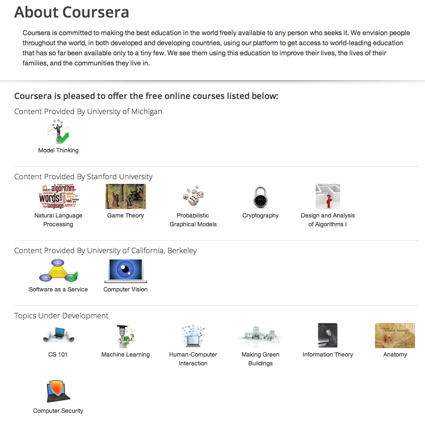
I've signed up for the free Stanford Cryptography course offered for free online through Coursera. This is one of a number of courses being offered through Coursera:
I teach networking and wireless courses where we introduce the concepts of encryption and cryptography, but not at this level and to this depth. I felt it would inform my lectures and enrich my own understanding to participate in ("take") this course. My Masters and PhD work both required a great deal of high-level math, but it's been nearly 20 years since I've done that sort of math on a day-to-day basis. Likewise my programming skills – I used to be quite the Fortran programmer – have no doubt atrophied. In addition to my interest in the content of this course, I'm very interested in the quality of the course and the quality of the online delivery. I hope to be able to learn some new things that I can bring to my online and web-enhanced courses.
Over the next 10 weeks, I'll be posting my experiences in this online course – I encourage you to register and follow along.
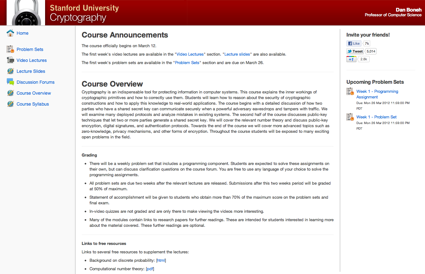
The course, taught by Dan Boneh, which begins tomorrow March 12th, consists of "Video Lectures" (along with the slides themselves), "Problem Sets" and a "Discussion Forum".
The course is split into two modules and scheduled to run for 10 weeks:
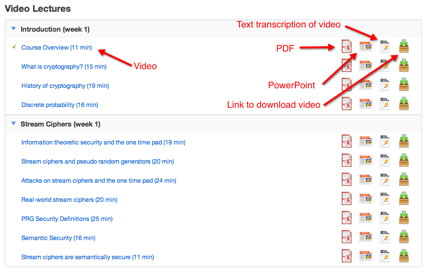
The Video Lectures, which are delivered in small bite-sized pieces, are available online and can be downloaded. The slides are available as PDF and PowerPoint, along with a text-based transcription of the video (great for ADA compliance!).
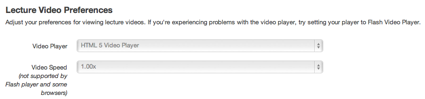
A great feature in the preferences in the ability to toggle the format of the videos – either Flash or HTML5.
The HTML5 version looks great on an iPad – even without a Retina display:
Public Key Cryptography: Diffie-Hellman Key Exchange - YouTube:
Diffie-Hellman key exchange was one of the earliest practical implementations of key exchange within the field of cryptography. It relies on the discrete logarithm problem. This test clip will be part of the final chapter of Gambling with Secrets!
John Markoff reporting for the NY Times – How 18th-Century Copiale Cipher Was Cracked:
It has been more than six decades since Warren Weaver, a pioneer in automated language translation, suggested applying code-breaking techniques to the challenge of interpreting a foreign language.
In an oft-cited letter in 1947 to the mathematician Norbert Weiner, he wrote: “One naturally wonders if the problem of translation could conceivably be treated as a problem in cryptography. When I look at an article in Russian, I say: ‘This is really written in English, but it has been coded in some strange symbols. I will now proceed to decode.’ ”
That insight led to a generation of statistics-based language programs like Google Translate — and, not so incidentally, to new tools for breaking codes that go back to the Middle Ages.
Now a team of Swedish and American linguists has applied statistics-based translation techniques to crack one of the most stubborn of codes: the Copiale Cipher, a hand-lettered 105-page manuscript that appears to date from the late 18th century. They described their work at a meeting of the Association for Computational Linguistics in Portland, Ore.
Discovered in an academic archive in the former East Germany, the elaborately bound volume of gold and green brocade paper holds 75,000 characters, a perplexing mix of mysterious symbols and Roman letters. The name comes from one of only two non-coded inscriptions in the document.
Kevin Knight, a computer scientist at the Information Sciences Institute at the University of Southern California, collaborated with Beata Megyesi and Christiane Schaefer of Uppsala University in Sweden to decipher the first 16 pages. They turn out to be a detailed description of a ritual from a secret society that apparently had a fascination with eye surgery and ophthalmology.
The 2010 U.S. Wiretap Report was released a couple of weeks ago, the latest in a series of puzzles published annually, on and off, by congressional mandate since the Nixon administration. The report, as its name implies, summarizes legal wiretapping by federal and state law enforcement agencies. The reports are puzzles because they are notoriously incomplete; the data relies on spotty reporting, and information on "national security" (FISA) taps is excluded altogether. Still, it's the most complete public picture of wiretapping as practiced in the US that we have, and as such, is of likely interest to many readers here.
We now know that there were at least 3194 criminal wiretaps last year (1207 of these were by federal law enforcement and 1987 were done by state and local agencies). The previous year there were only 2376 reported, but it isn't clear how much of this increase was due to improved data collection in 2010. Again, this is only "Title III" content wiretaps for criminal investigations (mostly drug cases); it doesn't include "pen registers" that record call details without audio or taps for counterintelligence and counterterrorism investigations, which presumably have accounted for an increasing proportion of intercepts since 2001. And there's apparently still a fair bit of underreporting in the statistics. So we don't really know how much wiretapping the government actually does in total or what the trends really look like. There's a lot of noise among the signals here.
But for all the noise, one interesting fact stands out rather clearly. Despite dire predictions to the contrary, the open availability of cryptography has done little to hinder law enforcement's ability to conduct investigations.
Since 2002, the annual wiretap report has included a curious statistic: the number of times law enforcement encountered encryption on an authorized tap, along with the number of times that this prevented them from getting the evidence they were seeking.
the latest wiretap report identifies a total of just six (out of 3194) cases in which encryption was encountered, and that prevented recovery of evidence a grand total of ... (drumroll) ... zero times. Not once. Previous wiretap reports have indicated similarly minuscule numbers.

Nakamoto wanted people to be able to exchange money electronically securely without the need for a third party, such as a bank or a company like PayPal. He based Bitcoin on cryptographic techniques that allow you to be sure the money you receive is genuine, even if you don't trust the sender.
Wikipedia screenshot from Discover app by Cooliris
- Posted using BlogPress from my iPad
 .
. When Ricky McCormick's body was discovered in a Missouri cornfield in 1999, police officers discovered something unusual in his pockets: Two curious notes that appeared to be written in code. If McCormick had been murdered, as investigators suspected, they figured these cryptic clues might lead them to the culprit. Soon the FBI was involved.
Twelve years later, the FBI is still so confounded by the codes that they've posted them online with the hope that someone out there can make sense of them.
It may seem strange that McCormick, a high-school dropout who spent most of his time on the street, could baffle the FBI's top cryptologists. But according to Jonathan Katz, an associate computer-science professor at the University of Maryland who teaches cryptography, amateur ciphers can be the most difficult to unlock.
When experts attempt to break a wartime code, they know the general context of the message. They know who's communicating with whom and what they're communicating about. But when it comes to rogue codes, cryptologists don't even know what language the cipher was written in.
...
Editor's note: The headline on this article, "Cxjlrp Zfmebop," is a simple Caesar cipher in which every letter of the original headline is shifted three letters back in the alphabet. To decode it, you just go in reverse: C+3 is F, X+3 is A, and so forth.