Showing posts with label encryption. Show all posts

Friday, December 14, 2012

YouTube Search Encrypted ...

... but streaming video not encrypted. Hmmm ... could lead to a false sense of privacy.
From Martin Sauter ... Observation: Youtube Is Now HTTPS - But The Streams Are Not

When I watched a video on Youtube today I noticed that the page's URL was https://www.youtube.com.... Interesting, I thought, it's encrypted now! If the streams are encrytped too, that would have interesting implications for video caching and compression servers in some mobile networks as they would no longer be able to compress and scale videos.

So I ran a quick Wireshark trace to see if the streams themselves were encrypted, too. However, they were not. An interesting implication of this is that the user might get the impression that the session is secure. But as the videos are sent in the clear, it's actually not secure at all. From the outside, it is no longer possible to see what the user is searching for, but which videos are streamed are still visible and can be cached or modified or simply blocked.


- Posted using BlogPress from my iPad

Monday, September 10, 2012

Phil Zimmermann and Former Navy Seal To Secure Phone Calls

NewImage

From Julie Bort … World-Famous Privacy Guru Phil Zimmermann Teams With Navy Seals To Secure Your Phone Calls:

Silent Circle got its start with a phone call—the everyday kind of communication the privacy-protection startup hopes to secure when it launches its first product next month.

Internet Hall of Famer and privacy guru Phil Zimmermann was minding his own business (as he always does) when he got a call from a former Navy Seal, Mike Janke.

Zimmermann didn't know Janke. But Janke had a big idea for a new kind of superprivate, secure version of Skype. So he called up one of the world's experts on privacy and security and asked him to help found a company.

Tuesday, August 14, 2012

Researchers Seek Help Cracking Encrypted Malware Payload

NewImage

Kids, time to get those hard disks spinning and generate some CPU-cycles.

From Kim Zetter … Researchers Seek Help Cracking Gauss Mystery Payload:

Researchers at Kaspersky Lab in Russia are asking the public for help in cracking an encrypted warhead that gets delivered to infected machines by the Gauss malware toolkit.

The warhead gets decrypted by the malware using a key composed of configuration data from the system it’s targeting. But without knowing what systems it’s targeting or the configuration on that system, the researchers have been unable to reproduce the key to crack the encryption.

“We are asking anyone interested in cryptology, numerology and mathematics to join us in solving the mystery and extracting the hidden payload,” the researchers write in a blog post published Tuesday.

Sunday, April 08, 2012

Encrypt Everything

Interesting movement from Canada … and some good resources – Encrypt Everything

Operation Encrypt Everything (OpE^2) was started in 2012 by members of the Pirate Party of Canada to counteract the increasing threat of total communications surveillance by governments and private industry. It is intended to bring together information about protecting your data and privacy online, and making easily-understood instructions available to our digital comrades.

By getting in the habit of using good encryption practices, you can ensure that your financial records, web surfing history, conversations with friends, and photos of your loved ones are private, and not endangered by your national government, a foreign government, major corporations like Facebook or Google, or even malicious hackers.

When we want something to be secure, we tend to lock it up - and that's what encryption is, a lock and key for your private life, ensuring that your recent credit card purchases, vacation photos, web browsing history or chat conversations aren't going to be on the front page of tomorrow's newspapers...or the topic of family conversation at Thanksgiving. It's not enough to decide that you'll try and protect this photograph, or that e-Mail, if you want true security and privacy, you must...ENCRYPT EVERYTHING!

...

Privacy Guides


Thursday, March 22, 2012

Can the NSA Break AES?

Bruce Schneier wonders Can the NSA Break AES? He doesn't think so, but I'm not so sure.

In an excellent article in Wired, James Bamford talks about the NSA's codebreaking capability.

According to another top official also involved with the program, the NSA made an enormous breakthrough several years ago in its ability to cryptanalyze, or break, unfathomably complex encryption systems employed by not only governments around the world but also many average computer users in the US. The upshot, according to this official: "Everybody's a target; everybody with communication is a target."

Bamford has been writing about the NSA for decades, and people tell him all sorts of confidential things. Reading the above, the obvious question to ask is: can the NSA break AES?

My guess is that they can't. That is, they don't have a cryptanalytic attack against the AES algorithm that allows them to recover a key from known or chosen ciphertext with a reasonable time and memory complexity. I believe that what the "top official" was referring to is attacks that focus on the implementation and bypass the encryption algorithm: side-channel attacks, attacks against the key generation systems (either exploiting bad random number generators or sloppy password creation habits), attacks that target the endpoints of the communication system and not the wire, attacks that exploit key leakage, attacks against buggy implementations of the algorithm, and so on. These attacks are likely to be much more effective against computer encryption.

Sunday, March 11, 2012

Stanford Online Cryptography Course – Week 1, Day 1

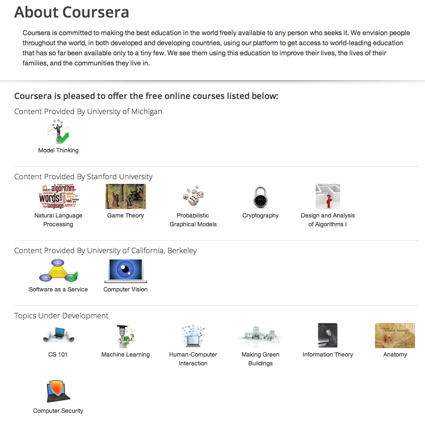
I've signed up for the free Stanford Cryptography course offered for free online through Coursera. This is one of a number of courses being offered through Coursera:

NewImage

I teach networking and wireless courses where we introduce the concepts of encryption and cryptography, but not at this level and to this depth. I felt it would inform my lectures and enrich my own understanding to participate in ("take") this course. My Masters and PhD work both required a great deal of high-level math, but it's been nearly 20 years since I've done that sort of math on a day-to-day basis. Likewise my programming skills – I used to be quite the Fortran programmer – have no doubt atrophied. In addition to my interest in the content of this course, I'm very interested in the quality of the course and the quality of the online delivery. I hope to be able to learn some new things that I can bring to my online and web-enhanced courses.

Over the next 10 weeks, I'll be posting my experiences in this online course – I encourage you to register and follow along.

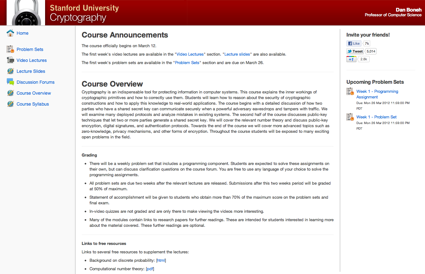
The course, taught by Dan Boneh, which begins tomorrow March 12th, consists of "Video Lectures" (along with the slides themselves), "Problem Sets" and a "Discussion Forum".

NewImage

The course is split into two modules and scheduled to run for 10 weeks:

NewImage

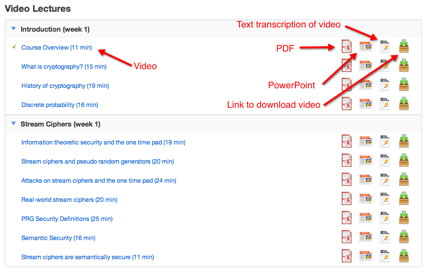
The Video Lectures, which are delivered in small bite-sized pieces, are available online and can be downloaded. The slides are available as PDF and PowerPoint, along with a text-based transcription of the video (great for ADA compliance!).

NewImage

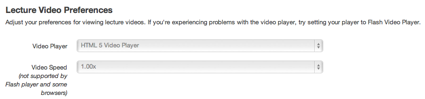
A great feature in the preferences in the ability to toggle the format of the videos – either Flash or HTML5.

NewImage

The HTML5 version looks great on an iPad – even without a Retina display:

Cryptography course


Saturday, March 10, 2012

Public Key Cryptography Explained

Public Key Cryptography: Diffie-Hellman Key Exchange - YouTube:

Diffie-Hellman key exchange was one of the earliest practical implementations of key exchange within the field of cryptography. It relies on the discrete logarithm problem. This test clip will be part of the final chapter of Gambling with Secrets!

Encrypting Your Plaintext Passwords

Yishan Wong provides some advice for websites … Encrypting Your Plaintext Passwords. Although the post is old – end of 2009 – the advice is still relevant. I wonder how many sites still store plaintext passwords.

If you have been following technology news, you may have heard that the popular social application site RockYou was recently hacked, with all user passwords stored in plaintext stolen (over 32 million accounts). This is a terrible security lapse, not just because it compromises every RockYou account, but because many users use the same password across multiple sites, so a file containing emails and plaintext passwords means that the attacker can compromise a great many of these accounts for all those people across the web. Repeat: the popularity of RockYou means that anyone with a RockYou account is likely to have their other accounts on other sites compromised.

Like many people conscious of web security, my initial reaction to the incident was to shake my head and tsk-tsk at RockYou's foolishness at storing their passwords in plaintext, and then I realized that the real problem wasn't that plenty of sites do this, but rather that, yes, plenty of sites out there have done this, but even with this report, they likely have no idea how to fix that problem. Think about it: if you weren't sophisticated enough to encrypt your passwords in the first place, you likely aren't up to the task of migrating your plaintext passwords into an encrypted format, which is a tricky migration involving lots of moving parts and little details.

This blog post is therefore a step-by-step description of how to migrate your site from using plaintext passwords to encrypted passwords. If you run a small (or large) but growing website, you probably want to fix this immediately. If you do not understand all the steps, to find a technical friend (or a reliable contractor) who does, and ask them to implement it for you. I am also available for consulting gigs at a very high hourly rate.

Wednesday, February 29, 2012

Data Locker - Encrypt Your Dropbox Data

Sounds like a great service! Data Locker:

The explosive growth of personal cloud services like Dropbox sends a clear message that computer, tablet, and smartphone users greatly value synchronized data access across all of their devices. But many users struggle with the trade-offs between convenience and concern over the security of personal data stored in the cloud. DataLocker eliminates this concern by enabling users to easily encrypt sensitive information in their Dropbox account without sacrificing the convenience of anywhere access.

The DataLocker suite, offered for free by AppSense Labs, includes native clients for Windows, Mac, iPhone, and iPad. The Windows and Mac clients are capable of encrypting and storing secure files in any local file system or cloud storage location, including Dropbox. The DataLocker iOS application stores files in Dropbox. (Additional storage options are planned in future versions of the iOS application.)


Monday, February 27, 2012

U.S. Courts and Encrypted Hard Drives

I'm more confused now – I'm not sure how the two rulings don't conflict, but I'm not a lawyer.
Via Bruce Schneider … U.S. Federal Court Rules that it is Unconstitutional for the Police to Force Someone to Decrypt their Laptop:
A U.S. Federal Court ruled that it is unconstitutional for the police to force someone to decrypt their laptop computer:
Thursday’s decision by the 11th U.S. Circuit Court of Appeals said that an encrypted hard drive is akin to a combination to a safe, and is off limits, because compelling the unlocking of either of them is the equivalent of forcing testimony.
Here's the actual decision. And another blog post.
Note that this a different case, and an opposite ruling, than this. Although the legal experts say that the rulings are not actually in conflict:
Also note that the court’s analysis isn’t inconsistent with Boucher and Fricosu, the two district court cases on 5th Amendment limits on decryption. In both of those prior cases, the district courts merely held on the facts of the case that the testimony was a foregone conclusion.

Wednesday, January 25, 2012

Can a Judge Compel One to Decrypt Their Laptop?

I guess the answer is yes.

David Kravets reporting … Judge Orders Defendant to Decrypt Laptop:

A judge on Monday ordered a Colorado woman to decrypt her laptop computer so prosecutors can use the files against her in a criminal case.

The defendant, accused of bank fraud, had unsuccessfully argued that being forced to do so violates the Fifth Amendment’s protection against compelled self-incrimination.

“I conclude that the Fifth Amendment is not implicated by requiring production of the unencrypted contents of the Toshiba Satellite M305 laptop computer,” Colorado U.S. District Judge Robert Blackburnruled Monday. (.pdf)

The authorities seized the laptop from defendant Ramona Fricosu in 2010 with a court warrant while investigating financial fraud.

The case is being closely watched (.pdf) by civil rights groups, as the issue has never been squarely weighed in on by the Supreme Court.

Friday, November 18, 2011

Full Disk Encryption and Law Enforcement

From Sebastian Anthony Full disk encryption is too good, says US intelligence agency:

You might be shocked to learn this, but when a quivering-lipped Chloe from 24 cracks the encryption on a terrorist’s hard drive in 30 seconds, the TV show is faking it. “So what? It’s just a TV show.” Well, yes, but it turns out thatreal federal intelligence agencies, like the FBI, CIA, and NSA, also have a problem cracking encrypted hard disks — and according to a new research paper, this is a serious risk to national security.

The study, titled “The growing impact of full disk encryption on digital forensics,” illustrates the difficulty that CSI teams have in obtaining enough digital data to build a solid case against criminals. According to the researchers, one of which is a member of US-CERT — the US government’s primary defense against internet and digital threats — there are three main problems with full disk encryption (FDE): First, evidence-gathering goons can turn off a computer (for transportation) without realizing it’s encrypted, and thus can’t get back at the data (unless the arrestee gives up his password, which he doesn’t have to do); second, if the analysis team doesn’t know that the disk is encrypted, it can waste hours trying to read something that’s ultimately unreadable; and finally, in the case of hardware-level disk encryption, tampering with the device can trigger self-destruction of the data.

The paper does go on to suggest some ways to ameliorate these issues, though: Better awareness at the evidence-gathering stage would help, but it also suggests “on-scene forensic acquisition” of data, which involves ripping unencrypted data from volatile, live memory (with the cryogenic RAM freezing technique, presumably). Ultimately, though, the researchers aren’t hopeful: “Research is needed to develop new techniques and technology for breaking or bypassing full disk encryption,” concludes the paper.

Tuesday, October 11, 2011

RFID Encryption Cracked

German researchers crack RFID encryption:

The physical security of your company and its data just got less secure if your company is one of millions that use a particular kind of smart card designed to give commuters, corporate wage slaves and security specialists quick passage through, security gates and sown the invisible elevator that takes them to the secret headquarters underneath the streets of Cardiff.

A team of German scientistshave demonstrated a hack that lets them make a perfect clone of the kind of magnetic security cardused to give workers in corporate or government buildings –including NASA– and as a daily ticket replacement on busses and subways. The same team broke a previous version of contactless-ID cards fromMifarein2008, prompting the company toupgrade its security, creating a card able to be programmed only once and which contained a unique identifying number that could be checked against the programmed content on the card for extra security.

Higher-functioning cards have come processing capablity, including the ability to create random identifying numbers to help prevent copies,128-bit key encryption, support for AES encryption and a series of other extra features.

...

Researchers David Oswald and Christof Paar atRuhr University in Germany, who worked on the crack of the KeeLoq remote keyless entry system in 2008, used side-channel analysis for both cracks. The technique relies on use of a probe and oscilloscope to record the card's broadcasts while it's being read by and RFID reader.

It takes about seven hours to crack the security on one card and get its 112-bit encryption key, the researchers said. It only works if you've already spent months profiling the card's architecture, behavior and responses. Cracking time could be cut to as little as three hours, Paar and Oswald said.

The weak point for the MF31CD40 – and many of NXD's other cards – is that it does little or nothing to resist being recorded, prodded and poked by crackers.

The EV1 upgrade to that card has an on-chip backup management systems,an authentication mechanism that uses three separate authentication methods, encryption based on the 3DES hardware encryption that meets security requirements for most U.S. government agencies, but is compatible with existing systems designed to read the card using Near Field Communications (NFC) radio systems.

That probably means it does not yet contain any countermeasures able to stave off determined crackers poking it to see how it reacts.[emphasis added – MQ]


Saturday, August 06, 2011

Encrypting Data in the Cloud

Kristin Lauter, Michael Naehrig and Vinod Vaikuntanathan ask Can Homomorphic Encryption be Practical?. The particular application they explore is encrypting cloud-based data while still being able to perform cloud-based computation on the data. Read the full paper here.
Abstract: The prospect of outsourcing an increasing amount of data storage and management to cloud services raises many new privacy concerns for individuals and businesses alike. The privacy concerns can be satisfactorily addressed if users encrypt the data they send to the cloud. If the encryption scheme is homomorphic, the cloud can still perform meaningful computations on the data, even though it is encrypted.

In fact, we now know a number of constructions of fully homomorphic encryption schemes that allow arbitrary computation on encrypted data. In the last two years, solutions for fully homomorphic encryption have been proposed and improved upon, but it is hard to ignore the elephant in the room, namely efficiency -- can homomorphic encryption ever be efficient enough to be practical? Certainly, it seems that all known fully homomorphic encryption schemes have a long way to go before they can be used in practice. Given this state of affairs, our contribution is two-fold.

First, we exhibit a number of real-world applications, in the medical, financial, and the advertising domains, which require only that the encryption scheme is "somewhat" homomorphic. Somewhat homomorphic encryption schemes, which support a limited number of homomorphic operations, can be much faster, and more compact than fully homomorphic encryption schemes.

Secondly, we show a proof-of-concept implementation of the recent somewhat homomorphic encryption scheme of Brakerski and Vaikuntanathan, whose security relies on the ring learning with errors (Ring LWE) problem. The scheme is very efficient, and has reasonably short ciphertexts. Our unoptimized implementation in Magma enjoys comparable efficiency to even optimized pairing-based schemes with the same level of security and homomorphic capacity. We also show a number of application-specific optimizations to the encryption scheme, most notably the ability to convert between different message encodings in a ciphertext.

Thursday, July 14, 2011

Why Wiretapping Wins

In case you didn't read all of Matt Blaze's article, here's his explanation of why wiretapping wins out over encryption.

Wiretapping and Cryptography Today:
[a government eavesdropper can] exploit the fact that the cleartext (or the keys to decrypt it) for almost all encrypted traffic today is typically available, somewhere, on a general-purpose computer that is exposed to government access, either explicitly or through surreptitious means. And as systems become more sophisticated and incorporate more features, the exposure of cleartext and keys to third party access tends to increase correspondingly.

Take, for example, that most ubiquitous instrument of criminal (and legitimate) communication, the cellular phone. In the 1990's, most cellular calls were transmitted over the air as unencrypted analog signals, easily intercepted, by police and curious neighbor alike, with an inexpensive radio receiver. Today cellular signals are almost always encrypted, making over-the-air interception a losing proposition. But the 2010 wiretap reports tells us that the majority of law enforcement wiretaps were for cellular calls, and that encryption was not a barrier. This is because, by 2010, investigators had moved on from over-the-air interception. They found ways instead to tap cellphones at the endpoint where plaintext is available (in the cellular phone company where the call connects to the wireline network).

Thursday, May 26, 2011

What's Bitcoin and Why Should I Care?

MIT's Technology Review magazine has a nice overview of bitcoin. Seems to be using public-key encryption to exchange digital currency.


What Bitcoin Is, and Why It Matters

Nakamoto wanted people to be able to exchange money electronically securely without the need for a third party, such as a bank or a company like PayPal. He based Bitcoin on cryptographic techniques that allow you to be sure the money you receive is genuine, even if you don't trust the sender.
Wikipedia screenshot from Discover app by Cooliris

- Posted using BlogPress from my iPad

Thursday, February 24, 2011

Encryption 101

Great introduction to the basics of encryption from Mike Chapple. Click to read article:
Encryption provides the ability to use mathematical algorithms to protect the confidentiality and integrity of information transmitted via insecure means or stored in an insecure location. While the detailed mathematics underlying encryption may be intimidating, the basic concepts are quite accessible, and all technology professionals should have at least a basic understanding of how encryption provides these security benefits.

Tuesday, December 21, 2010

Data Encryption, the EFF and Code Breaking


An interesting history of DES - the Data Encryption Standard - and the efforts of the Electronic Frontier Foundation to demonstrate the inherent weaknesses in DES. At the time. DES was the federal standard for encryption of all non-classified data. It's interesting that the first crack was demonstrated as early as 1997, but a replacement - the Advanced Encryption Standard (AES) - was not approved until mid 2002.

EFF DES cracker - Wikipedia, the free encyclopedia:
In cryptography, the EFF DES cracker (nicknamed "Deep Crack") is a machine built by the Electronic Frontier Foundation (EFF) in 1998 to perform a brute force search of DES cipher's key space — that is, to decrypt an encrypted message by trying every possible key. The aim in doing this was to prove that DES's key is not long enough to be secure.

DES uses a 56-bit key, meaning that there are 256 possible keys under which a message can be encrypted. This is exactly 72,057,594,037,927,936, or approximately 72 quadrillion, possible keys. When DES was approved as a federal standard in 1976, a machine fast enough to test that many keys in a reasonable amount of time would have cost an unreasonable amount of money to build. 
The DES challenges 

Since DES was a federal standard, the US government encouraged the use of DES for all non-classified data. RSA Security wished to demonstrate that DES's key length was not enough to ensure security, so they set up the DES Challenges in 1997, offering a monetary prize. The first DES Challenge was solved in 96 days by the DESCHALL Project led by Rocke Verser in Loveland, Colorado. RSA Security set up DES Challenge II-1, which was solved by distributed.net in 41 days in January and February 1998. 

In 1998, the EFF built Deep Crack for less than $250,000.[1] In response to DES Challenge II-2, on July 17, 1998, Deep Crack decrypted a DES-encrypted message after only 56 hours of work, winning $10,000. This was the final blow to DES, against which there were already some published cryptanalytic attacks. The brute force attack showed that cracking DES was actually a very practical proposition. For well-endowed governments or corporations, building a machine like Deep Crack would be no problem. 
Six months later, in response to RSA Security's DES Challenge III, and in collaboration with distributed.net, the EFF used Deep Crack to decrypt another DES-encrypted message, winning another $10,000. This time, the operation took less than a day — 22 hours and 15 minutes. The decryption was completed on January 19, 1999. In October of that year, DES was reaffirmed as a federal standard, but this time the standard recommended Triple DES (also referred to as 3DES or TDES). 
The small key-space of DES, and relatively high computational costs of triple DES resulted in its replacement by AES as a Federal standard, effective May 26, 2002.
 Photo German-Dutch Enigma machine by Bogdan Migulski - http://flic.kr/p/4yfuYE

Wednesday, March 10, 2010

RSA 1024-bit Private Key Encryption Cracked

safe.jpgWow - cracking a 1024 bit key. This is pretty impressive. Makes we wonder the capabilities the NSA has.

RSA 1024-bit private key encryption cracked - Techworld.com
Three University of Michigan computer scientists say they have found a way to exploit a weakness in RSA security technology used to protect everything from media players to smartphones and ecommerce servers.

RSA authentication is susceptible, they say, to changes in the voltage supply to a private key holder. The researchers – Andrea Pellegrini, Valeria Bertacco and Todd Austin - outline their findings in a paper titled ‘Fault-based attack of RSA authentication’  to be presented 10 March at the Design, Automation and Test in Europe conference.

'The RSA algorithm gives security under the assumption that as long as the private key is private, you can't break in unless you guess it. We've shown that that's not true,' said Valeria Bertacco, an associate professor in the Department of Electrical Engineering and Computer Science, in a statement

I'll have to read the paper to learn more about how this is done, but I'm fascinated by the idea of a varying electric current to "stress out" the computer.
While guessing the 1,000-plus digits of binary code in a private key would take unfathomable hours, the researchers say that by varying electric current to a secured computer using an inexpensive purpose-built device they were able to stress out the computer and figure out the 1,024-bit private key in about 100 hours – all without leaving a trace.

The researchers in their paper outline how they made the attack on a SPARC system running Linux. They also say they have come up with a solution, which involves a cryptographic technique called salting that involves randomly juggling a private key's digits.

Thursday, February 18, 2010

Steganography Podcast - Embedding Secret Messages in Online Conversations


On February 15, 2010, Gordon Snyder and I recorded a podcast titled Vice over IP: Embedding Secret Messages in Online Conversations. In the podcast we discuss embedding secret messages in images and Voice over IP sessions using a technology called steganography. The podcast is based on an excellent article in this months IEEE Spectrum titled Vice Over IP: The VoIP Steganography Threat. Here's a list of some of the questions we answer:

Before we delve into this new topic, lets provide the audience with a little background. First what is steganography - sounds like a dinosaur?
Can you give us some examples?
How does steganography work?
How do we stop it? Can we?
How would spectrum analysis help detect these messages?
What is network steganography and how does it work?
What are the three methods or flavors of network steganography that researchers have developed? Can you describe each?
Should we be worried?


Fascinating and interesting stuff. Here's how to listen:

To access show notes and audio of our 24 minute and 5 second podcast titled 
Vice over IP: Embedding Secret Messages in Online Conversationsclick here.

Listen to it directly in your web browser by clicking here.

If you have iTunes installed you can subscribe to our podcasts by clicking here.

LinkWithin

Related Posts Plugin for WordPress, Blogger...