Hackaday Links Column Banner

Hackaday Links: October 11, 2026

It probably goes without saying that if you send four humans to observe the Moon up close, they’ll see things that those of us stuck here on Earth have never noticed. Luckily for us, they took impeccable notes and brought plenty of cameras, which NASA has shared with the rest of the class as Artemis II: Sights & Sounds of Science.

Well, technically it’s called the Artemis II Preliminary Lunar Science Report, but we appreciate the space agency adding a little flair to it and formatting the findings for public consumption. Arguably the most significant observations detailed in the report are the impact flashes on the lunar surface. As you may recall, the trajectory of the Orion spacecraft meant the crew experienced a unique solar eclipse on the sixth day of the mission, giving them an unprecedented close-up view of the darkened Moon. During this time, they were able to see flashes of light with their unaided eyes, which NASA has since confirmed were small rocky fragments — perhaps no more than a few inches wide — slamming into the lunar surface at incredible speeds.

To boldly go where no whisky has gone before.

The Artemis II mission was one for the history books, for most of us the most significant space mission of our lifetimes. But as access to space becomes cheaper and more routine, it stands to reason that not all activities in orbit will be quite so momentous. For example, students from the University of Glasgow and Japan’s Kyushu Institute are currently collaborating on a planned mission to distill whisky in space for the first time.

Scheduled to launch in 2028, the CubeSat will carry 10 ml of fluid and spend five years in orbit studying how its chemical composition changes, with a special interest in how the frequent changes experienced as the spacecraft travels around the Earth could influence the maturing process. While this might not seem terribly interesting to teetotalers, it offers an opportunity to gain more practical experience with orbital manufacturing which will likely inform future missions.

Continue reading “Hackaday Links: October 11, 2026” →

Hackaday Links Column Banner

Hackaday Links: May 10, 2026

While Artemis II was primarily a demonstration flight of the architecture NASA plans to use for future lunar missions, it was also an excellent excuse for the crew to snap some photos of the Moon and Earth with the benefit of modern camera technology. If you’ve been looking forward to seeing more of the crew’s images, you’re in luck, as thousands of new images have recently been released.

Now we don’t mean to beat up on the folks at NASA, but browsing through these images, we couldn’t help but be reminded of an article we saw on PetaPixel that discussed the space agency’s haphazard approach to sharing images online.

It’s really more like an unsorted file dump than anything, made worse by the fact that you have to access it through a government website that looks and performs like it was designed in the early 2000s. There’s even a prominent button that attempts to load a gallery feature that relies on the long-deprecated Adobe Flash. It would be nice to see the situation improved by the time astronauts actually touch down on the lunar surface, but we wouldn’t count on it.

Speaking of old tech, we’ve been following the resurgence of keyboard-equipped smartphones with great interest, as we imagine many of you have been. A recent CNBC article addresses the trend, although it didn’t quite take the nerd contingent into account. We want physical keys so we can work in the terminal and write code without fighting an on-screen keyboard, but of course, that’s not exactly what your average consumer is looking for.

It’s quite the opposite, in fact. A 20-something user referenced in the article explained how the younger generations see the physical keyboard as a way to be less connected to their phones, describing it as “an extra barrier of inconvenience that adds more steps into the thinking process.” If you need us, we’ll be collecting dust in the corner.

Continue reading “Hackaday Links: May 10, 2026” →

Hackaday Links Column Banner

Hackaday Links: April 26, 2026

It’s been three weeks since the Artemis II crew returned to Earth, and while the mission might be over for Reid Wiseman, Victor Glover, Christina Hammock Koch, and Jeremy Hansen, the work is only just beginning for engineers back at NASA. In a blog post earlier this week, the space agency went over the preliminary post-mission assessments of the spacecraft and its ground support equipment, and detailed some of the work that’s currently taking place as preparations begin for Artemis III.

During Artemis I, higher than expected damage was noted on both the Orion’s heat shield and the Space Launch System (SLS) launch pad. But according to NASA, the changes implemented after that first mission seem to have prevented similar issues this time around. The post also explains that reusable components of the Orion spacecraft, such as the avionics and the crew seats, are already in the process of being removed from Integrity so they can be installed in the next capsule on the production line.

While watching the live stream of the Artemis mission is the closest most of us will ever get to experiencing spaceflight, that doesn’t mean you can’t explore the solar system from the comfort of your own home — or more specifically, your browser. [Sani Huttunen] has created an incredible web-based solar system simulator that lets you explore our celestial neighborhood throughout different periods of time. You can tour the moons of Jupiter, see how the planets aligned on the date of your birth, and even check in on the Voyager probes. There are some very valid reasons to be skeptical about software moving to the web, but we’ve got to admit, this is a very slick demonstration of just how far modern browsers have come.

Continue reading “Hackaday Links: April 26, 2026” →

Hackaday Links Column Banner

Hackaday Links: April 12, 2026

At this point, we’ll assume you already know that four humans took a sightseeing trip around the Moon and made their triumphant return to Earth on Friday. Even if you somehow avoided hearing about it through mainstream channels, we kept a running account of the mission’s highlights stuck to the front page of the site for the ten days that the crew was in space.

On the assumption that you might be a bit burned out with space news at this point, we won’t bring up it up in this post… other than to point out that excitement for the lunar flyby has driven the number of simultaneous players of Kerbal Space Program to its highest count ever — nearly 20,000 armchair astronauts spent this weekend trying to cobble together their own rocket in honor of the Artemis II mission.

With so many folks focused on the Moon it would be the perfect time for a company to sneak out some bad news, which is perhaps why Amazon picked this week to announce they would be dropping support for Kindles released before 2012. Presumably there aren’t too many first and second generation Kindles still out there in the wild, but the 2012 cutoff does mean the first iteration of the Paperwhite will be one of the devices being put out to pasture come May 20th.

Continue reading “Hackaday Links: April 12, 2026” →

In Space (Probably) Everyone Can Hear You.. Well, You Know

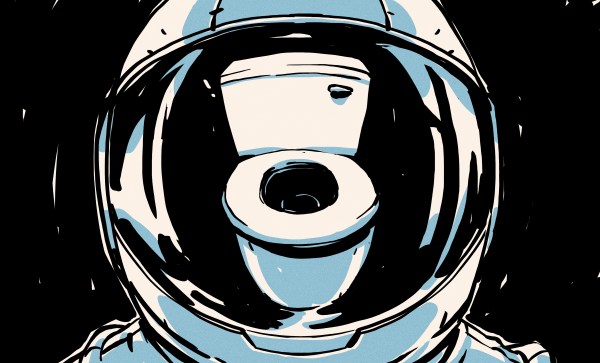
The news is full of reports from the moon-bound Integrity, otherwise known as Artemis II. Mostly, the news is good, but there has been one “Houston, we have a problem…” moment. The space toilet, otherwise known as the Universal Waste Management System or UWMS is making a burning smell while in use. While we would love to be astronauts, we really don’t want to go ten days without using the can, and it made us wonder how, exactly, the astronauts answered the call of nature.

The Old Days

Back in the Apollo-era, going to the bathroom was a messy business. The capsule wasn’t that big, and there were no women on board. So you simply strapped an adhesive-rimmed bag or tube to yourself and answered nature’s call with your two closest coworkers right there.

Space Shuttle facilities (by [Svobodat] CC BY-SA 3.0)
To add insult to injury, the “#2 bags” needed some packet mixed in to keep it from going bad in the bag before it could return to Earth for — no kidding — scientific study.

The system was far from perfect. Apollo 8 and Apollo 10 both had to do some housekeeping due to leaky bags.

Astronaut Ken Mattingly reportedly said, “Man, one of the feats of my existence the other day was, in 42 minutes, I strapped on a bag, went out of both ends, and ate lunch…. I used to want to be the first man to Mars. This has convinced me that, if we got to go on Apollo, I ain’t interested.”

Still, it was better than the first Mercury launch, where Alan Shepard famously relieved himself in his spacesuit while sitting on the pad for over eight hours. Later missions used hoses.

Things got slightly better with Skylab, where there was more room. The Shuttle also had a toilet. You got a curtain for privacy, but you couldn’t go #1 and #2 at the same time. Also, apparently, the contraptions were not easily workable for females.

Continue reading “In Space (Probably) Everyone Can Hear You.. Well, You Know” →

Hackaday Links Column Banner

Hackaday Links: March 22, 2026

On Friday, Reuters reported that Amazon is going to try to get into the smartphone game…again. The Fire Phone was perhaps Amazon’s biggest commercial misstep, and was only on the market for about a year before it was discontinued in the summer of 2015. But now industry sources are saying that a new phone code-named “Transformer” is in the works from the e-commerce giant.

At this point, there’s no word on how much the phone would cost or when it would hit the market. The only information Reuters was able to squeeze out of their contacts was that the device would feature AI heavily. Real shocker there — anyone with an Echo device in their kitchen could tell you that Amazon is desperate to get you talking to their gadgets, presumably so they can convince you to buy something. While a smartphone with even more AI features we didn’t ask for certainly won’t be on our Wish List, if history is any indicator, we might be able to pick these things up cheap on the second-hand market.

On the subject of AI screwing everything up, earlier this week, the Electronic Frontier Foundation reported that The New York Times had started blocking the Internet Archive’s crawlers, citing concerns over their content being scraped up by bots for training data. The EFF likens this to a newspaper asking libraries to stop storing copies of their old editions, and warns that in an era where most people get their news via the Internet, not having an archived copy of sites like The Times will put holes in the digital record. They also point out that mirroring web pages for the purposes of making them more easily searchable is a widely accepted practice (ask Google) and has been legally recognized as fair use in court.

Assuming we take the NYT’s side of the story at face value, there’s a tiny part of our cold robotic heart that feels some sympathy for them. Over the last year or so, we’ve noticed some suspicious activity that we believe to be bots siphoning up content from the blog and Hackaday.io, and it’s resulted in a few technical headaches for us. On the other hand, what’s Hackaday here for if not to share information? Surely the same could be said for any newspaper, be it the local rag or The New York Times. If a chatbot learning some new phrases from us is the cost of doing business in 2026, so be it. Can’t stop the signal.

Continue reading “Hackaday Links: March 22, 2026” →