Hackaday Links Column Banner

Hackaday Links: October 11, 2026

It probably goes without saying that if you send four humans to observe the Moon up close, they’ll see things that those of us stuck here on Earth have never noticed. Luckily for us, they took impeccable notes and brought plenty of cameras, which NASA has shared with the rest of the class as Artemis II: Sights & Sounds of Science.

Well, technically it’s called the Artemis II Preliminary Lunar Science Report, but we appreciate the space agency adding a little flair to it and formatting the findings for public consumption. Arguably the most significant observations detailed in the report are the impact flashes on the lunar surface. As you may recall, the trajectory of the Orion spacecraft meant the crew experienced a unique solar eclipse on the sixth day of the mission, giving them an unprecedented close-up view of the darkened Moon. During this time, they were able to see flashes of light with their unaided eyes, which NASA has since confirmed were small rocky fragments — perhaps no more than a few inches wide — slamming into the lunar surface at incredible speeds.

To boldly go where no whisky has gone before.

The Artemis II mission was one for the history books, for most of us the most significant space mission of our lifetimes. But as access to space becomes cheaper and more routine, it stands to reason that not all activities in orbit will be quite so momentous. For example, students from the University of Glasgow and Japan’s Kyushu Institute are currently collaborating on a planned mission to distill whisky in space for the first time.

Scheduled to launch in 2028, the CubeSat will carry 10 ml of fluid and spend five years in orbit studying how its chemical composition changes, with a special interest in how the frequent changes experienced as the spacecraft travels around the Earth could influence the maturing process. While this might not seem terribly interesting to teetotalers, it offers an opportunity to gain more practical experience with orbital manufacturing which will likely inform future missions.

Continue reading “Hackaday Links: October 11, 2026” →

Hackaday Links Column Banner

Hackaday Links: August 23, 2026

We’ll start this week off with some disappointing, though not entirely unexpected, news — the ambitious commercial mission to save NASA’s Neil Gehrels Swift Observatory is officially a bust. The space agency provided an update earlier this week explaining that the attitude control issues with the LINK spacecraft that started a few weeks after it launched will prevent it from being able to safely dock with the Swift Observatory and boost its altitude. As such, the space telescope is now expected to reenter the Earth’s atmosphere and burn up before the end of the year.

Although LINK won’t be able to live up to its name, NASA did say operator Katalyst Space has been given permission to continue with the rendezvous attempt. The two craft won’t actually make contact with each other, but teams on both sides feel there’s lessons to be learned and data to be collected by seeing the orbital dance of these two vehicles play out for as long as possible.

Speaking of hardware that couldn’t quite hit its design goals, TechCrunch is reporting that a class action lawsuit has been filed against Oura by customers that say the company made misleading claims about the sleep-tracking accuracy of their smart rings. Namely, that the rings could somehow detect which stage of sleep the wearer was in with only the pulse and temperature sensors it has onboard.

Continue reading “Hackaday Links: August 23, 2026” →

Hackaday Links Column Banner

Hackaday Links: September 7, 2025

Two weeks ago, it was holographic cops. This week, it’s humanoid robot doctors. Or is it? We’re pretty sure it’s not, as MediBot, supposedly a $10,000 medical robot from Tesla, appears to be completely made up. Aside from the one story we came across, we can’t find any other references to it, which we think would make quite a splash in the media if it were legit. The article also has a notable lack of links and no quotes at all, even the kind that reporters obviously pull from press releases to make it seem like they actually interviewed someone.

Continue reading “Hackaday Links: September 7, 2025” →

Surfing The Web Like It’s 1978 — Carbonyl

[Fathy] gets a kick out of doing odd things with Chromium, and Carbonyl is a clever byproduct of that hobby. In this case, it’s what you get when you connect chrome’s renderer to an SVG output module and then convert that SVG to colored characters on a terminal. See, html2svg is an earlier project, taking Chromium’s Skia engine and plugging it into an SVG back-end. And once you have SVG, why not render it to the terminal?


And the results are actually pretty impressive. Imagery is rendered using Unicode 2584, a half-block character. The background and foreground color can be set per character, giving us two controllable pixels per character. Text is handled a bit differently, rendering using the normal text fonts, making for readable pages.

The source is very much a work in progress, but there are some neat ideas already coalescing around the project, like using sixels for better rendering. There’s already decent mouse support and audio output, making for an impressive terminal experience. This might be a project to keep an eye on.

Turn Timing Diagrams Into ASCII Art, For Friendlier Pasting

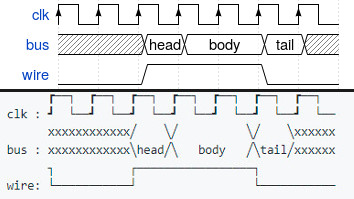
We all use text-based fields at one time or another, and being limited to ASCII only can end up being a limitation. That’s what led [Luke Wren] to create asciiwave, a fantastic tool that turns WaveDrom timing diagrams into ASCII art. Unlike images, ASCII timing diagrams are suitable for pasting into comment fields, change logs, or anywhere else that accepts text only. [Update: As the author kindly shared in the comments below, this tool’s original niche is pasting into HDL (e.g. Verilog) source code comments, where it has a special kind of usefulness.]

WaveDrom itself is a nifty JavaScript tool that we have covered before. It accepts timing diagrams expressed as JSON data, and renders nicely-readable digital timing diagrams as images directly inside one’s browser.

As cool and useful as that is, images can’t be pasted into text fields. That’s where asciiwave comes in. It reads the exact same format that WaveDrom uses, but generates an ASCII-art timing diagram instead. So if you’ve found WaveDrom useful, but wish you could generate ASCII versions, here’s your solution.

3D ASCII art

Online Tool Turns STLs Into 3D ASCII Art

If you look hard enough, most of the projects we feature on these pages have some practical value. They may seem frivolous, but there’s usually something that compelled the hacker to commit time and effort to its doing. That doesn’t mean we don’t get our share of just-for-funsies projects, of course, which certainly describes this online 3D ASCII art generator.

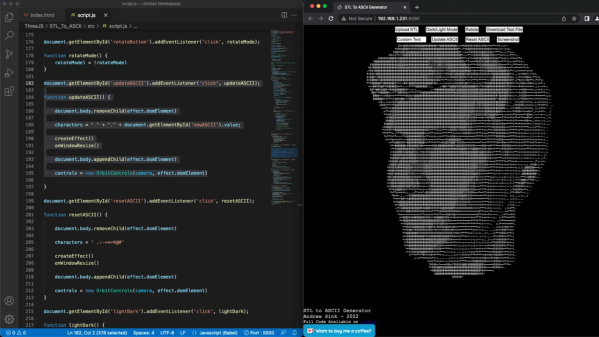
But wait — maybe that’s not quite right. After all, [Andrew Sink] put a lot of time into the code for this, and for its predecessor, his automatic 3D low-poly generator. That project led to the current work, which like before takes an STL model as input, this time turning it into an ASCII art render. The character set used for shading the model is customizable; with the default set, the shading is surprisingly good, though. You can also swap to a black-on-white theme if you like, navigate around the model with the mouse, and even export the ASCII art as either a PNG or as a raw text file, no doubt suitable to send to your tractor-feed printer.

[Andrew]’s code, which is all up on GitHub, makes liberal use of the three.js library, so maybe stretching his 3D JavaScript skills is really the hidden practical aspect of this one. Not that it needs one — we think it’s cool just for the gee-whiz factor.

Continue reading “Online Tool Turns STLs Into 3D ASCII Art” →

Enjoy An ASCII Version Of Star Wars In The Palm Of Your Hand For May The 4th

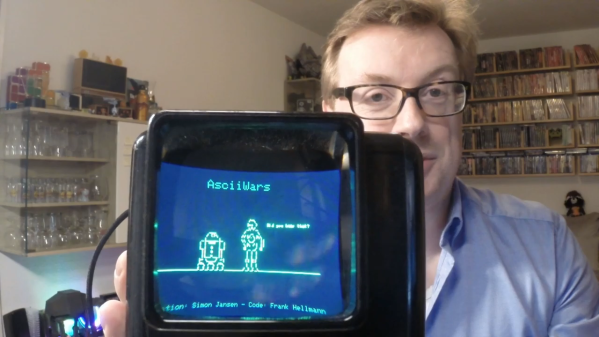
Everyone by now has probably seen the original — and best; fight us — installment of the Star Wars franchise, and likely the ASCII-art animation version of it that improves greatly on the film by eliminating all those distracting special effects, human actors, and the soundtrack. But what we haven’t had until now is a portable player for ASCIIWars, to enjoy the film in all its character-based glory while you’re on the go.

While this tribute to [Simon Jansen]’s amazing ASCII-art achievement might seem like a simple repackaging of the original, [Frank] actually had to go to some lengths to make this work. After getting [Simon]’s blessing, the build started with a WEMOS D1 Mini, a good platform for the project less for its wireless capabilities and more for its 4 MB of flash memory. A 240×360 TFT LCD display was selected to show the film; the scale of the display made most fonts hard to read, so [Frank] used Picopixel, a font designed for legibility on small screens. The animation file is stored on the SPIFFS file system on the D1’s flash memory, and a few lines of code parse it and send it to the display. The final touch is mounting the whole thing is an old slide viewer, which magnifies the display to make it a little easier to see.

As much as we applaud [Frank]’s tribute to [Simon]’s effort, there’s no reason to confine this to the Star Wars universe. If you read up on the history of ASCII art, which goes surprisingly far back, you might be inspired to render another classic film in ASCIImation and put it on a viewer like this. ASCII-Metropolis, anyone?

Continue reading “Enjoy An ASCII Version Of Star Wars In The Palm Of Your Hand For May The 4th” →