Single Button, Handheld Gaming Console

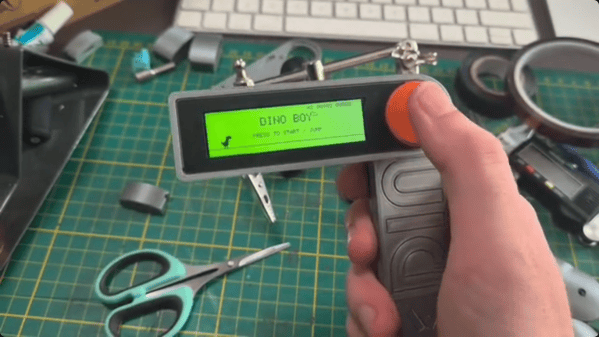
Those of us who grew up in the 70s and 80s might be familiar with the Atari 2600 console and its now relatively unrecognizable (by modern standards) controller with only a single button and stiff whole-hand joystick. By comparison, the Steam Deck has somewhere around 24 buttons and two joysticks depending on how they are counted. But even the Atari might be providing more user inputs than are really necessary for quality gaming. Take a look at the Dinoboy, a handheld console with only a single button.

Part of what makes this system work is that it’s playing the classic dinosaur jumping game first included in Google Chrome which loads when the browser can’t connect to the Internet, and the user’s single input was the space bar. In this case, the handheld has its single button where the user’s thumb naturally rests. The console itself is in two parts, hinged where the button is placed. When unfolded, the top half reveals a wide screen and the bottom half is held by the hand. The screen supports two color formats, a black and white style and another which replicates the dot matrix display of the original Game Boy.

The small handheld console has another trick up its sleeve too. [Paul], the system’s creator, built it as a way to stop doomscrolling so along with having this quick-deploying game on hand, there’s also an NFC tag hidden near the hinge which, when swiped passed a phone, also turns that phone’s airplane mode on. It’s a double-whammy of removing the gamer from the dark patterns and algorithms dominating the mainstream Internet. And, this isn’t [Paul]’s only dinosaur jumper console either. We recently featured a similar (but much larger) build of his housed in a classic arcade-style cabinet.


This Week In Security: New Spectre Attacks, Crushing Quantity Of Linux Vulns, Google Gets Too Much AI, And Hacking Lawnmowers

Just-in-time, or JIT, compilation could be considered a fundamental backbone of modern computing.  JIT compilation turns scripting languages like JavaScript or intermediary binary forms like Web Assembly into native code on the fly, giving web apps, and things that are web apps under the covers like Electron-based tools, near native speed.  A new paper explores leveraging JIT systems to revive Spectre-v2 attacks against processors.

Most modern processors gain performance by using a trick called “speculative execution”.  The processor guesses the likely result of a compare, and begins executing some of the next instructions before the results are actually known.  If the processor guessed right, things continue and there is a speed gain because it can jump ahead, but if the processor guessed wrong, any instructions that were run and any side effects of running them are discarded and execution resumes on the actual path.  In theory, anyhow.

In practice, the Spectre class of attacks targets branch prediction. It was discovered that when the wrong branch was chosen, not all of the results were truly hidden; Patterns of failures in guessing branches can be used to leak behavior processing encryption keys and other activities. The attacks evolved with the research dubbed Spectre-V2, which showed that non-privileged contexts, like non-root users and virtual machines, could poison the instruction prediction and use it to read arbitrary memory.  Fixes to the Linux kernel and other platforms were required to mitigate the worst of the effects.

The paper shows that by using self-modifying code in the JIT, the processor can be tricked into loading cached versions of the instructions.  The fixes to the kernel to prevent Spectre attacks include identifying malicious code patterns that attack the branch prediction, and stopping or changing them:  By causing the CPU to execute the cached copy of instructions instead of the live copy, the attack ignores the fixed instructions entirely and can attack the branch prediction algorithm.

To prove the attack is feasible in the real world, the researchers targeted several JIT compilers, including the SpiderMonkey JavaScript engine used by Firefox, the eBPF JIT found in the Linux kernel, and GraalVM, the JIT used in Python.  They found success with each, demonstrating that the attack is at least plausible.

Research like this is unlikely to be an instant world-melter, and will help find possible mitigations in the future to prevent these sorts of attacks.  Operating systems that support a high-security “lock-down” mode, like macOS and iOS, often disable JIT entirely, out of concern about these sorts of attacks.  There’s probably no need to start disabling JIT on every system, but attacks like these have a tendency to evolve.

Continue reading “This Week In Security: New Spectre Attacks, Crushing Quantity Of Linux Vulns, Google Gets Too Much AI, And Hacking Lawnmowers” →

Hackaday Links Column Banner

Hackaday Links: August 2, 2026

About a month ago, we brought you word that the commercial rescue mission designed by Katalyst Space to save NASA’s Swift gamma-ray observatory had reached orbit and early indicators were looking good. Unfortunately, it didn’t take long for things to start going sideways, and up until very recently, the situation seemed pretty dire. But according to an interview with Katalyst’s CEO published yesterday by Ars Technica, the company has made some impressive progress on getting things back under control.

For reasons unknown, the robotic vehicle started tumbling out of control last week. Shortly after that, mission controllers lost contact with Swift. After 24 hours without contact from the ground, the spacecraft automatically performed a sort of “hard reset” in an attempt to regain communications. That got it talking again, but somewhere along the way the craft overheated, which in turn cooked the control circuitry for the reaction wheels, which would usually be used to control its orientation. Not great, not terrible.

As of yesterday’s update, we now know that engineers have figured out a way to gimbal the thrust from the craft’s xenon-fueled electric thrusters — which were originally intended for orbit-raising — to counteract its spinning. It’s slow going as these thrusters don’t have a lot of kick, but it seems to be working. We’ll keep an eye on this one and let you know when we know more.

Continue reading “Hackaday Links: August 2, 2026” →

Pong-like Cabinet For Classic Dinosaur Jumper

Back when Google ran a functional search engine, there used to be all kinds of quirky, fun antics hidden in their products. From Easter eggs in certain search results, to a flight simulator hidden in Google Maps, to funny, engaging April Fools jokes, it was a lighter, less corporate time. Now, though, to recreate any of that early Google magic, we have to do it on our own, and [Paul] has come up with an arcade cabinet for the classic Google Chrome dinosaur game that does just that.

Although the Dinosaur Game is still available in modern versions of Google Chrome, it lends itself almost perfectly to an arcade cabinet. Built from 18 mm plywood, the cabinet is standard DIY arcade fare with a built-in shelf to house the electronics and a 4:3 flatscreen monitor for a display. The Raspberry Pi 3B is also just enough to run the game, but the software running on it is unique. The Pi runs an operating system called FullPageOS, which automatically loads a modified version of the Dino jumper in full-screen mode. It’s been changed to look more like an arcade game than a browser Easter egg, with features like a leaderboard and an automatic-play screensaver mode, and the build is rounded out by a cactus-shaped scratching post to accompany the cabinet.

As for gameplay, we couldn’t ask for a simpler user interface. A single button is all that’s needed for this game, and it’s surprisingly engaging. It is a bit large for a single-button game, even with its reduced-width cabinet, so if you’re looking for something smaller, you could always base it on a tabletop arcade system instead.

Google Earth Desktop Client To Be Retired In 2027

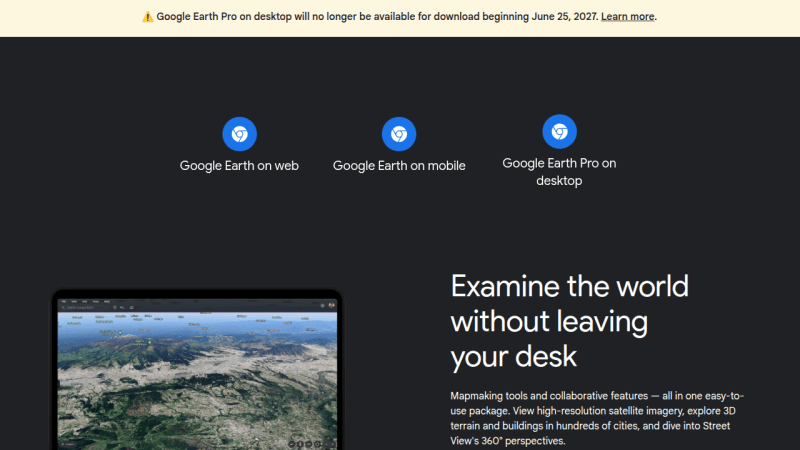
Come next year, those looking to explore the globe virtually via Google Earth will have to do so on their smartphone or from within their browser, as the search giant has decided to discontinue the service’s desktop client in June 2027.

The good news is, the lights won’t be going out immediately. According to a post made on Google Earth’s official support community by Community Manager [Aamir F.], the June cutoff date applies to new downloads, but nothing is changing on the backend, so existing installs will continue to work.

Continue reading “Google Earth Desktop Client To Be Retired In 2027” →

Hackaday Links Column Banner

Hackaday Links: March 1, 2026

We’ll start this week off with a bit of controversy from Linux Land. Anyone who’s ever used the sudo command knows that you don’t see any kind of visual feedback while entering your password. This was intended as a security feature, as it was believed that an on-screen indicator of how many characters had been entered would allow somebody snooping over your shoulder to figure out the length of your password. But in Ubuntu 26.04, that’s no longer the case. The traditional sudo binary has been replaced with a one written in Rust, which Canonical has recently patched to follow the modern convention of showing asterisks on the password prompt.

As you might expect, this prompted an immediate reaction from Linux greybeards. A bug report was filed just a few days ago demanding that the change be reverted, arguing that breaking a decades-old expectation with no warning could be confusing for users. The official response from a Canonical dev was that they see it the other way around, and that the change was made to improve the user experience. It was also pointed out that those who want to revert to the old style of prompt can do so with a config change. The issue was immediately marked as “Won’t Fix”, but the discussion is ongoing.

Speaking of unexpected changes, multiple reports are coming in that the February security update for Samsung Galaxy devices, which is currently rolling out, removes several functions from the Android recovery menu. After the update is applied to phones such as the S25 and Fold 7, long-standing features, such as the ability to wipe the device’s cache partition or install updates via Android Debug Bridge (ADB), disappear.

Continue reading “Hackaday Links: March 1, 2026” →

Google Is Building A New OS

Windows, macOS, and Linux are the three major desktop OSs in today’s world. However, there could soon be a new contender, with Google stepping up to the plate (via The Verge).

You’ve probably used Google’s operating systems before. Android holds a dominant market share in the smartphone space, and ChromeOS is readily available on a large range of notebooks intended for lightweight tasks. Going forward, it appears Google aims to leverage its experience with these products and merge them into something new under the working title of “Aluminium OS.”

The news comes to us via a job listing, which sought a Senior Product Manager to work on a “new Aluminium, Android-based, operating system.” The hint is in the name—with speculation that the -ium part of Aluminium indicates its relationship to Chromium, the open-source version of Chrome. The listing also indicated that the new OS would have “Artificial Intelligence (AI) at the core.” At this stage, it appears Google will target everything from cheaper entry level hardware to mid-market and premium machines.

It’s early days yet, and there’s no word as to when Google might speak more officiously on the topic of its new operating system. It’s a big move from one of the largest tech companies out there. Even still, it will be a tall order for Google to knock off the stalwart offerings from Microsoft and Apple in any meaningful way. Meanwhile, if you’ve got secret knowledge of the project and they forget to make you sign an NDA, don’t hesitate to reach out!