

The pogo-quadcopter on ice

Pogo-Bot Goes All Terrain With Compliant Foot

What do you get when you combine a pogo stick, a quadcopter, and engineering students from the University of Toronto? This thing, apparently– a “monopedal hopping robot” that uses a spikey, pivoting foot pad tensioned by what look like elastic bands to keep it upright on all terrain from soft sand to hard ice.

It’s an interesting concept. The thrust from the four propellers is what gives the energy to get the robot moving, but its pogo-like hopping is entirely down to the spring-loaded single legged “landing gear”. Early iterations just used a spike on the end of that leg, but that failed in ways that some might find humorous, which you will see if you watch the video embedded below. Giving the monopod an actual foot with some traction and the ability to pivot and match the terrain works much better– now not only can this robot leap tall fences in a single bound, an errant ice patch won’t send it skittering away.

This isn’t the first one-legged robot we’ve seen; some only use their leg while others have wings, but this odd quadcopter is the first we’ve seen to brave Canadian winter. Continue reading “Pogo-Bot Goes All Terrain With Compliant Foot” →
Tiny Pogo Robot Gets Wings, Does Flips

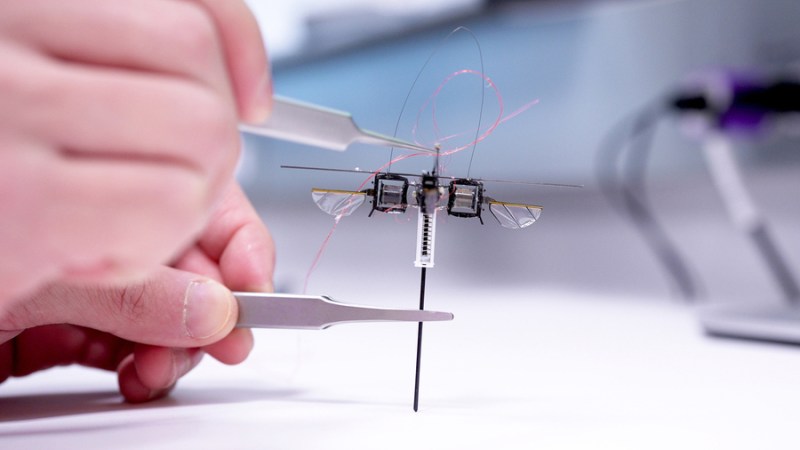
Most robots depend on controlled environments, because the real world is hard to get around in. The smaller the robot, the bigger this problem because little wheels (or legs) can take only little steps. One way around that is MIT’s latest one-legged hopping robot, which sports a set of four insect-like wings on its top end and can quickly pogo-hop its way across different terrain with ease.

The four wings provide lift, and steer the robot so that its single leg lands precisely.

The wings aren’t for flying in the usual sense. They provide lift, but also help the tiny device steer itself so that its hops land precisely. Earlier incarnations of one-legged hopping robots (like this one) accomplished this with propellers and electric motors, but traditional motors are a non-starter on a device that weighs less than a paperclip.

Right now, this little winged hopper is not completely self-contained (power and control systems are off-board) but running it as a tethered unit allows researchers to test and evaluate different, minimalistic ways for a machine to move around efficiently. And efficiency is the whole goal of going in this direction.

Certainly tiny flying drones already exist and get about in the real world just fine. But if one wants to shed mass, ditch conventional motors, and reduce cost and power consumption, this tiny winged hopping machine is one way to do it. And it can even carry payloads! The payloads are tiny, of course, but being able to haul around ten times one’s own weight and still function reliably is an impressive feat.

You can watch it in action in the video embedded just below the page break. Once you’ve watched that, we’d like to remind you that novel locomotion isn’t just the domain of hopping robots. Tiny robots with explosive joints is just as wild as it sounds.

Continue reading “Tiny Pogo Robot Gets Wings, Does Flips” →









