Log In


Apatite
A group of related mineral species
This page kindly sponsored by Matt Zukowski

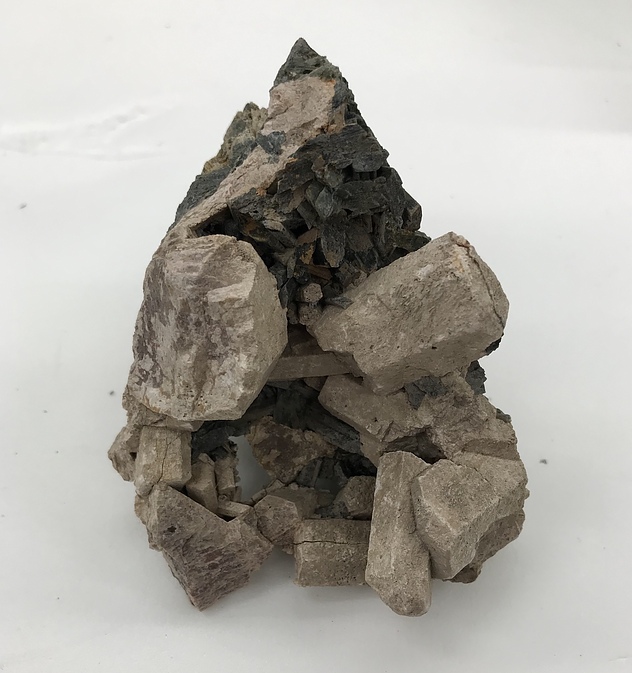

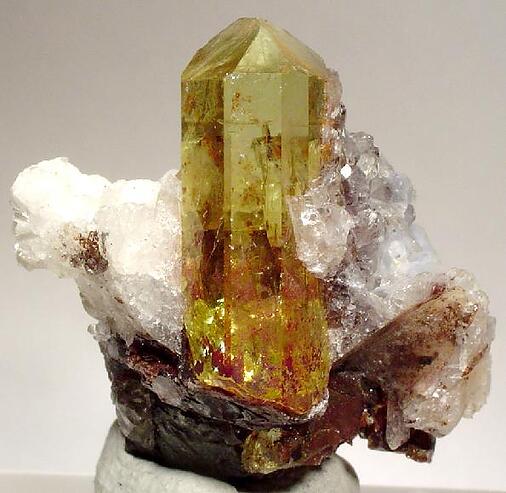

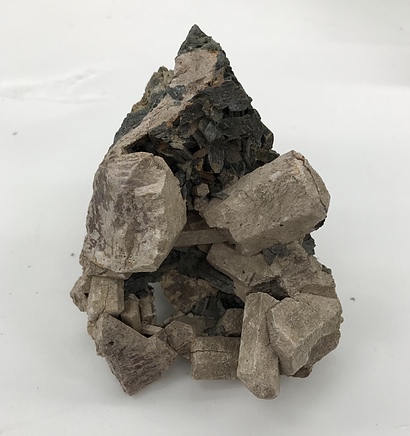

About Apatite
Formula:
Ca5(PO4)3A
A = F, Cl or OH
Member of:
Name:
The name ('Apatit') was invented by A.G. Werner probably sometime in the mid-1780s, which he later described as being named from the Greek verb απατάω (strictly ἀπατάω; transliterated as apatáō) as the derivation, which means ‘to deceive (someone)’ or ‘to be deceptive’, because, as he wrote, "until now it has misled all mineralogists in its identification." (Roycroft & Cuypers, 2015).
"Apatite" is a field term for unidentified calcium phosphate members of the apatite group.
Most "apatite" is fluorapatite, whereas hydroxylapatite is much less common and chlorapatite is very rare.
"Apatite" crystals are short to long hexagonal prisms [0001], with {1010} and {1011} dominant; also thick tabular {0001}, frequently in the crystals of hydrothermal origin in pegmatites and veins, with {1010}, relatively large {0001}, and often also {1011} or low pyramids. Massive, coarse granular to compact. Globular or reniform at times with a sub-fibrous, scaly, or imperfectly columnar structure or as fibrous crusts; stalactitic; earthy; oolitic. May be rock-forming in beds of great extent; as nodular concretions in clays and shales; conglomeritic.
Apatite may be confused with beryl, milarite or phenakite.
Some apatites from Kazakhstan show the alexandrite effect, being yellowish-green in daylight and a pinkish-orange under incandescent light.
 Visit gemdat.org for gemological information about Apatite.
Most "apatite" is fluorapatite, whereas hydroxylapatite is much less common and chlorapatite is very rare.
"Apatite" crystals are short to long hexagonal prisms [0001], with {1010} and {1011} dominant; also thick tabular {0001}, frequently in the crystals of hydrothermal origin in pegmatites and veins, with {1010}, relatively large {0001}, and often also {1011} or low pyramids. Massive, coarse granular to compact. Globular or reniform at times with a sub-fibrous, scaly, or imperfectly columnar structure or as fibrous crusts; stalactitic; earthy; oolitic. May be rock-forming in beds of great extent; as nodular concretions in clays and shales; conglomeritic.
Apatite may be confused with beryl, milarite or phenakite.
Some apatites from Kazakhstan show the alexandrite effect, being yellowish-green in daylight and a pinkish-orange under incandescent light.
Visit gemdat.org for gemological information about Apatite.Unique Identifiers
Mindat ID:
29229
Long-form identifier:
mindat:1:1:29229:0
Similar Names
| Amatite | A variety of Opal | SiO2 · nH2O |
| Apatite-(CaCl) | A synonym of Chlorapatite | |
| Apatite-(CaF) | A synonym of Fluorapatite | |
| Apatite-(CaOH) | A synonym of Hydroxylapatite | |
| Apatite-(CaOH)-M | A synonym of 'Hydroxylapatite-M' | |
| Apatite-(SrOH) | A synonym of Fluorstrophite | |
| Apatoid | ||
| Ayatite | A synonym of Corundum |
Mineral Symbols
As of 2021 there are now IMA–CNMNC approved mineral symbols (abbreviations) for each mineral species, useful for tables and diagrams.
Please only use the official IMA–CNMNC symbol. Older variants are listed for historical use only.
Please only use the official IMA–CNMNC symbol. Older variants are listed for historical use only.
| Symbol | Source | Reference for Standard |
|---|---|---|
| Ap | IMA–CNMNC | Warr, L.N. (2021). IMA–CNMNC approved mineral symbols. Mineralogical Magazine, 85(3), 291-320. doi:10.1180/mgm.2021.43 |
| Ap | Kretz (1983) | Kretz, R. (1983) Symbols of rock-forming minerals. American Mineralogist, 68, 277–279. |
| Ap | Siivolam & Schmid (2007) | Siivolam, J. and Schmid, R. (2007) Recommendations by the IUGS Subcommission on the Systematics of Metamorphic Rocks: List of mineral abbreviations. Web-version 01.02.07. IUGS Commission on the Systematics in Petrology. download |
| Ap | Whitney & Evans (2010) | Whitney, D.L. and Evans, B.W. (2010) Abbreviations for names of rock-forming minerals. American Mineralogist, 95, 185–187 doi:10.2138/am.2010.3371 |
| Ap | The Canadian Mineralogist (2019) | The Canadian Mineralogist (2019) The Canadian Mineralogist list of symbols for rock- and ore-forming minerals (December 30, 2019). download |
| Ap | Warr (2020) | Warr, L.N. (2020) Recommended abbreviations for the names of clay minerals and associated phases. Clay Minerals, 55, 261–264 doi:10.1180/clm.2020.30 |
Pronunciation of Apatite
Pronunciation:
| Play | Recorded by | Country |
|---|---|---|
| Jolyon Ralph | United Kingdom |
Chemistry of Apatite
Mindat Formula:
Ca5(PO4)3A
A = F, Cl or OH
A = F, Cl or OH
Age distribution
Recorded ages:
Mesoarchean to Neogene : 3068 ± 225 Ma to 15.7 ± 0.4 Ma - based on 39 recorded ages.
Sample ages:
| Sample ID | Recorded age | Geologic Time | Dating method |
|---|---|---|---|
| 1 | 15.7 ± 0.4 Ma | Miocene | Fission-track |
| 2 | 19.7 ± 2 Ma | Miocene | fission track |
| 3 | 21.8 ± 2.2 Ma | Miocene | fission track |
| 4 | 22.2 ± 2.4 Ma | Miocene | fission track |
| 5 | 24.3 ± 1.9 Ma | Oligocene | fission track |
| 6 | 26.6 ± 3.5 Ma | Oligocene | fission track |
| 7 | 30.0 ± 1.5 Ma | Oligocene | Fission-track dating of apatite from carbonatite |
| 8 | 36.6 to 34.1 Ma | Eocene | Fission-track |
| 9 | 67.7 to 64.9 Ma | Phanerozoic | Fission-track |
| 10 | 72.0 ± 5.3 Ma | Late/Upper Cretaceous | Fission-track |
| 11 | 82.5 Ma | Late/Upper Cretaceous | Fission-track |
| 12 | 87.1 Ma | Late/Upper Cretaceous | fission track |
| 13 | 123 ± 11 Ma | Early/Lower Cretaceous | fission track |
| 14 | 317.3 ± 1.6 Ma | Pennsylvanian | U-Pb |
| 15 | 324 to 317 Ma | Carboniferous | U-Pb |
| 16 | 376 ± 1.6 Ma | Late/Upper Devonian | Rb-Sr |
| 17 | 905 ± 2 Ma | Tonian | Rb-Sr |
| 18 | 2672 Ma | Neoarchean | Pb-Pb |
| 19 | 2833 ± 36 Ma | Mesoarchean | Pb-Pb |
| 20 | 3068 ± 225 Ma | Mesoarchean | Pb-Pb |
Sample references:
Synonyms of Apatite
Other Language Names for Apatite
Arabic:اباتيت
Bulgarian:Апатит
Catalan:Apatita
Croatian:Apatit
Czech:Apatit
Dutch:Apatiet
Esperanto:Apatito
Estonian:Apatiit
Finnish:Apatiitti
French:Apatite
Asparagolith
Chaux phosphatatée
Chrysolite ordinaire
La Pierre Phosphorique
Phosphate calcaire
Pierre d'Asperge
Asparagolith
Chaux phosphatatée
Chrysolite ordinaire
La Pierre Phosphorique
Phosphate calcaire
Pierre d'Asperge
German:Apatit
Augustit
Kietyogit
Kietyöit
Phosphorsaurer Kalk
Sächsischer Beryll
Sombrerit
Spargelgrüne Steinkrystalle aus Spanien nähern Apatit
Spargelstein
Augustit
Kietyogit
Kietyöit
Phosphorsaurer Kalk
Sächsischer Beryll
Sombrerit
Spargelgrüne Steinkrystalle aus Spanien nähern Apatit
Spargelstein
Hebrew:אפטיט
Hungarian:Apatit
Italian:Apatito
Japanese:燐灰石
Kazakh (Arabic Script):Апатит
Korean:인회석
Lithuanian:Apatitas
Norwegian:Apatitt
Polish:Apatyt
Portuguese:Apatite
Romanian:Apatit
Russian:Апатит
Serbian:Апатит
Simplified Chinese:磷灰石
Slovak:Apatit
Swedish:Apatit
Thai:อะพาไทต์
Turkish:Apatit
Ukrainian:Апатит
Varieties of Apatite
| Améthiste Basaltine (of Sage) | A violet variety of Apatite from Saxony. |
| Apatized Wood | Fossilized wood where the replacement of the wood is by phosphates, principally apatite. |
| Asparagas Stone | A yellowish green coloured apatite, especially from Marcia, Spain. |
| Carbonate-rich Apatite | Synonyms pertaining to undifferentiated carbonate-bearing apatites (fluorapatite, hydroxylapatite) are listed in this file. Crystals short to long hexagonal prisms [0001], with {1010} and {1011} dominant; also thick tabular {0001}, frequently in the crys... |
| Cerapatite | An apatite with 3.18% rare earth elements (REE) and 1.33% Ce2O3 from the Kola Peninsula. Originally reported from Kola Peninsula, Murmanskaja Oblast', Northern Region, Russia. |
| Collophane | A name used for the massive, cryptocrystalline, colloidal (amorphous) varieties of carbonate-rich fluorapatite or carbonate-rich hydroxylapatite, such as those that constitute the bulk of phosphate rock and fossil bone. The original material was carbonate... |
| Eupyrchroite | A fibrous, mammillated variety of apatite. |
| Lazur-Apatite | A sky-blue variety of Apatite from Siberia. |
| Moroxite | A blue-green variety of Apatite from Arendal, Norway. |
| Pseudoapatite | Name for apatite pseudomorph after pyromorphite. Possibly carbonate-apatite. |
| Talkapatit | A name applied to an apparent magnesian variety of Apatite. |
| Trillium | A yellow-green gem variety of apatite. Originally reported from Bancroft District, Hastings Co., Ontario, Canada. |
| Yttriumapatite | A name introduced by G. Flink in 1889 of a variety of apatite with 3.36 wt% Y2O3, found in the Narsaarsuk pegmatite (Narssârssuk pegmatite), Igaliku, Kujalleq, Greenland. |
Relationship of Apatite to other Species
Member of:
Other Members of Apatite Group:
| Alforsite | Ba5(PO4)3Cl | Hex. 6/m : P63/m |
| Chlorapatite | Ca5(PO4)3Cl | Hex. 6/m : P63/m |
| Fluoralforsite | Ba5(PO4)3F | Hex. 6/m : P6/m |
| Fluorapatite | Ca5(PO4)3F | Hex. 6/m : P63/m |
| Fluorpyromorphite | Pb5(PO4)3F | Hex. 6/m : P63/m |
| Hydroxylapatite | Ca5(PO4)3(OH) | Hex. 6/m : P63/m |
| Hydroxylpyromorphite | Pb5(PO4)3(OH) | Hex. 6/mmm(6/m2/m2/m) : P63/mcm |
| Johnbaumite | Ca5(AsO4)3(OH) | Hex. 6/m : P63/m |
| Mimetite | Pb5(AsO4)3Cl | Hex. 6/m : P63/m |
| 'Oxypyromorphite' | Pb10(PO4)6O | |
| Pieczkaite | Mn5(PO4)3Cl | Hex. 6/m : P63/m |
| Pliniusite | Ca5(VO4)3F | Hex. 6/m : P63/m |
| Pyromorphite | Pb5(PO4)3Cl | Hex. 6/m : P63/m |
| Stronadelphite | Sr5(PO4)3F | Hex. 6/m : P63/m |
| Svabite | Ca5(AsO4)3F | Hex. 6/mmm(6/m2/m2/m) : P63/mmc |
| Turneaureite | Ca5(AsO4)3Cl | Hex. 6/m : P63/m |
| 'Unnamed (OH-analogue of Mimetite)' | Pb5(AsO4)3(OH) | Hex. 6/m : P63/m |
| Vanadinite | Pb5(VO4)3Cl | Hex. 6/m : P63/m |
Other Information
Health Risks:
No information on health risks for this material has been entered into the database. You should always treat mineral specimens with care.
Apatite in petrology
An essential component of rock names highlighted in red, an accessory component in rock names highlighted in green.
- Igneous rock
- Sedimentary rock and sediment
- Metamorphic rock
- Meteorite and other extra-terrestrial rock and sediment
Internet Links for Apatite
mindat.org URL:
https://www.mindat.org/min-29229.html
Please feel free to link to this page.
Please feel free to link to this page.
Search Engines:
Mineral Dealers:
References for Apatite
Reference List:
Rose, G. (1827): Ueber die chemische Zusammensetzung der Apatite. Annalen der Physik 1827 (2), 185f.
Rammelsberg, Carl Friedrich (1860) Handbuch der Mineralchemie (1st ed.) Wilhelm Engelmann, Leipzig. pp.351-355
Baumhauer, H. (1908) Über die Brechungsexponenten und die Doppelbrechung des Apatits von verschiedenen Fundorten. Zeitschrift für Kristallographie, Mineralogie und Petrographie, 45 (1-6). 555-568 doi:10.1524/zkri.1908.45.1.555
Lacroix, A. (1910) Minéralogie de la France et de ses colonies Vol. 4. Library Polytechnique, Paris. p.558 - [optical anomalies], p, 561. [phosphate rock deps.]
McConnell, Duncan (1937) The substitution of SiO4- and SO4-groups for PO4-groups in the apatite structure; ellestadite, the end-member. American Mineralogist, 22 (9). 977-986
McConnell, Duncan (1938) A structural investigation of the isomorphism of the apatite group. American Mineralogist, 23 (1) 1-19
McConnell, Duncan; Groner, John W. (1940) The problem of the carbonate-apatites. III. Carbonate-apatite from Magnet Cove. American Mineralogist, 25 (3). p.157-167.
Johnson, P. D., Prener, J. S., Kingsley, J. D. (1963) Apatite: Origin of Blue Color. Science, 141 (3586). 1179-1180 doi:10.1126/science.141.3586.1179
KAY, M. I., YOUNG, R. A., POSNER, A. S. (1964) Crystal Structure of Hydroxyapatite. Nature, 204 (4963). 1050-1052 doi:10.1038/2041050a0
McConnell, Duncan (1973) Apatite - Its Crystal Chemistry, Mineralogy, Utilization, and Geologic and Biologic Occurrences - Applied Mineralogy No. 5. Springer Vienna. doi:10.1007/978-3-7091-8314-4
Lang, A. R., Walmsley, J. C. (1983) Apatite inclusions in natural diamond coat. Physics and Chemistry of Minerals, 9 (1). 6-8 doi:10.1007/bf00309462
Hughes, John M., Cameron, Maryellen, Crowley, Kevin D. (1989) Structural variations in natural F, OH, and Cl apatites. American Mineralogist, 74 (7-8) 870-876
Hughes, John M., Cameron, Maryellen, Crowley, Kevin D. (1990) Crystal structures of natural ternary apatites: Solid solution in the Ca5(PO4)3X (X = F, OH, Cl) system. American Mineralogist, 75 (3-4) 295-304
Reisfeld, R., Gaft, M., Boulon, G., Panczer, C., Jørgensen, C.K. (1996) Laser-induced luminescence of rare-earth elements in natural fluor-apatites. Journal of Luminescence, 69 (5) 343-353 doi:10.1016/s0022-2313(96)00114-7
Gaft, M., Reisfeld, R., Panczer, G., Shoval, S., Champagnon, B., Boulon, G. (1997) Eu3+ luminescence in high-symmetry sites of natural apatite. Journal of Luminescence, 72. 572-574 doi:10.1016/s0022-2313(96)00229-3
Panczer, G, Gaft, M, Reisfeld, R, Shoval, S, Boulon, G, Champagnon, B (1998) Luminescence of uranium in natural apatites. Journal of Alloys and Compounds, 275. 269-272 doi:10.1016/s0925-8388(98)00318-1
Jonckheere, Raymond C., Wagner, Günther A. (2000) On the occurrence of anomalous fission tracks in apatite and titanite. American Mineralogist, 85 (11) 1744-1753 doi:10.2138/am-2000-11-1218
Hughes, J. M., Rakovan, J. (2002) The Crystal Structure of Apatite, Ca5(PO4)3(F,OH,Cl), in Phosphates: Geochemical, Geobiological, and Materials Importance. Reviews in Mineralogy and Geochemistry, 48 (1). 1-12 doi:10.2138/rmg.2002.48.1
Pan, Y., Fleet, M. E. (2002) Compositions of the Apatite-Group Minerals: Substitution Mechanisms and Controlling Factors, in Phosphates: Geochemical, Geobiological, and Materials Importance. Reviews in Mineralogy and Geochemistry, 48 (1). 13-49 doi:10.2138/rmg.2002.48.2
Belousova, E.A., Griffin, W.L., O'Reilly, Suzanne Y., Fisher, N.I. (2002) Apatite as an indicator mineral for mineral exploration: trace-element compositions and their relationship to host rock type. Journal of Geochemical Exploration, 76 (1) 45-69 doi:10.1016/s0375-6742(02)00204-2
Flora, Natalie J., Yoder, Claude H., Jenkins, H. Donald Brooke (2004) Lattice Energies of Apatites and the Estimation of ΔHf°(PO43-, g) Inorganic Chemistry, 43 (7) 2340-2345 doi:10.1021/ic030255o
Czaja, M., Bodył, S., Głuchowski, P., Mazurak, Z., Strek, W. (2008) Luminescence properties of rare earth ions in fluorite, apatite and scheelite minerals. Journal of Alloys and Compounds, 451. 290-292 doi:10.1016/j.jallcom.2007.04.058
Bodył, S.; Czaja, M.; Mazurak, Z. (2009) Optical properties of Pr3+, Sm3+ and Er3+ ions in apatite, fluorite and phosphate glasses. Physics Procedia, 2 (2). 515-525 doi:10.1016/j.phpro.2009.07.037
Pasero, Marco, Kampf, Anthony R., Ferraris, Cristiano, Pekov, Igor V., Rakovan, John, White, Timothy J. (2010) Nomenclature of the apatite supergroup minerals. European Journal of Mineralogy, 22 (2) 163-179 doi:10.1127/0935-1221/2010/0022-2022
Czaja, M., Bodył, S., Lisiecki, R., Mazurak, Z. (2010) Luminescence properties of Pr3+ and Sm3+ ions in natural apatites. Physics and Chemistry of Minerals, 37 (7) 425-433 doi:10.1007/s00269-009-0344-9
Hovis, G. L., Scott, B. T., Altomare, C. M., Leaman, A. R., Morris, M. D., Tomaino, G. P., McCubbin, F. M. (2014) Thermal expansion of fluorapatite-hydroxylapatite crystalline solutions. American Mineralogist, 99 (11) 2171-2175 doi:10.2138/am-2014-4914
Hughes, J. M.; Heffernan, K. M.; Goldoff, B.; Nekvasil, H. (2014) Cl-rich fluorapatite, devoid of OH, from the Three Peaks Area, Utah: the first reported structure of natural Cl-rich fluorapatite. The Canadian Mineralogist, 52 (4). 643-652 doi:10.3749/canmin.1400014
Hughes, John M. (2015) The many facets of apatite. American Mineralogist, 100 (5) 1033-1039 doi:10.2138/am-2015-5193
Hughes, J. M., Rakovan, J. F. (2015) Structurally Robust, Chemically Diverse: Apatite and Apatite Supergroup Minerals. Elements, 11 (3) 165-170 doi:10.2113/gselements.11.3.165
Patrick D. Roycroft, Martine Cuypers (2015) The Etymology of The Mineral Name ‘Apatite’: A Clarification. Irish Journal of Earth Sciences, 33. 71 doi:10.3318/ijes.2015.33.71
Teiber, Holger, Marks, Michael A. W., Arzamastsev, Andrei A., Wenzel, Thomas, Markl, Gregor (2015) Compositional variation in apatite from various host rocks: clues with regards to source composition and crystallization conditions. Neues Jahrbuch für Mineralogie - Abhandlungen Journal of Mineralogy and Geochemistry, 192 (2) 151-167 doi:10.1127/njma/2015/0277
Pasteris, Jill Dill (2016) A mineralogical view of apatitic biomaterials. American Mineralogist, 101 (12) 2594-2610 doi:10.2138/am-2016-5732
Mao, Mao, Rukhlov, Alexei S., Rowins, Stephen M., Spence, Jody, Coogan, Laurence A. (2016) Apatite Trace Element Compositions: A Robust New Tool for Mineral Exploration. Economic Geology, 111 (5) 1187-1222 doi:10.2113/econgeo.111.5.1187
Hughes, John M., Harlov, Daniel, Rakovan, John F. (2018) Structural variations along the apatite F-OH join. American Mineralogist, 103 (12) 1981-1987 doi:10.2138/am-2018-6608
Rakovan, John, Scovil, Jeffrey A. (2021) Apatite and the Apatite Supergroup. Rocks & Minerals, 96 (1). 13-19 doi:10.1080/00357529.2021.1827906
Romppanen, Sari, Häkkänen, Heikki, Kaski, Saara (2021) Laser-induced time-resolved luminescence in analysis of rare earth elements in apatite and calcite. Journal of Luminescence, 233. 117929 doi:10.1016/j.jlumin.2021.117929
Hazrah, Kaveer, Antao, Sytle (2022) Apatite, Ca10(PO4)6(OH,F,Cl)2: Structural Variations, Natural Solid Solutions, Intergrowths, and Zoning. Minerals, 12 (5) 527 doi:10.3390/min12050527
Yan, Qicheng, Liu, Ziyuan, Guo, Ying (2022) Study on Fluorescence Properties of Green-Blue Apatite. Crystals, 12 (6) 866 doi:10.3390/cryst12060866
Rakovan, John (2022) Fluorescence Zoning: Examples in Apatite. Rocks & Minerals, 97 (1) 36-47 doi:10.1080/00357529.2022.1989950
Qiu, Kun-Feng, Zhou, Tong, Chew, David, Hou, Zhao-Liang, Müller, Axel, Yu, Hao-Cheng, Lee, Robert G., Chen, Huan, Deng, Jun (2024) Apatite trace element composition as an indicator of ore deposit types: A machine learning approach. American Mineralogist, 109 (2) 303-314 doi:10.2138/am-2022-8805
Zheng, Yu-yu, Xu, Bo, Lentz, David R., Yu, Xiao-yan, Hou, Zeng-qian, Wang, Tao (2024) Machine learning applied to apatite compositions for determining mineralization potential. American Mineralogist, 109 (8) 1394-1405 doi:10.2138/am-2023-9115
Kieffer, Marie A., Dare, Sarah A.S., Gendron, Marylou (2024) Trace element discrimination diagrams to identify igneous apatite from I-, S- and A-type granites and mafic intrusions: Implications for provenance studies and mineral exploration. Chemical Geology, 649. 121965 doi:10.1016/j.chemgeo.2024.121965
Significant localities for Apatite
Showing 14 significant localities out of 11,039 recorded on mindat.org.
 symbol to view information about a locality.
The
Locality List
 - This locality has map coordinates listed.
- This locality has estimated coordinates.
ⓘ - Click for references and further information on this occurrence.
? - Indicates mineral may be doubtful at this locality.
 - Good crystals or important locality for species.
 - World class for species or very significant.
(TL) - Type Locality for a valid mineral species.
(FRL) - First Recorded Locality for everything else (eg varieties).
All localities listed without proper references should be considered as questionable.
Belgium | |
| Harjo Neutkens collection. |
Canada | |
| Matthew Neuzil Collection |
| R & M for the collector Ottawa-North Bay +1 other reference |
| R & M for the collector Ottawa-North Bay +1 other reference | |
| Olivier Langelier Collection |
France | |
| Lefèvre M. (1996) |
Greenland | |
| [var: Yttriumapatite] Flink (1901) +1 other reference |
| Petersen et al. (1993) |
Italy | |
| Struever (1871) |
Pakistan | |
| personnal observation on field (in Peshawar) |
Peru | |
| - (specimens are widespread in numerous collections) |
Spain | |
| Garcia G. et al. (2004) |
Sweden | |
| The Swedish Museum of Natural History ... +1 other reference |
USA | |
| State NJ Bull. #50:192. +2 other references |

Oksøyekollen, Snarum, Modum, Buskerud, Norway