
Pyromorphite
A valid IMA mineral species - grandfathered
This page kindly sponsored by Bob Cooke





About Pyromorphite
Formula:
Pb5(PO4)3Cl
Colour:
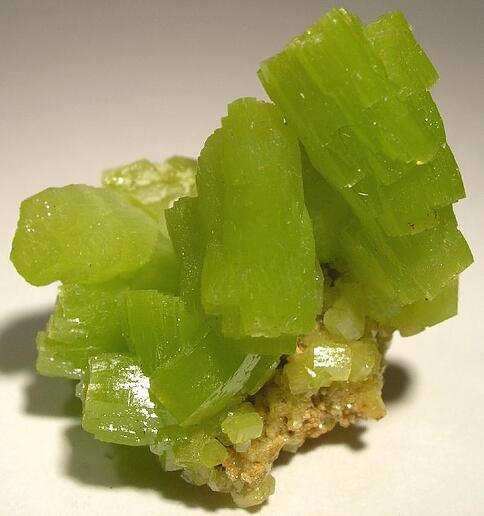
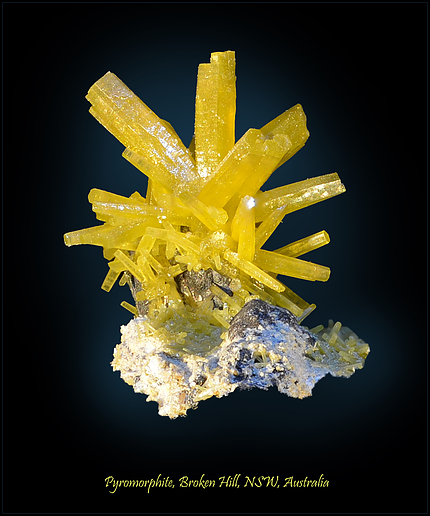
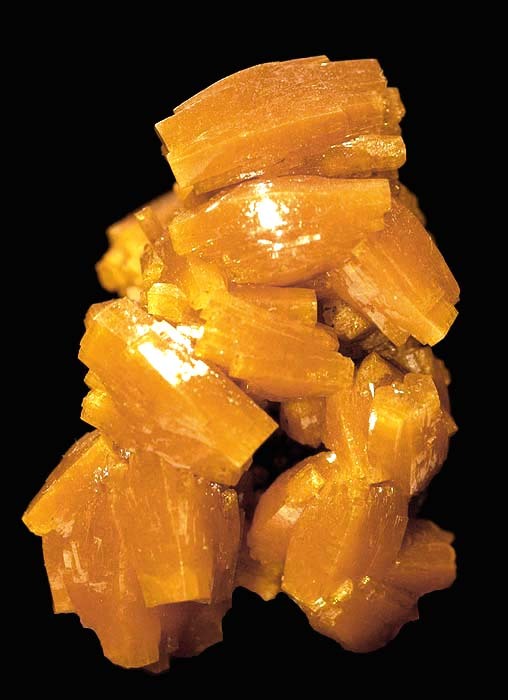
Green to dark green, yellow, greenish-yellow or yellowish-green, orangish-yellow, shades of brown, white and colourless; colourless or faintly tinted in transmitted light.
Lustre:
Sub-Vitreous, Resinous, Waxy, Greasy
Hardness:
3½ - 4
Specific Gravity:
7.04
Crystal System:
Hexagonal
Member of:
Name:
Originally called Grön Blyspat and Minera plumbi viridis by Johan Gottschalk Wallerius in 1748 and, later, Mine de plumb verte in 1753. An author named "Schultze", possibly Christian Friedrich Schultze [1730-1775 of Dresden, Germany] used the descriptive terms grünbleierz and braunbleierz in 1761 onward that have been subsequently attributed to Abraham Gottlob Werner in 1791. Named pyromorphite in 1813 by Johann Friedrich Ludwig Hausmann from the Greek for "fire" and "form", because, after being melted into a globule, a sample will begin to take on a crystalline shape during cooling. Hausmann also used the name traubenblei in 1813. Additional names have been introduced for minerals that were thought to be something other than pyromorphite including: polysphaerite by August Breithaupt in 1832, nuissierite by G. Barruel in 1836, miesite by August Breithaupt in 1841, cherokine by Charles U. Shepard in 1857, plumbeine and sexagulit by August Breithaupt in 1863, and collieite by Robert Brown in 1927.
Type Locality:
Isostructural with:
Apatite group, apatite supergroup.
Mimetite-pyromorphite series.
The phosphate analogue of mimetite and vanadinite.
A secondary lead mineral found in the oxidised zones of lead deposits. Typically found as green, yellowish, brownish, greyish or white barrel-shaped hexagonal prisms, in clusters or as druses on matrix. The individual crystals are often modified or etched, giving a hopper-like appearance. This lead chloride phosphate forms a complete series with mimetite (lead chloride arsenate), and many specimens are intermediates between the two end-members.
"Ca-rich pyromorphite" may be phosphohedyphane.
Also forms a series with hydroxylpyromorphite and fluorpyromorphite.
Baker (1966) showed by synthesis that there is a complete series between mimetite, pyromorphite and vanadinite.
A rather stable Pb phase also forming in contaminated urban and industrial soils, was shown by Sayer et al. (1999) to be solubilized by organic-acid-forming fungi (Aspergillus niger), thus forming oxalates: 'unnamed (Pb oxalate)' and 'unnamed (Pb oxalate dihydrate)'. These oxalates, although insoluble and thus immobilizing Pb, are predicted to be thermodynamically unstable in many soils.
 Visit gemdat.org for gemological information about Pyromorphite.
Mimetite-pyromorphite series.
The phosphate analogue of mimetite and vanadinite.
A secondary lead mineral found in the oxidised zones of lead deposits. Typically found as green, yellowish, brownish, greyish or white barrel-shaped hexagonal prisms, in clusters or as druses on matrix. The individual crystals are often modified or etched, giving a hopper-like appearance. This lead chloride phosphate forms a complete series with mimetite (lead chloride arsenate), and many specimens are intermediates between the two end-members.
"Ca-rich pyromorphite" may be phosphohedyphane.
Also forms a series with hydroxylpyromorphite and fluorpyromorphite.
Baker (1966) showed by synthesis that there is a complete series between mimetite, pyromorphite and vanadinite.
A rather stable Pb phase also forming in contaminated urban and industrial soils, was shown by Sayer et al. (1999) to be solubilized by organic-acid-forming fungi (Aspergillus niger), thus forming oxalates: 'unnamed (Pb oxalate)' and 'unnamed (Pb oxalate dihydrate)'. These oxalates, although insoluble and thus immobilizing Pb, are predicted to be thermodynamically unstable in many soils.
Visit gemdat.org for gemological information about Pyromorphite.Unique Identifiers
Mindat ID:
3320
Long-form identifier:
mindat:1:1:3320:2
IMA Classification of Pyromorphite
Approved, 'Grandfathered' (first described prior to 1959)
IMA Formula:
Pb2+5(PO4)3Cl
Classification of Pyromorphite
8.BN.05
8 : PHOSPHATES, ARSENATES, VANADATES
B : Phosphates, etc., with additional anions, without H2O
N : With only large cations, (OH, etc.):RO4 = 0.33:1
8 : PHOSPHATES, ARSENATES, VANADATES
B : Phosphates, etc., with additional anions, without H2O
N : With only large cations, (OH, etc.):RO4 = 0.33:1
Dana 7th ed.:
41.8.4.1
41.8.4.1
41 : ANHYDROUS PHOSPHATES, ETC.CONTAINING HYDROXYL OR HALOGEN
8 : A5(XO4)3Zq
41 : ANHYDROUS PHOSPHATES, ETC.CONTAINING HYDROXYL OR HALOGEN
8 : A5(XO4)3Zq
22.2.9
22 : Phosphates, Arsenates or Vanadates with other Anions
2 : Phosphates, arsenates or vanadates with chloride
22 : Phosphates, Arsenates or Vanadates with other Anions
2 : Phosphates, arsenates or vanadates with chloride
Mineral Symbols
As of 2021 there are now IMA–CNMNC approved mineral symbols (abbreviations) for each mineral species, useful for tables and diagrams.
| Symbol | Source | Reference for Standard |
|---|---|---|
| Pym | IMA–CNMNC | Warr, L.N. (2021). IMA–CNMNC approved mineral symbols. Mineralogical Magazine, 85(3), 291-320. doi:10.1180/mgm.2021.43 |
Physical Properties of Pyromorphite
Sub-Vitreous, Resinous, Waxy, Greasy
Transparency:
Transparent, Translucent
Colour:
Green to dark green, yellow, greenish-yellow or yellowish-green, orangish-yellow, shades of brown, white and colourless; colourless or faintly tinted in transmitted light.
Comment:
Colorless when pure
Streak:
White
Hardness:
3½ - 4 on Mohs scale
Hardness Data:
Measured
Tenacity:
Brittle
Cleavage:
Poor/Indistinct
In traces on {1011}.
In traces on {1011}.
Fracture:
Irregular/Uneven, Sub-Conchoidal
Density:
7.04 g/cm3 (Measured) 7.109 g/cm3 (Calculated)
Optical Data of Pyromorphite
Type:
Uniaxial (-)
RI values:
nω = 2.058 nε = 2.048
Birefringence:
0.010
Max. Birefringence:
δ = 0.010
Based on recorded range of RI values above.
Based on recorded range of RI values above.
Interference Colours:
The colours simulate birefringence patterns seen in thin section under crossed polars. They do not take into account mineral colouration or opacity.
Michel-Levy Bar The default colours simulate the birefringence range for a 30 µm thin-section thickness. Adjust the slider to simulate a different thickness.
Grain Simulation You can rotate the grain simulation to show how this range might look as you rotated a sample under crossed polars. Each grain retains its interference colour (retardation) while its brightness falls to black at extinction and reaches a maximum between extinction positions.
The colours simulate birefringence patterns seen in thin section under crossed polars. They do not take into account mineral colouration or opacity.
Michel-Levy Bar The default colours simulate the birefringence range for a 30 µm thin-section thickness. Adjust the slider to simulate a different thickness.
Grain Simulation You can rotate the grain simulation to show how this range might look as you rotated a sample under crossed polars. Each grain retains its interference colour (retardation) while its brightness falls to black at extinction and reaches a maximum between extinction positions.
Surface Relief:
Very High (positive)
Relative to Canada balsam mounting medium (n ≈ 1.537).
Relative to Canada balsam mounting medium (n ≈ 1.537).
This shows the grain boundary and Becke line effect under plane-polarised
light, based on the contrast between this mineral's average refractive
index and the mounting medium. It does not take into account mineral
colouration.
In focus
Interference Figure:
This shows the idealized uniaxial interference figure - the conoscopic
(convergent-light, Bertrand-lens-in) view, for a grain cut with the optic axis
centred and vertical. The coloured rings are isochromatics, computed with the
same physics as the Michel-Lévy bar above; the dark cross is the isogyre.
For a genuinely uniaxial mineral viewed this way, that cross stays perfectly stationary if you rotate the stage - unlike a biaxial mineral, where it splits apart on rotation. That invariance is itself the standard diagnostic test for telling uniaxial and biaxial minerals apart at the microscope.
For a genuinely uniaxial mineral viewed this way, that cross stays perfectly stationary if you rotate the stage - unlike a biaxial mineral, where it splits apart on rotation. That invariance is itself the standard diagnostic test for telling uniaxial and biaxial minerals apart at the microscope.
Optical Extinction:
Parallel
Pleochroism:
Weak
Comments:
Visible in tinted material in transmitted light.
Comments:
May be anomalously biaxial -, sectored.
Chemistry of Pyromorphite
Mindat Formula:
Pb5(PO4)3Cl
Element Weights:
Elements listed:
Common Impurities:
F,Ra,Ca,Cr,V,As
Crystallography of Pyromorphite
Crystal System:
Hexagonal
Class (H-M):
6/m - Dipyramidal
Space Group:
P63/m
Setting:
P63/m
Cell Parameters:
a = 9.987 Å, c = 7.33 Å
Ratio:
a:c = 1 : 0.734
Unit Cell V:
633.15 ų (Calculated from Unit Cell)
Z:
2
Morphology:
Crystals prismatic [0001] and usually simple, showing {1010}, {0001}, {1011}; barrel-shaped, spindle-shaped, and sometimes equant; terminations may be cavernous ("hopper" or "skeletal"); more rarely tabular {0001} or pyramidal; sometimes in branching groups of prismatic crystals in parallel positions, tapering to points; may also be globular, reniform, wart-like with sub-columnar structure, and granular. Crystals may show concentric growth patterns, probably due to P/As content variation.
Twinning:
Very rare on {1122}; a twin is described by Goldschmidt & Schröder (1913).
{1010} at Puech de Compolibat (Mills et al., 2012)
{1010} at Puech de Compolibat (Mills et al., 2012)
Crystallographic forms of Pyromorphite
Crystal Atlas:
Image Loading
Click on an icon to view

Pyromorphite no.6 - {100} - Goldschmidt (1913-1926)
Pyromorphite no.7 - {100} - Goldschmidt (1913-1926)
Pyromorphite no.12 - {100} - Goldschmidt (1913-1926)
3d models and HTML5 code kindly provided by
www.smorf.nl.
Toggle
Edge Lines | Miller Indices | Axes
Transparency
Opaque | Translucent | Transparent
View
Along a-axis | Along b-axis | Along c-axis | Start rotation | Stop rotation
Edge Lines | Miller Indices | Axes
Transparency
Opaque | Translucent | Transparent
View
Along a-axis | Along b-axis | Along c-axis | Start rotation | Stop rotation
Crystal Structure
Load
Unit Cell | Unit Cell Packed
2x2x2 | 3x3x3 | 4x4x4
Unit Cell | Unit Cell Packed
2x2x2 | 3x3x3 | 4x4x4
Show
Big Balls | Small Balls | Just Balls | Spacefill
Polyhedra Off | Si Polyhedra | All Polyhedra
Remove metal-metal sticks
Big Balls | Small Balls | Just Balls | Spacefill
Polyhedra Off | Si Polyhedra | All Polyhedra
Remove metal-metal sticks
Display Options
Black Background | White Background
Perspective On | Perspective Off
2D | Stereo | Red-Blue | Red-Cyan
Black Background | White Background
Perspective On | Perspective Off
2D | Stereo | Red-Blue | Red-Cyan
View
CIF File Best | x | y | z | a | b | c
CIF File Best | x | y | z | a | b | c
Rotation
Stop | Start
Stop | Start
Labels
Console Off | On | Grey | Yellow
Console Off | On | Grey | Yellow
Data courtesy of the American Mineralogist Crystal Structure Database. Click on an AMCSD ID to view structure
| ID | Species | Reference | Link | Year | Locality | Pressure (GPa) | Temp (K) |
|---|---|---|---|---|---|---|---|
| 0020247 | Pyromorphite | Okudera H (2013) Relationships among channel typology and atomic displacements in the structures of Pb5(BO4)3Cl with B = P (pyromorphite), V (vanadinite), and As (mimetite) American Mineralogist 98 1573-1579 | 2013 | Daoping mine, Guangxi, China | 0 | 293 | |
| 0020246 | Pyromorphite | Okudera H (2013) Relationships among channel typology and atomic displacements in the structures of Pb5(BO4)3Cl with B = P (pyromorphite), V (vanadinite), and As (mimetite) American Mineralogist 98 1573-1579 | 2013 | Daoping mine, Guangxi, China | 0 | 293 | |
| 0020825 | Pyromorphite | Mills S J, Ferraris G, Kampf A R, Favreau G (2012) Twinning in pyromorphite: The first documented occurrence of twinning by merohedry in the apatite supergroup American Mineralogist 97 415-418 | 2012 | Puech de Compolibat, Combret, Aveyron | 0 | 293 | |
| 0013571 | Pyromorphite | Miyake M, Ishigaki K, Suzuki T (1986) Structure refinements of Pb2+ ion-exchanged apatites by X-ray powder pattern-fitting Journal of Solid State Chemistry 61 230-235 | 1986 | synthetic | 0 | 293 | |
| 0013570 | Pyromorphite | Miyake M, Ishigaki K, Suzuki T (1986) Structure refinements of Pb2+ ion-exchanged apatites by X-ray powder pattern-fitting Journal of Solid State Chemistry 61 230-235 | 1986 | synthetic | 0 | 293 | |
| 0005226 | Pyromorphite | Dai Y S, Hughes J M (1989) Crystal-structure refinements of vanadinite and pyromorphite The Canadian Mineralogist 27 189-192 |  | 1989 | 0 | 293 | |
| 0018026 | Pyromorphite | Hendricks S, Jefferson M, Mosley V (1932) The crystal structures of some natural and synthetic apatite-like substances _cod_database_code 1011137 Zeitschrift fur Kristallographie 81 352-369 | 1932 | 0 | 293 |
CIF Raw Data - click here to close
Epitaxial Relationships of Pyromorphite
Epitaxial Minerals:
| 'Galena' | PbS |
Epitaxy Comments:
Galena forms thin films on the surface of Pyromorphite crystals (Blaubleierz; Plumbeine) with Galena {001} [001] parallel with Pyromorphite {0001} (1120) (1010) [0001].
X-Ray Powder Diffraction
Loading XRD data...
Data courtesy of RRUFF project at University of Arizona, used with permission.
Powder Diffraction Data:
| d-spacing | Intensity |
|---|---|
| 4.13 Å | (50) |
| 3.38 Å | (30) |
| 3.27 Å | (40) |
| 2.99 Å | (100) |
| 2.96 Å | (100) |
| 2.89 Å | (60) |
| 2.064 Å | (30) |
| 1.861 Å | (30) |
Comments:
Data given are for synthetic material.
Geological Environment
Paragenetic Mode(s):
| Paragenetic Mode | Earliest Age (Ga) |
|---|---|
| Stage 7: Great Oxidation Event | <2.4 |
| 45b : [Other oxidized fumarolic minerals] | |
| 47c : [Carbonates, phosphates, borates, nitrates] | |
| 47g : [Halogen-bearing surface weathering minerals] |
Geological Setting:
A secondary mineral found in the oxidised zones of lead ore deposits.
Type Occurrence of Pyromorphite
Synonyms of Pyromorphite
Other Language Names for Pyromorphite
Basque:Piromorfita
Bosnian:Piromorfit
Catalan:Piromorfita
Dutch:Pyromorfiet
Galician:Piromorfita
German:Pyromorphit
Bleiapatit
Braunbleierz
Buntbleierz
Grünbleierz
Grün Bleyerz
Phosphorblei
Phosphorbleyspat
Phosphorsäurehaltiges Blei
Phosphorsaures Blei
Pseudokampylith
Sexangulit
Bleiapatit
Braunbleierz
Buntbleierz
Grünbleierz
Grün Bleyerz
Phosphorblei
Phosphorbleyspat
Phosphorsäurehaltiges Blei
Phosphorsaures Blei
Pseudokampylith
Sexangulit
Irish Gaelic:Phireamoirfiít
Italian:Piromorfite
Japanese:緑鉛鉱
Latin:Minera plumbi viridis (in part)
Polish:Piromorfit
Portuguese:Piromorfite
Russian:Пироморфит
Simplified Chinese:磷氯铅矿
Swedish:Grön Blyspat
Traditional Chinese:磷氯鉛礦
Varieties of Pyromorphite
| Calcium-bearing Pyromorphite | A "calcium-bearing variety of pyromorphite", although samples from several occurrences are now known to be in fact the species phosphohedyphane. |
| Collieite | A vanadian and calcian variety which contains approximately 4.1% V2O5. Originally reported from Leadhills, Scotland, UK. |
| Nussièrite | A local designation for pyromorphite containing minor arsenate. Originally described from Nuizière (Nuissière Mine), Chenelette, Beaujeu, Rhône, Rhône-Alpes, France. |
Relationship of Pyromorphite to other Species
Member of:
Other Members of Apatite Group:
| Alforsite | Ba5(PO4)3Cl | Hex. 6/m : P63/m |
| 'Apatite' | Ca5(PO4)3A | |
| Chlorapatite | Ca5(PO4)3Cl | Hex. 6/m : P63/m |
| Fluoralforsite | Ba5(PO4)3F | Hex. 6/m : P6/m |
| Fluorapatite | Ca5(PO4)3F | Hex. 6/m : P63/m |
| Fluorpyromorphite | Pb5(PO4)3F | Hex. 6/m : P63/m |
| Hydroxylapatite | Ca5(PO4)3(OH) | Hex. 6/m : P63/m |
| Hydroxylpyromorphite | Pb5(PO4)3(OH) | Hex. 6/mmm(6/m2/m2/m) : P63/mcm |
| Johnbaumite | Ca5(AsO4)3(OH) | Hex. 6/m : P63/m |
| Mimetite | Pb5(AsO4)3Cl | Hex. 6/m : P63/m |
| 'Oxypyromorphite' | Pb10(PO4)6O | |
| Pieczkaite | Mn5(PO4)3Cl | Hex. 6/m : P63/m |
| Pliniusite | Ca5(VO4)3F | Hex. 6/m : P63/m |
| Stronadelphite | Sr5(PO4)3F | Hex. 6/m : P63/m |
| Svabite | Ca5(AsO4)3F | Hex. 6/mmm(6/m2/m2/m) : P63/mmc |
| Turneaureite | Ca5(AsO4)3Cl | Hex. 6/m : P63/m |
| 'Unnamed (OH-analogue of Mimetite)' | Pb5(AsO4)3(OH) | Hex. 6/m : P63/m |
| Vanadinite | Pb5(VO4)3Cl | Hex. 6/m : P63/m |
Forms a series with:
Common Associates
Associations Based on Photo Data:
| 1,193 photos of Pyromorphite associated with Quartz | SiO2 |
| 717 photos of Pyromorphite associated with Plumbogummite | PbAl3(PO4)(PO3OH)(OH)6 |
| 617 photos of Pyromorphite associated with Wulfenite | Pb(MoO4) |
| 616 photos of Pyromorphite associated with Cerussite | PbCO3 |
| 413 photos of Pyromorphite associated with Baryte | BaSO4 |
| 296 photos of Pyromorphite associated with Crocoite | PbCr6+O4 |
| 265 photos of Pyromorphite associated with Malachite | Cu2(CO3)(OH)2 |
| 230 photos of Pyromorphite associated with Galena | PbS |
| 187 photos of Pyromorphite associated with Goethite | Fe3+O(OH) |
| 118 photos of Pyromorphite associated with Fluorite | CaF2 |
Related Minerals - Strunz-mindat Grouping
| 8.BN. | Fluoralforsite | Ba5(PO4)3F |
| 8.BN. | Aradite | BaCa6[(SiO4)(VO4)](VO4)2F |
| 8.BN. | Magganasite | CuFe3+3O(AsO4)3 |
| 8.BN. | Fluorpyromorphite | Pb5(PO4)3F |
| 8.BN. | Fluorsigaiite | Ca2Sr3(PO4)3F |
| 8.BN.05 | Pieczkaite | Mn5(PO4)3Cl |
| 8.BN.05 | Fluorapatite | Ca5(PO4)3F |
| 8.BN.05 | Fluorcaphite | SrCaCa3(PO4)3F |
| 8.BN.05 | Vanadinite | Pb5(VO4)3Cl |
| 8.BN.05 | Hedyphane | Ca2Pb3(AsO4)3Cl |
| 8.BN.05 | Hydroxylhedyphane | Ca2Pb3(AsO4)3(OH) |
| 8.BN.05 | 'Mimetite-M' | Pb5(AsO4)3Cl |
| 8.BN.05 | Johnbaumite | Ca5(AsO4)3(OH) |
| 8.BN.05 | Pliniusite | Ca5(VO4)3F |
| 8.BN.05 | 'Hydroxylapatite-M' | Ca5(PO4)3OH |
| 8.BN.05 | Hydroxylpyromorphite | Pb5(PO4)3(OH) |
| 8.BN.05 | Miyahisaite | (Sr,Ca)2Ba3(PO4)3F |
| 8.BN.05 | Carlgieseckeite-(Nd) | NaNdCa3(PO4)3F |
| 8.BN.05 | Belovite-(Ce) | NaCeSr3(PO4)3F |
| 8.BN.05 | Kuannersuite-(Ce) | NaCeBa3(PO4)3F0.5Cl0.5 |
| 8.BN.05 | Alforsite | Ba5(PO4)3Cl |
| 8.BN.05 | 'Unnamed (OH-analogue of Mimetite)' | Pb5(AsO4)3(OH) |
| 8.BN.05 | Stronadelphite | Sr5(PO4)3F |
| 8.BN.05 | Parafiniukite | Ca2Mn3(PO4)3Cl |
| 8.BN.05 | Mimetite | Pb5(AsO4)3Cl |
| 8.BN.05 va | 'Germanate-pyromorphite' | Pb5(PO4)2GeO4 |
| 8.BN.05 | Belovite-(La) | NaLaSr3(PO4)3F |
| 8.BN.05 | Fluorphosphohedyphane | Ca2Pb3(PO4)3F |
| 8.BN.05 | Fluorstrophite | SrCaSr3(PO4)3F |
| 8.BN.05 | Hydroxylapatite | Ca5(PO4)3(OH) |
| 8.BN.05 | 'Johnbaumite-M' | Ca5(AsO4)3OH |
| 8.BN.05 | Phosphohedyphane | Ca2Pb3(PO4)3Cl |
| 8.BN.05 | Turneaureite | Ca5(AsO4)3Cl |
| 8.BN.05 | Morelandite | Ca2Ba3(AsO4)3Cl |
| 8.BN.05 | 'Oxypyromorphite' | Pb10(PO4)6O |
| 8.BN.05 | Deloneite | (Na0.5REE0.25Ca0.25)(Ca0.75REE0.25)Sr1.5(CaNa0.25REE0.25)(PO4)3F0.5(OH)0.5 |
| 8.BN.05 | Chlorapatite | Ca5(PO4)3Cl |
| 8.BN.05 | Vanackerite | Pb4Cd(AsO4)3Cl |
| 8.BN.05 | Svabite | Ca5(AsO4)3F |
| 8.BN.10 | Arctite | Na2Ca4(PO4)3F |
| 8.BN.10 | Krügerite | BaCa6(SiO4)2[(P0.5S0.5)O4]2F |
| 8.BN.15 | Goryainovite | Ca2(PO4)Cl |
Fluorescence of Pyromorphite
May be yellow to orange in SW and LW
Other Information
Electrical:
Piezoelectric if biaxial.
Notes:
Soluble in HNO3 and KOH. Slightly soluble in carbonated water.
Forms pseudomorphs after Galena and Cerussite (common).
Galena frequently occurs as more or less complete pseudomorphs after pyromorphite. Other pseudomorphs include Apatite after Pyromorphite and Plumbogummite encrusted on, and replacing, Pyromorphite.
Forms pseudomorphs after Galena and Cerussite (common).
Galena frequently occurs as more or less complete pseudomorphs after pyromorphite. Other pseudomorphs include Apatite after Pyromorphite and Plumbogummite encrusted on, and replacing, Pyromorphite.
Health Risks:
No information on health risks for this material has been entered into the database. You should always treat mineral specimens with care.
Internet Links for Pyromorphite
mindat.org URL:
https://www.mindat.org/min-3320.html
Please feel free to link to this page.
Please feel free to link to this page.
Search Engines:
External Links:
Mineral Dealers:
References for Pyromorphite
Reference List:
Hausmann, Johann Friedrich Ludwig (1813) Handbuch der Mineralogie (1st ed.). Vandenhoeck und Ruprecht. pp.1089-1090 - as Polychrom & Pyromorphit
Bertrand, Emile (1881) Étude optique de différents minéraux. Bulletin de la Société minéralogique de France, 4 (2). 34-38 doi:10.3406/bulmi.1881.1616p.35
Jannettaz, Édouard (1881) Sur les phénomènes optiques de la Pyromorphite et du Mimetèse. Bulletin de Minéralogie, 4 (2) 39-40 doi:10.3406/bulmi.1881.1618
Jannettaz, Édouard, Michel, Léopold (1881) Note sur les relations de la composition chimique et des caractères optiques dans le groupe des pyromorphites et des mimétites. Bulletin de Minéralogie, 4 (7) 196-225 doi:10.3406/bulmi.1881.1661
Bowman, H. L. (1903) Note on the Refrative Indices of Pyromorphite, Mimetite, and Vanadinite. Mineralogical Magazine and Journal of the Mineralogical Society, 13 (62) 324-329 doi:10.1180/minmag.1903.013.62.04
Goldschmidt, V.; Schröder, B. (1913) Pyromorphitzwilling. Zeitschrift für Krystallographie, 51 (1-6). 362-364 doi:10.1524/zkri.1913.51.1.362
Strens, R. G. J. (1963) Pyromorphite as a possible primary phase. Mineralogical Magazine and Journal of the Mineralogical Society, 33 (263) 722-723 doi:10.1180/minmag.1963.033.263.13
Baker, W. E. (1966) An x-ray diffraction study of synthetic members of the pyromorphite series. American Mineralogist, 51 (11-12) 1712-1721
Dai, Y., Hughes, J. M. (1989) Crystal-structure refinements of vanadinite and pyromorphite. The Canadian Mineralogist, 27 (2) 189-192
Inegbenebor, Adedayo I., Thomas, John H., Williams, Peter A. (1989) The chemical stability of mimetite and distribution coefficients for pyromorphite–mimetite solid-solutions. Mineralogical Magazine, 53 (371) 363-371 doi:10.1180/minmag.1989.053.371.12
Podsiadlo, H. (1990) Polymorphic transitions in the binary system lead chlorapatite Pb10(PO4)6Cl2 — calcium fluorapatite Ca10(PO4)6F2. Journal of Thermal Analysis, 36 (3). 1205-1211 doi:10.1007/bf01904653
Hashimoto, H., Matsumoto, T. (1998) Structure refinements of two natural pyromorphites, Pb5(PO4)3Cl, and crystal chemistry of chlorapatite group, M5(PO4)3Cl. Zeitschrift für Kristallographie, 213 (11). 585-590 doi:10.1524/zkri.1998.213.11.585
Eighmy, T. Taylor; Shaw, Elisabeth L.; Eusden, J. Dykstra; Francis, Carl A. (1998) Chloropyromorphite (Pb5(PO4)3Cl) by XPS: An Environmentally Important Secondary Mineral. Surface Science Spectra, 5 (2). 122-129 doi:10.1116/1.1247862
Zhang, Pengchu, Ryan, James A. (1999) Formation of Chloropyromorphite from Galena (PbS) in the Presence of Hydroxyapatite. Environmental Science & Technology, 33 (4). 618-624 doi:10.1021/es980314a
Zhang, Pengchu, Ryan, James A. (1999) Transformation of Pb(II) from Cerrusite to Chloropyromorphite in the Presence of Hydroxyapatite under Varying Conditions of pH. Environmental Science & Technology, 33 (4). 625-630 doi:10.1021/es980268e
Shannon, Robert D., Shannon, Ruth C., Medenbach, Olaf, Fischer, Reinhard X. (2002) Refractive Index and Dispersion of Fluorides and Oxides. Journal of Physical and Chemical Reference Data, 31 (4) 931-970 doi:10.1063/1.1497384
Frost, Ray L., Palmer, Sara J. (2007) A Raman spectroscopic study of the phosphate mineral pyromorphite Pb5(PO4)3Cl. Polyhedron, 26 (15) 4533-4541 doi:10.1016/j.poly.2007.06.004
Frost, Ray L., Bouzaid, Jocelyne M., Palmer, Sara (2007) The structure of mimetite, arsenian pyromorphite and hedyphane – A Raman spectroscopic study. Polyhedron, 26 (13) 2964-2970 doi:10.1016/j.poly.2007.01.038
Frost, Ray L., Jagannadha Reddy, B., Palmer, Sara J. (2008) The structure of mimetite, arsenian pyromorphite and hedyphane – A near-infrared spectroscopic study. Polyhedron, 27 (6) 1747-1753 doi:10.1016/j.poly.2008.02.008
Knyazev, A.V., Chernorukov, N.G., Bulanov, E.N. (2011) Isomorphism and phase diagram of Pb5(PO4)3F–Pb5(PO4)3Cl system. Thermochimica Acta, 513. 112-118 doi:10.1016/j.tca.2010.11.020
Flis, Justyna, Manecki, Maciej, Bajda, Tomasz (2011) Solubility of pyromorphite Pb5(PO4)3Cl–mimetite Pb5(AsO4)3Cl solid solution series. Geochimica et Cosmochimica Acta, 75 (7) 1858-1868 doi:10.1016/j.gca.2011.01.021
Mills, S. J., Ferraris, G., Kampf, A. R., Favreau, G. (2012) Twinning in pyromorphite: The first documented occurrence of twinning by merohedry in the apatite supergroup. American Mineralogist, 97 (2) 415-418 doi:10.2138/am.2012.3984
Burmann, Fabian, Keim, Maximilian F., Oelmann, Yvonne, Teiber, Holger, Marks, Michael A.W., Markl, Gregor (2013) The source of phosphate in the oxidation zone of ore deposits: Evidence from oxygen isotope compositions of pyromorphite. Geochimica et Cosmochimica Acta, 123. 427-439 doi:10.1016/j.gca.2013.07.042
Okudera, H. (2013) Relationships among channel topology and atomic displacements in the structures of Pb5(BO4)3Cl with B = P (pyromorphite), V (vanadinite), and As (mimetite) American Mineralogist, 98 (8) 1573-1579 doi:10.2138/am.2013.4417
Markl, G., Marks, M. A. W., Holzapfel, J., Wenzel, T. (2014) Major, minor, and trace element composition of pyromorphite-group minerals as recorder of supergene weathering processes from the Schwarzwald mining district, SW Germany. American Mineralogist, 99 (5) 1133-1146 doi:10.2138/am.2014.4789
Keim, Maximilian F., Markl, Gregor (2015) Weathering of galena: Mineralogical processes, hydrogeochemical fluid path modeling, and estimation of the growth rate of pyromorphite. American Mineralogist, 100 (7) 1584-1594 doi:10.2138/am-2015-5183
Localities for Pyromorphite
Showing 2,118 localities.
 symbol to view information about a locality.
The
symbol to view information about a locality.
The Locality List
 - This locality has map coordinates listed.
- This locality has estimated coordinates.
ⓘ - Click for references and further information on this occurrence.
? - Indicates mineral may be doubtful at this locality.
- This locality has map coordinates listed.
- This locality has estimated coordinates.
ⓘ - Click for references and further information on this occurrence.
? - Indicates mineral may be doubtful at this locality.
 - Good crystals or important locality for species.
 - World class for species or very significant.
(TL) - Type Locality for a valid mineral species.
(FRL) - First Recorded Locality for everything else (eg varieties).
- World class for species or very significant.
(TL) - Type Locality for a valid mineral species.
(FRL) - First Recorded Locality for everything else (eg varieties).
All localities listed without proper references should be considered as questionable.
Quick NavTopAbout PyromorphiteUnique IdentifiersIMA Classification Classification Mineral SymbolsPhysical Properties Optical Data Chemistry Crystallography Crystallographic forms Crystal StructureEpitaxial Relationships X-Ray Powder DiffractionGeological EnvironmentType Occurrence SynonymsOther LanguagesVarietiesRelationshipsCommon AssociatesStrunz-MindatFluorescence Other InformationInternet Links References Localities Locality List

Bunker Hill Mine, Wardner, Shoshone County, Idaho, USA