2026 Retrocomputing Challenge: NEC 286 Laptop Rides Again

The sad reality is that all consumer electronics are going to be e-waste eventually. [Cory Whitesell] was determined his old NEC ProSpeed 286 Laptop wouldn’t meet that fate until absolutely necessary, so when his attempts at repairs failed, his efforts pivoted to create a retro battlestation from the stylish old machine.

That screen looks too good to be stock, but otherwise you can’t tell from this angle.

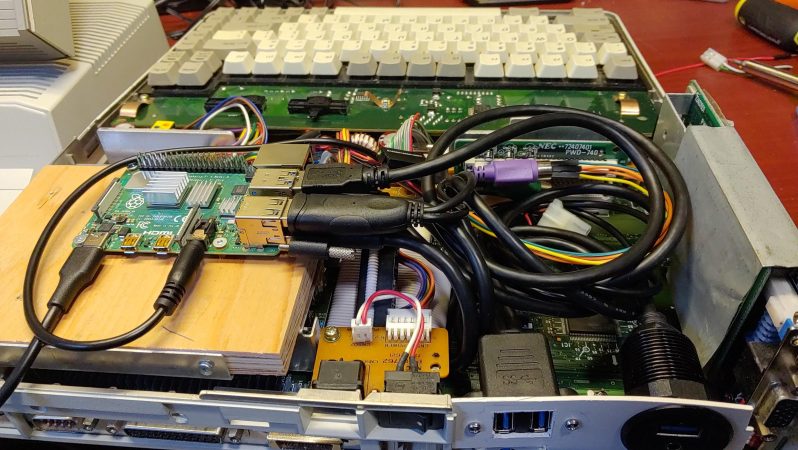
Externally, it looks pretty well stock, and [Cory] has retained as much of the internals as possible. The original power supply remains intact, with power taken off the original HDD’s molex connector. Said power drives a Raspberry Pi, which is small enough to fit inside without any gutting. The original keyboard connects easily enough via a PS/2 to USB adapter, while the passive-matrix LCD has been replaced with a modern screen of the same dimensions. You’d have to be a pretty hard-core purist to mourn that last change.

With emulation on the Pi, he can still have the DOS experience you’d expect from this machine, but its also powerful enough to be useful in the modern day. While we place no bets on whether or not this mod will stay relevant for another 38 years, a more powerful single-board computer or slightly-squished cell phone can be placed in the drive bay instead once the Pi’s ARM processor inevitably starts to look as anemic as the 286 does now.

Not everyone loves this kind of restomod, but we’ve featured more than a few and have a special category for it in our ongoing retrocomputing contest for those who will do everything to keep classics out of the e-waste bin, including remaking them.

Failing To Make A Fanless PC

The discerning modern gamer’s quest is to find a quieter computer without sacrificing performance. That proves challenging when modern components are highly efficient at producing monumental quantities of thermal energy. So the typical solution ends up moving enough air through the computer to create a rather tumultuous racket. So why have fans at all? Well, as [Billet Labs] demonstrates, that’s not necessarily a good idea. 

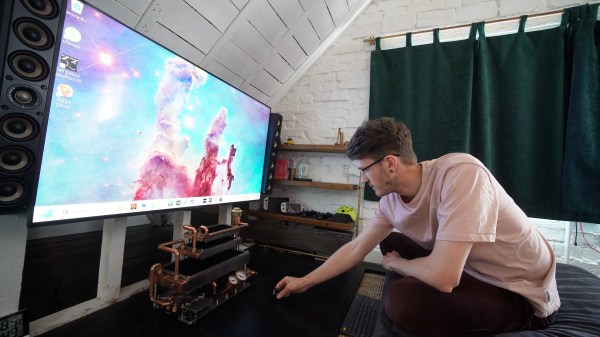
The build begins with a block of aluminum which, with a bit of hand-metal work, may become the base of the PC “case.” A dry-fit of the aesthetically modified parts taken from a previous attempt at a fanless PC reveals the steampunk aesthetic that defines the build. On final assembly, a large amount of thermal paste under the flex ATX power supply and 6mm of thermal pads under the motherboard provide passive cooling to the block of aluminum they are attached to

The cooling loop begins with three radiators: a big one, a small one, and a slightly smaller one. But raw metal PC radiators are difficult and expensive to come by these days. Some paint stripping and polishing will fix that problem. A few hand-made mounting brackets complete the aesthetic. All three radiators are stacked above the motherboard, and on top of each other, positioned horizontally to encourage passive airflow through them.

Continue reading “Failing To Make A Fanless PC” →

Audio-Forward Case Mod Of Classic 90s Portable TV

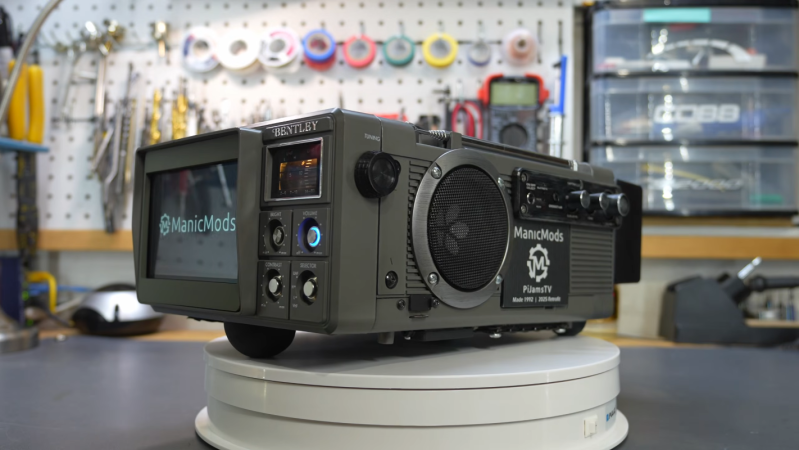
The humble cathode ray tube (CRT) was once the technology behind almost all of our televisions and computer displays. Its replacements, from LCD screens to OLED and others, are generally cheaper to make and better to look at. Old televisions were comparatively large as well, but their size can be an advantage for people like [ManicMods] aka [Jeff]. His latest build ditches the CRT from an old Bently portable TV and uses the huge space available in the case for a hi-fi audio system and some other parts that turn it into an impressive portable home theater system.

After removing most of the internals of the TV, the first part to go in is the stereo and subwoofer combo as it takes up the most amount of space. The subwoofer section points downward and the two stereo speakers are mounted to the sides. To free up the most space inside, the new display is mounted forward of the original bezel, with a new 3D printed one helping to hold it in place. Behind it goes a Raspberry Pi, loaded with the moOde audio player, a high quality DAC for audio output, and a 1 TB SSD with [Jeff]’s uncompressed audio library. Most of the ports are extended out to the case including the SD card slot so other operating systems can be loaded on the Pi, and there are a ton of options for hooking up external speakers and displays as well, making it an extremely modular and expandable portable media center.

Also added to the finished product are a few small game controllers, since the Pi is perfectly capable of playing retro games, as well as a small wireless keyboard and trackpad combo. Although the CRT’s demise will be felt harder by some than by others, the original look of the case is preserved somewhat by keeping the original tuning display and locations of the original control buttons and knobs. If preserving the CRTs are of upmost importance, though, this build used a pair of them in a VR headset.

Continue reading “Audio-Forward Case Mod Of Classic 90s Portable TV” →

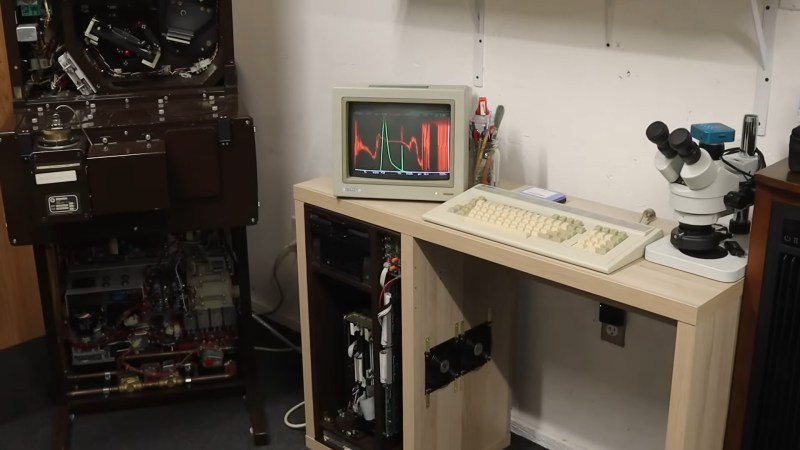
The ikea desk, with the spectrometer on the far left.

PDP-11 Lives In Literal Computer Desk Once More

When you think of iconic parings, your brain probably goes more to “cookies and milk” than “DEC and Ikea” but after watching [Dave]’s latest on Usagi Electric where he puts a PDP-11 into an Ikea desk, you may rethink that.

The PDP-11 is vintage hardware that actually lived inside of a different desk, once upon a time, serving as the control unit for an FTIR spectrometer. While the lab equipment has thankfully survived the decades, the desk did not and when [Dave] got the unit it was as a pile of parts. He revived it, of course– it’s kind of what he does– but it didn’t get a new desk for years, until his latest shop re-organization.

The one concession to modernity– and missing parts– is using switching power supplies rather than the bulky linear PSU that would have originally powered the unit. It’s a good thing, too, or we have trouble picturing how everything would fit! This particular PDP-11 comes with the high performance vector processing unit in order to crunch those spectrographs, and apparently those chips idle at about 60C, so the desk-case got some decent-sized 120V fans to keep everything cool and running for years to come.

This isn’t the most aesthetic or fanciest case-mod we’ve seen, mostly being made of surplus plywood and scrap metal fittings, but it certainly gets the job done. Given that the PDP-11 has been crammed into every form-factor known to man, from a system-on-a-chip (before anybody really talked about SOCs) to desktop workstations, and of course the hulking cabinets with their iconic blinkenlights-– it’s hard to say that this installation isn’t reasonably authentic, even if it isn’t the original desk.

Continue reading “PDP-11 Lives In Literal Computer Desk Once More” →

Making A Laptop With A Mechanical Keyboard

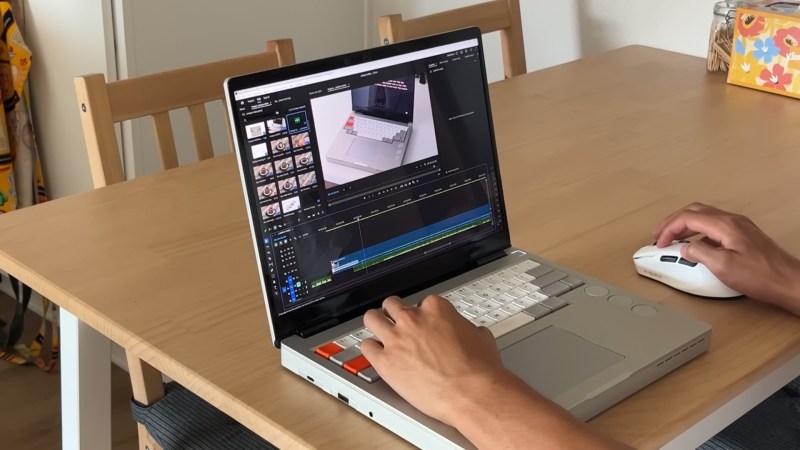
A laptop is one of the greatest tools at the disposal of a hacker. They come in all manner of shapes and sizes with all manner of features. But perhaps the greatest limit held by all laptops is their chiclet keyboard. While certainly serviceable, a proper mechanical keyboard will always reign supreme, which is why [flurples] built a laptop around a mechanical keyboard. 

Such a keyboard could not fit inside any normal laptop, so a custom machined case was in order. The starting point was a standard Framework Laptop 13. Its open source documentation certainly helped the project, but numerous parts such as the audio board and fingerprint sensor are not documented making for a long and tedious process. But the resulting machined aluminum case looks at least as good as a stock Framework chassis, all be it, quite a bit thicker.

Continue reading “Making A Laptop With A Mechanical Keyboard” →

A New Screen Upgrade For The GBA

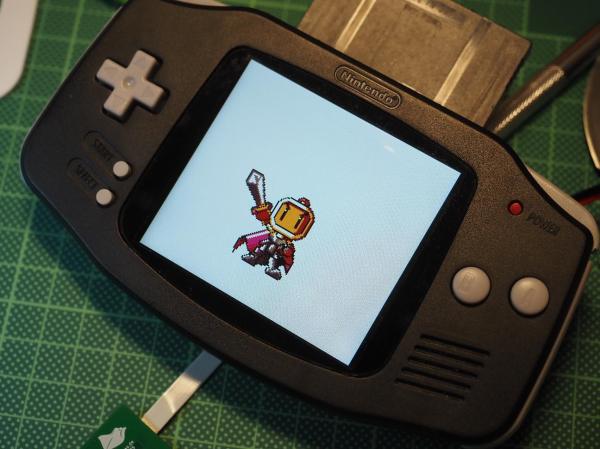
The Game Boy Advance (GBA) was released in 2001 to breathe some new life into the handheld market, and it did it with remarkable success. Unfortunately, the original models had a glaring problem: their unlit LCD screens could be very difficult to see. For that reason, console modders who work on these systems tend to improve the screen first like this project which brings a few other upgrades as well.

The fully open-source modification is called the Open AGB Display and brings an IPS display to the classic console. The new screen has 480×480 resolution which is slightly larger than the original resolution but handles upscaling with no noticeable artifacts and even supports adding some back in like scanlines and pixelation to keep the early 00s aesthetic. The build does require permanently modifying the case though, but for the original GBA we don’t see much downside. [Tobi] also goes through a ton of detail on how the mod works as well, for those who want to take a deep dive into the background theory.

There has been a lot of activity in the Game Boy Advance communities lately though as the hardware and software become more understood. If you don’t want to modify original hardware, want an upgraded experience, but still want to use the original game cartridges we might recommend something like the Game Bub instead.

Vintage Stereo Stack Becomes Neat PC Case

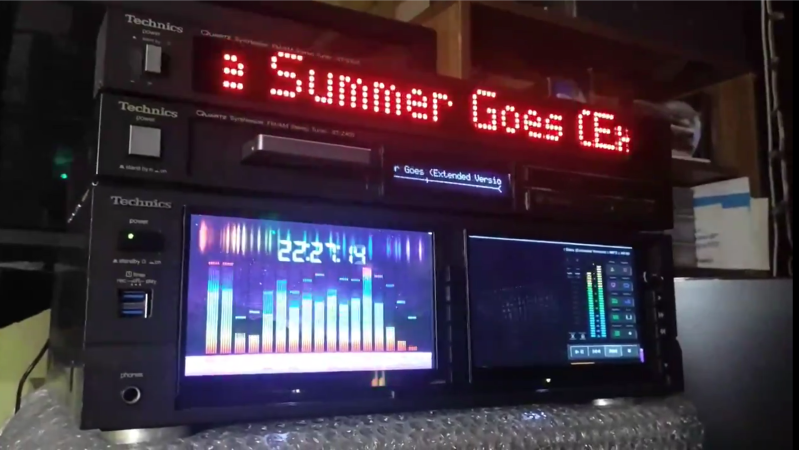
Vintage hi-fi gear has a look and feel all its own. [ThunderOwl] happened to be playing in this space, turning a heavily-modified Technics stereo stack into an awesome neo-retro PC case. Meet the “TechnicsPC!”

This is good. We like this.

You have to hunt across BlueSky for the goodies, but it’s well worth it. The main build concerned throwing a PC into an old Technics receiver, along with a pair of LCD displays and a bunch of buttons for control. If the big screens weren’t enough of a tell that you’re looking at an anachronism, the USB ports just below the power switch will tip you off. A later addition saw a former Technics tuner module stripped out and refitted with card readers and a DVD/CD drive. Perhaps the most era-appropriate addition, though, is the scrolling LED display on top. Stuffed inside another tuner module, it’s a super 90s touch that somehow just works.

These days, off-the-shelf computers are so fancy and glowy that DIY casemodding has fallen away from the public consciousness. And yet, every so often, we see a magnificent build like this one that reminds us just how creative modders can really be. Video after the break.

Continue reading “Vintage Stereo Stack Becomes Neat PC Case” →