The train was one of the game-changing inventions that defined the Industrial Age. No more would humanity rely on tempestuous animals to haul goods and passengers great distances across the land. Fire and steam came along to rapidly increase the speed of travel and transformed the very fabric of society itself.
To this day, the vast majority of train networks rely on the same basic principle—heavy locomotives and carriages running steel wheels on steel tracks. Yet, there is a curious alternative twist on this concept that sees trains of carriages riding on tires instead. But what would possess anyone to build a rubber tired train?
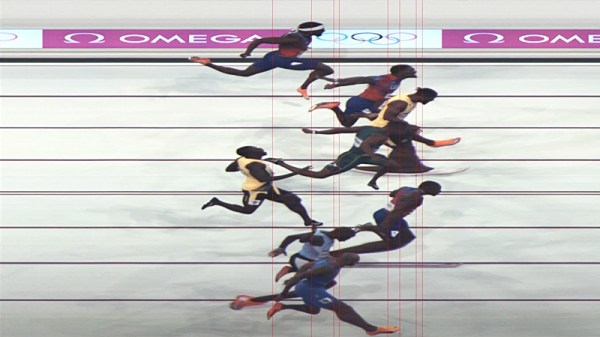
Advanced technology played a crucial role in determining the winner of the men’s 100-meter final at the Paris 2024 Olympics. In a historically close race, American sprinter Noah Lyles narrowly edged out Jamaica’s Kishane Thompson by just five-thousandths of a second. The final decision relied on an image captured by an Omega photo finish camera that shoots an astonishing 40,000 frames per second.
Omega, the Olympics’ official timekeeper for decades, has continually innovated to enhance performance measurement. The Omega Scan ‘O’ Vision Ultimate, the camera used for this photo finish, is a significant upgrade from its 10,000 frames per second predecessor. The new system captures four times as many frames per second and offers higher resolution, providing a detailed view of the moment each runner’s torso touches the finish line. This level of detail was crucial in determining that Lyles’ torso touched the line first, securing his gold medal.
This camera is part of Omega’s broader technological advancements for the Paris 2024 Olympics, which include advanced Computer Vision systems utilizing AI and high-definition cameras to track athletes in real-time. For a closer look at how technology decided this historic race, watch the video by Eurosport that captured the event.
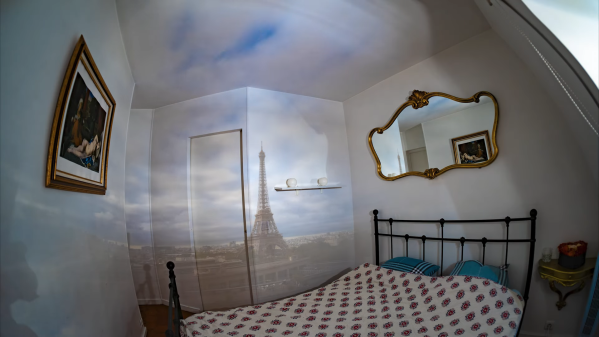
We haven’t checked, but we’ll go out on a limb here and say this is the first project we’ve featured with a BOM that includes “an apartment in Paris with a breathtaking view of the Eiffel Tower.” We suppose there are other places in the world where a giant camera obscura like this would work too, but you’ve got to admit that the view is pretty spectacular.
Of course, a camera obscura is really just a dark room — that’s literally what it means in Latin — with a small aperture to admit light from the outside world. This projects an inverted image on the opposite wall, which must have looked absolutely magical to pre-technical people and honestly is still pretty stunning today. Either way, it’s a low-tech way of seeing the world in a different light. [Mathieu Stern] decided his camera obscura would turn the traditional design on its head. Literally — he wanted an upright image. Luckily, he found a supplier that makes special optics for camera obscura that do just that. It looks like the optic uses a Dove prism to invert the image, or in this case to turn it back into an upright image.
The real hack here was finding the perfect place with just the right view of the Eiffel Tower — not at all an easy task in a medieval city where streets go where they will and buildings tend to block the sightlines. [Mathieu] eventually managed to find just the right place. With a little aluminum foil to make the rented room really obscura and some strategically positioned sheets to improve the projection surface, he was able to project some beautiful images of the landmark and surrounding cityscape in a panorama on the apartment walls. The video below has some stills and time-lapse sequences that are pretty breathtaking.
We’ve seen other camera obscura before, including this mobile version which may have made things easier for [Mathieu], at the price of giving up a lot of the charm.
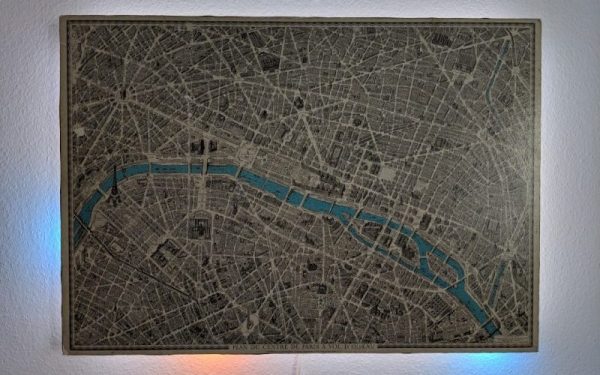
There’s plenty to love about antiques, from cars, furniture, to art. While it might be a little bit of survivorship bias, it’s easy to appreciate these older things for superior quality materials, craftsmanship, or even simplicity. They are missing out on all of our modern technology, though, so performing “restomods” on classics is a popular activity nowadays. This antique map of Paris, for example, is made of a beautiful hardwood but has been enhanced by some modern amenities as well.
At first the creator of this project, [Marc], just wanted to give it some ambient lighting, but it eventually progressed over the course of two years to have a series of Neopixels hidden behind it that illuminate according to the current sun and moon positions. The Neopixels get their instructions from an ESP8266 which calculates these positions using code [Marc] wrote himself based on the current date. Due to the limitations of the ESP8266 it’s not particularly precise, but it gets the job done to great effect.
To improve on the accuracy, [Marc] notes that an ESP32 could be used instead, but we can give the ESP8266 a pass for now since the whole project is an excellent art installation even if it is slightly off on its calculations. If you need higher accuracy for tracking celestial objects, you can always grab a Raspberry Pi too.
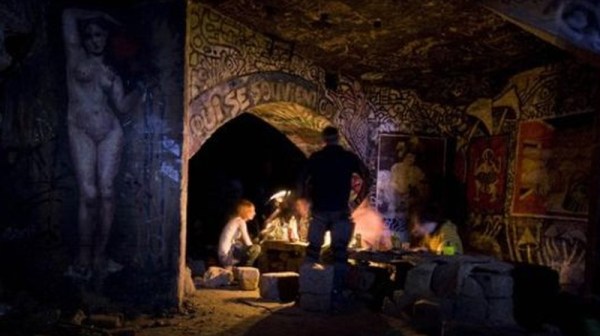
Deep in the heart of Paris, a series of underground tunnels snakes across the city. They cross into unkept public spaces from centuries ago that have since vanished from collective memory – abandoned basements, catacombs, and subways hundreds of miles apart.
Only a few groups still traverse these subterranean streets. One that came into public view a few years ago, Les UX (Urban eXperiment), has since claimed several refurbished developments, including restoring the long neglected Pantheon clock and building an underground cinema, complete with a bar and restaurant.
While the streets of Paris are tame during the day, at night is when Les UX really comes alive. A typical night might involve hiding in the shadows away from potential authorities roaming the streets, descending into the tunnels through a grate in the road, and carrying materials to an agreed upon drop off location. Other nights might involve wedging and climbing over pipes and ladders, following the routes into the basements of buildings left unguarded. Continue reading “The Story Of A Secret Underground Parisian Society”→
I think the restaurant is really close now… CC: E. Broeks
The best way to pull off this deception: tell your significant other that you’d want nothing more than a romantic week in Paris. Arrive in Paris, stash your bags, and then take either the number three or eleven Metro. When you get to the station that looks like the inside of a giant steam engine, Arts et Métiers, get out. You’re now ten Euros away from one of the coolest museums a hacker could visit.
A significant portion of modern science’s beginnings is sitting in the Musée, polished and beautiful. Most of them are housed in cabinets so old they’re part of the exhibit. Now, the Henry Ford museum in Detroit Michigan is a monument to industrialization, and cool in its own right, but it leaves some questions unanswered. We’re all spoiled by desktop CNCs, precision measurement tools for pennies, and more. How did we get here? How did they measure a shaft or turn a screw before precision digital micrometers? What did early automation look like? Early construction?
Also did I mention it has Foucault’s Pendulum? You know, the one that finally convinced everyone that the Earth rotated around an axis? No big deal.
The museum has a few permanent exhibits: instruments scientifique, matériaux, construction, communication, énergie, mécanique et transports.
What kind of basic museum would have just one example of Pascal’s work? CC: Anton Lefterov
Instruments Scientifiques was one of my favorites. Not only did it include old scientific instruments, it had sections containing some of the original experiments in optics, computation, and more. For example you can see not just one but a few original examples of Pascal’s Pascaline, arguably the first mechanical calculators in the modern era to be used by the layman for every day calculation, signed by Pascal. It’s also worth noting just how incredible the workmanship of these tools are. They’re beautiful.
Matériaux was initially a disappointment as I entered it from the wrong end. For me it started of with a tragically boring and simplistic display on recycling materials designed primarily to torture children on field trips. Luckily it quickly ramped into a fascinating display on materials manufacturing technology. How did we go from hand looms to fully automated Jacquard looms (of which you can see some of the first examples) to our modern day robotic looms? How did ceramic evolve? What was early steelmaking like? It’s very cool and models are all in beautiful condition.
It reeked of copper, machine oil, and phenolics. They just don’t make computers like they used to.
By the time I got to Communication I was reaching the limit of my endurance and also what you can fit into a single day of the museum. It’s a large building. It was packed through many of the early examples of computing, television, and space. There was quite a display of early camera equipment. You could get close enough to some truly massive old computers to smell the still off-gassing phenolics.
Construction held my interest for a long time. It’s not my usual interest, but after living in Paris for a month or so I was absolutely burning with curiosity. How did anyone without a single powered crane or vehicle build so many buildings out of stone? It’s packed for four rooms and two stores from floor to ceiling of beautiful little wood models explaining exactly how.
Énergie was quite cool. It followed the development of steam power for the most part. It started with primitive waterwheels. Moved on to turbines. Then showed the gradual increase in complexity until the the modern day. It had some internal combustion too, but much of that was reserved for the transports section of the museum. It also had some interactive displays to entertain children and Hackaday writers. However they were in desperate need of an oiling and this is by far the most ear-piercingly squeaky exhibit in the whole building.
Mécanique is competing with instruments scientifique as my favorite exhibit. Have you ever wanted to see hundreds of examples of screw machines, old lathes, and the evolution of the milling machine? What about models of the factories that built steam engines or massive wagon wheels. They even had a lathe that belonged to a French king. Apparently he thought metalworking was the way to get in touch with the common people.
Transports was a nice exhibit, but it fell a little short for me since I’d been to the aforementioned Henry Ford museum. However, it covered the history of some of the European automobile manufacturers pretty well. Had a nice section on trains and subways. And even had some models of the ships used in the European Space Agency.
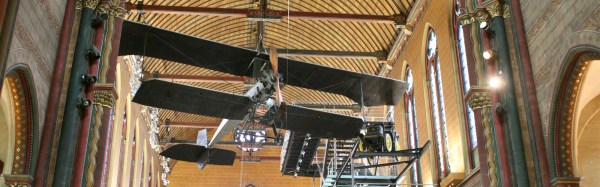
The entrance of the school. Has some original, “flying,” machines. CC: King Boshi
The last exhibit is the museum itself. It’s an historic building. It was originally built as a school for training engineers in 1794 but as the school grew out of it, it slowly transformed into the museum it is today. The architecture is beautiful. It’s adorned in stone and statue like all the French museums. It also has sections cut out in some of the higher storeys of the building so you can see how it was constructed.
Part of its beauty is also related to the school swallowing up the Priory of Saint Martin des Champs (Google translate does a great job if you don’t read French). The Priory is a beautiful old church, founded in 1079. It was home to the last trial by combat the country would see. You can piece together the story between the two pages dedicated to the combatants Jean de Carrouges and Jacques Le Gris.
The muses of agriculture and industry now look over the sanctuary.
The final display in the museum is in the church. It holds Foucault’s pendulum, dangling from the center of the sanctuary. If you get there early enough in the day you may get to watch it knock over a peg or two and prove the rotation for yourself.
Rather than the statues of the saints there are statues of the muses of Industrie and Agriculture. The hall is filled with more exhibits. There are cutaway original automobiles. A model of the Statue of Liberty. A catwalk lets you take a high view of the surroundings. It is also beautiful in and of itself. The church is well maintained and painted in the style original to them.
If you find yourself in Paris with a few hours (or days) to spare I highly recommend this museum. Any technical person would be hard pressed to leave uninspired and unawed by the display. It’s good to get a perspective on the past.
As many of the members of the Brian Benchoff hate/fan club know, the life of a Hackaday writer is nomadic and filled with exciting adventures. Jenny List is actually crime fighting cyborg (think Bond); it’s why she knows so much about electronics. James Hobson is Iron Man. The list goes on. There are lots of unnecessary details, but to summarize: Last month I was living in Washington State, this month I am in Paris, France. It’s really nice here, the buildings are beautiful, the cathedrals stunning, and the food significantly tastier.
However, as a contracting engineer with a project involving a deadline; I found myself in dire need of a significant amount of quick turn-around 3D printing during my working vacation to France. Through a lot of trial and tribulation, I eventually discovered that the most cost-effective way to get the prints done… was to just buy a cheap 3D printer and run it into the ground.
I was spoiled by my hackerspace in Louisville, KY. They had enough 3D printers to go around and the pricing was fixed at 10 cents a gram. For the amount of printing I needed, this would be a perfectly economical arrangement. So, I set out to find a hackerspace in Paris. Whereupon I reached my first and obvious problem; I speak very little French.
Most of the hackerspaces listed in Paris are, as far as I can tell, illegally squatting in a scary part of town, exclusive to a university, exclusive to a business, or closed down.
So, I googled a bit harder. Wow! Apparently a Techshop opened up in Paris. It’s about an hour away from where I live, but having toured a Techshop before, I knew they would have the nice version of the tool I need. So, one morning bright and early I got on the metro and headed over to get a tour of the place.
What I’ve discovered is this: If you need things like a water jet cutter, welding station, or a 50 grand CNC machine, Techshop is a really economical way to get access to and play with tools like that. However, if all you want is access to a laser cutter and a 3D printer, it will set you back five-hundred dollars and you’ll have to jump through some incredibly annoying hoops just to get access to them.
Only a small fee of 400 euros to used these bad boys.
See, most pieces of equipment at a Techshop need to be reserved. Only the 150 euro and 300 euro a month membership tiers can reserve equipment. The 150 tier can reserve something for two hours, the 300, four. If you’ve ever 3D printed you can immediately spot the problem with that. For small prints this could be workable, but if you have a lot of large prints four hours is just not enough. However, there is a work around. If you’re willing to take a metro ride late at night, arriving at the Techshop at 10:00pm, you can, of course, run a print overnight.
There were two more glitches in the Techshop plan. To be able to touch the printers required a two-hour course with a 100 euros fee. The filament also ran 65 euro per 500 g. My printing needs would easily cost me tens of hours in travel and had a starting fee of 400 euros to be workable.
The entrance to Usine.io is terrifying. It’s this massive pitch black hallway. I had no idea if I was in the right place until I got to the desk.
Now, I’m not saying Techshop isn’t absolutely wonderful when it comes to more advanced tools. It’s probably the only Hackerspace in the world where you’re entitled to expect that the CNC machine is in working order, properly trammed, and there are actually cutting bits for it. However, if all you need is a 3D printer, don’t bother.
Now, I asked around some more and found that there was a competing space in Paris called Usine.io. It had a flat fee of 180 euros a month and the training was free. I actually did end up getting a membership here for access to a CNC and basic tools, but for 3D printing it was a bust. They only had three printers serving a sizable membership base. This left the printers with a 48 hour line to get your print started and a maximum of 40 hours of printing a month. A die-hard user of 3D printing can easily use 40 hours in 3 days. Because I had to test many iterations for my project, my need the next month was easily triple that number.
However, the shop itself is really nicely outfitted.
The last avenue available to me aside from 3D printer ownership was contracting someone with a 3D printer to run my prints for me. However, after asking around I found the service to be quite expensive. Rent isn’t cheap in Paris after all. If I just needed a single small print it would be worth it, but if I needed lots of printing it would quickly add up to be more money than I had.
That left me with one option. Which, honestly, sounded absolutely insane for someone visiting a country for a few months. Buy a printer. It’s an indication of the state of 3D printing that the price has come down so far that buying a printer is more economical than having someone do it for you. Even a few years ago this was not possible. However, European Amazon Prime had a workable enough import printer to my doorstep faster than any commercially available service could even process my order. We’ve come a long way since the Darwin. That’s for sure.