DIY Algae Biodiesel Is Harder Than You Think

There’s one thing [Silent H] wants you to know before you watch his video about making biodiesel, embedded below: he started this project before he’d even heard of the Strait of Hormuz. No, he’s just independent-minded and wanted to try making his own fuel when diesel was– in retrospect– cheap as chips. That’s probably a good thing, because while [Silent] gets his pint of fuel at the end of the video, it’s not from algae; it’s from a backup crop of sunflowers.

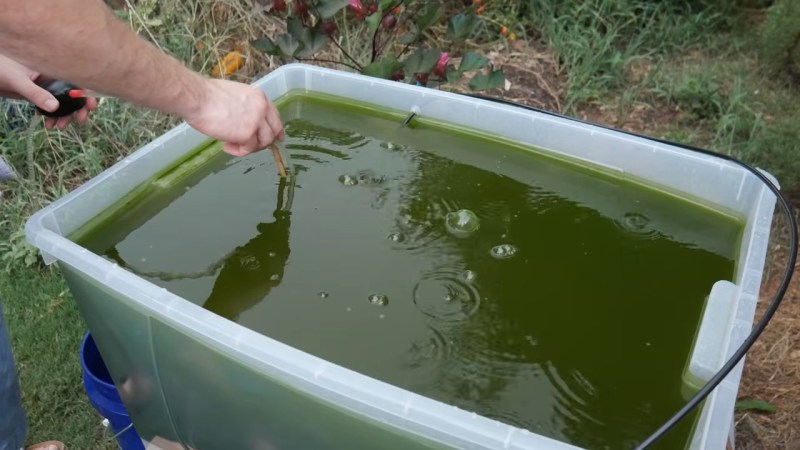
As it turns out, he picked what was the perfect algae and the absolute worst algae for making biodiesel from: Chlorella Vulgaris. It’s perfect because it’s easy to grow, and easy to extract from the growth medium, as it sinks when it is ‘ripe’, and has a very high oil content. Of course [Silent] didn’t want to toss algae cakes into a steam powered canoe, he wanted diesel fuel for his vehicle. That’s where the project broke down: Chlorella Vulgaris cells are exceptionally tough, and if you can’t rupture the cell wall, you can’t can’t get out any appreciable oil. A few grams by solvent extraction is all he manages before switching to more tractable feedstock.

That feedstock is sunflowers, which give up their oil through the application of violent pressure. That is to say, he crushes the seeds in an oil press. Oil acquired, he goes on to transesterfy the stuff, extracting glycerine to produce biodiesel– a process ripe for hacking that you’d think we’d cover more often.

We have covered the algae growth side of things before, but that algae seemed to be destined for other uses than fuel.

Continue reading “DIY Algae Biodiesel Is Harder Than You Think” →

Simple Open Source Photobioreactor

[Bhuvanmakes] says that he has the simplest open source photobioreactor. Is it? Since it is the only photobioreactor we are aware of, we’ll assume that it is. According to the post, other designs are either difficult to recreate since they require PC boards, sensors, and significant coding.

This project uses no microcontroller, so it has no coding. It also has no sensors. The device is essentially an acrylic tube with an air pump and some LEDs.

Continue reading “Simple Open Source Photobioreactor” →

The Liquid Trees Of Belgrade: The Facts Behind The Furore

Historically, nature has used trees to turn carbon dioxide back into oxygen for use by living creatures. The trees play a vital role in the carbon cycle, and have done so for millennia. Recently, humans have thrown things off a bit by getting rid of lots of trees and digging up a lot more carbon.

While great efforts are underway to replenish the world’s tree stocks, Belgrade has gone in a different direction, creating artificial “liquid trees” to capture carbon dioxide instead. This has spawned wild cries of dystopia and that the devices are an affront to nature. Let’s sidestep the hysteria and look at what’s actually going on.

Continue reading “The Liquid Trees Of Belgrade: The Facts Behind The Furore” →

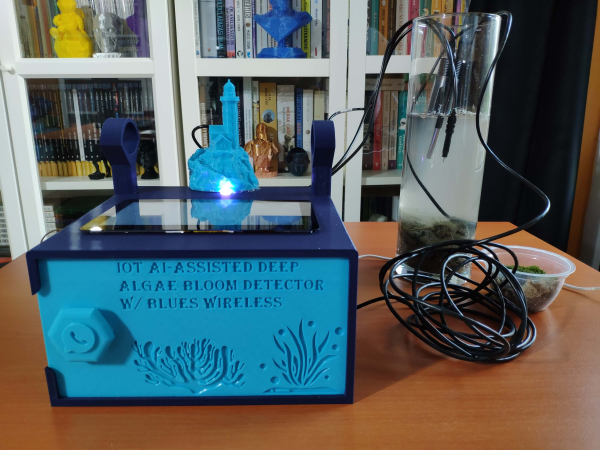
A blue enclosure with "IoT AI-assisted Deep Algae Bloom Detector w/Blues Wireless" written on the front. Two black cables run over a wooden desk to a cylinder with rocks on the bottom and filled with murky water. A bookshelf lurks in the background.

Detecting Algal Blooms With The Help Of AI

Harmful Algal Blooms (HABs) can have negative consequences for both marine life and human health, so it can be helpful to have early warning of when they’re on the way. Algal blooms deep below the surface can be especially difficult to detect, which is why [kutluhan_aktar] built an AI-assisted algal bloom detector.

After taking images of deep algal blooms with a boroscope, [kutluhan_aktar] trained a machine learning algorithm on them so a Raspberry Pi 4 could recognize future occurrences. For additional water quality information, the device also has an Arduino Nano connected to pH, TDS (total dissolved solids), and water temperature sensors which then are fed to the Pi via a serial connection. Once a potential bloom is spotted, the user can be notified via WhatsApp and appropriate measures taken.

If you’re looking for more environmental sensing hacks, check out the OpenCTD, this swarm of autonomous boats, or this drone buoy riding the Gulf Stream.

Running ARM Chips On Algae Power

What’s the size of an AA battery and can run an ARM Cortex M0+ for six months? Well… probably an AA battery, but obviously, that wouldn’t be worth mentioning. But researchers at Cambridge have built a cell of blue-green algae that can do the job.

As you might expect, the algae need light, since they generate energy through photosynthesis. However, unlike conventional solar cells, the algae continue to produce energy in the dark at least for a while. Presumably, the algae store energy during the day and release it at night to survive naturally-occurring periods of darkness.

Generating power from photosynthesis isn’t a new idea since photosynthesis releases electrons. A typical cell has gold electrodes and a proton exchange membrane of some kind. You can see a video from Cambridge below about generating electricity from photosynthesis. Keep in mind, of course, that the Cortex M0+ is capable of very low power operation. Don’t look for that algae-powered spot welder anytime soon.

People tend to get fixated on electricity as energy, but there are other ways to harness photosynthesis. For example, we’ve seen algae fueling a chicken hole in the past. Not to mention we’ve seen algae used to power a robot in a novel and non-electrical way.

Continue reading “Running ARM Chips On Algae Power” →

the algae panel

Move Aside Solar, We’re Installing An Algae Panel

[Cody] of Cody’sLab has been bit by what he describes as the algae growing bug. We at Hackaday didn’t know that was a disease floating around, but we’ll admit that we’re not surprised after the last few years. So not content to stick to the small-time algae farms, [Cody] decided to scale up and build a whole algae panel.

Now, why would you want to grow algae? There are edible varieties of algae, you can extract oils from it, and most importantly, it can be pumped around in liquid form. To top it off, all it needs is just sunlight, carbon dioxide, and a few minerals to grow. Unlike those other complicated land-based organisms that use photosynthesis, algae don’t need to build any structure to hold themselves up or collect sunlight; it floats.

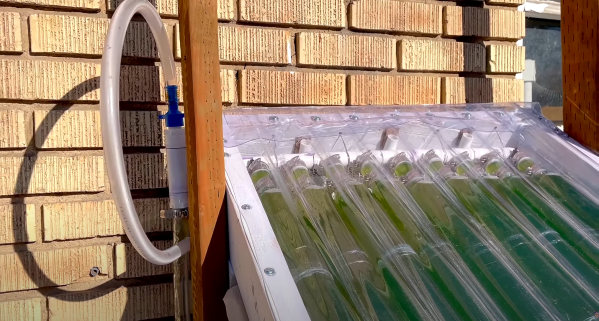
The real goal of the algae is to build a system known as “Chicken Hole.” The basic idea is to have a self-sufficient system. The algae feed the insects, the insects feed the chickens, and so on up the chain until it reaches [Cody]. While glass would make an ideal material for the algae tubes, plastic soda bottles seem like a decent proxy for a prototype and are much cheaper. He connected around 100 half-liter bottles to form long tubes and a PVC distribution system. The algae needs to be pumped into an insulated container to prevent it from freezing at night. At first, a simple timer outlet controlled the pump to only run during the day, draining it via gravity at night. However, the algae can’t heat up enough when running on cloudy, cold winter days, and it cools off. A solar panel and a temperature sensor form the logic for the pump, with a minimum temperature and sunlight needed to run.

[Cody] mentions that he can expect around 10 grams of algae per day on a panel this size in the winter. He’s going to need quite a few more if he’s going to scale up properly. Perhaps in the future, we’ll see panels growing algae robots? Video after the break.

Continue reading “Move Aside Solar, We’re Installing An Algae Panel” →

That’s No Moon… It’s An Algae Robot

When you think of a robot, you probably don’t think of a ball of underwater algae. But a team of university researchers used a 3D-printed exoskeleton and a ball of marimo algae to produce a moving underwater sensor platform. It is really at a proof-of-concept stage, but it seems as though it would be possible to make practical use of the technology.

Marimo are relatively rare balls of algae that occur in some parts of the world. A robot powered by algae runs on sunlight and could be electromagnetically quiet.

Continue reading “That’s No Moon… It’s An Algae Robot” →